
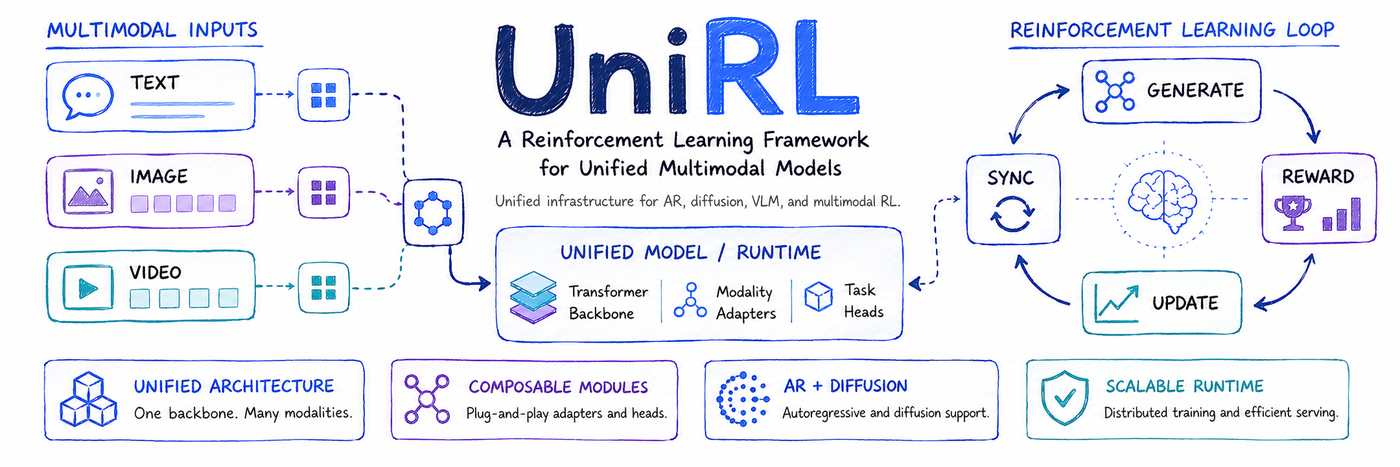
 ### A Reinforcement Learning Framework for Unified Multimodal Models
**U**(you)·**ni**(need)·**RL** for unified multimodal intelligence
[](pyproject.toml)
[](LICENSE)
[](https://unirl-project.github.io/unirl/)
[](https://unirl-project.github.io/unirl/community/wechat-qr.jpg)
### A Reinforcement Learning Framework for Unified Multimodal Models
**U**(you)·**ni**(need)·**RL** for unified multimodal intelligence
[](pyproject.toml)
[](LICENSE)
[](https://unirl-project.github.io/unirl/)
[](https://unirl-project.github.io/unirl/community/wechat-qr.jpg)
](https://unirl-project.github.io/unirl/community/wechat-qr.jpg)
News 🚀
- [2026-06] DRPO released — "Rethinking the Divergence Regularization in LLM RL" (arXiv).
- [2026-06] Flow-DPPO released — "FlowDPPO: Divergence Proximal Policy Optimization for Flow Matching Models" (arXiv).
- [2026-06] CPPO released — "Beyond Uniform Token-Level Trust Region in LLM Reinforcement Learning" (arXiv).
About 💡
UniRL applies one RL post-training loop — generate samples, score them, compute advantages, update the policy, and sync weights back to rollout workers — across multimodal model families.
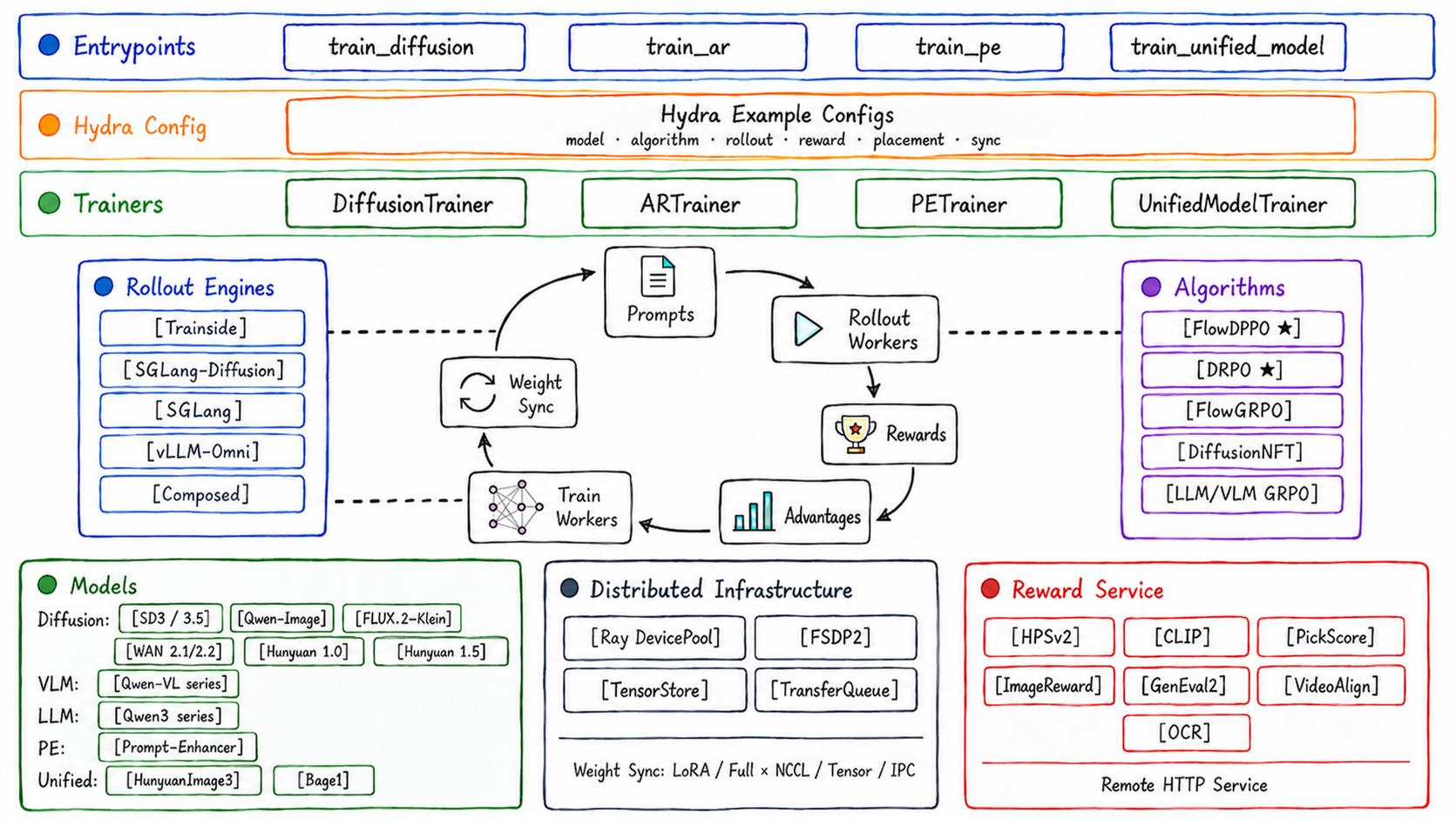
UniRL is a layered, composable system. Each entrypoint (train_diffusion,
train_ar, train_pe, train_unified_model) loads a Hydra example config
covering model, algorithm, rollout, reward, placement, and sync, then creates the
matching domain trainer (DiffusionTrainer, ARTrainer, PETrainer,
UnifiedModelTrainer). The trainer coordinates the RL loop across pluggable
rollout engines, algorithms, model bundles, reward services, and
the shared distributed runtime: Ray DevicePool, FSDP, Transfer
Queue (TQ), and LoRA/full-weight sync. See unirl/README.md for the
runtime loop, deployment modes, and module map.
The agentic entrypoint extends the AR path with multi-turn tool interaction. It
preserves each turn as a Sample lineage, scores terminal answers through a
reward service, and trains at a colocated rollout barrier.
Team-Proposed Algorithms 🌟
🌟 These algorithms are proposed by our team — the highlight of UniRL. Each algorithm's folder holds a step-by-step tutorial and a runnable example recipe. We highly recommend trying them in our framework!
| Algorithm | Paper | Tutorial | Notes |
|---|---|---|---|
| Flow-DPPO | "Flow-DPPO: Divergence Proximal Policy Optimization for Flow Matching Models" | FlowDPPO/ | Diffusion/flow RL with an exact divergence-based trust-region mask. |
| DRPO | "Rethinking the Divergence Regularization in LLM RL" | DRPO/ | Token-level LLM RL with a smooth advantage-weighted quadratic regularizer. |
| CPPO | "Beyond Uniform Token-Level Trust Region in LLM Reinforcement Learning" | CPPO/ | Token-level LLM RL with a position-weighted, cumulative-prefix-budget Binary-TV mask. |
UniRL also wires in standard reference algorithms — (LLM's)GRPO, DiffusionNFT,
DanceGRPO, and MixGRPO — in unirl/algorithms/.
Model Support 🎨
Model and algorithm support are two independent dimensions that compose within a domain: any diffusion algorithm (see above) runs on a diffusion model, AR algorithms on AR models — so UniRL covers many more model × algorithm combinations than the shipped example recipes alone. The table below is the model dimension; all listed models are supported (✅).
Each model maps to a domain entrypoint (train_diffusion, train_ar, train_pe,
train_unified_model); see Getting Started below to run any of them.
Training Modes 🧩
UniRL unifies four training modes, one Hydra example bucket and entrypoint each.
Examples are self-contained YAML files selected with
--config-name=<domain>/<example>:
| Domain | Trains | Entrypoint | Example |
|---|---|---|---|
diffusion/ |
Image / video diffusion models | train_diffusion |
diffusion/sd3/sd3_sglang_rollout_colocate |
ar/ |
Autoregressive models — vision-language (VLM) + text-only (LLM) | train_ar |
ar/qwen_vl_grpo_geo3k_mc_4x8, ar/qwen3_drpo_4b_base_dapo_sglang |
pe/ |
Prompt-enhancer (AR rewriter + diffusion reward) | train_pe |
pe/pe_sglang_full_pickscore |
unified_model/ |
Unified AR + diffusion models | train_unified_model |
unified_model/hi3_vllmomni |
See examples/README.md for the full launch guide, naming
schema, and how to add a recipe.
Agentic Workflows 🤖
The agentic rollout engine repeatedly performs model generation followed by an
environment step and returns a trajectory of Sample objects. One public
workflow is supported:
| Workflow | Entrypoint | Example recipe |
|---|---|---|
| Service-scored multi-turn tool use | train_agentic |
deep_research/deep_research_search_judge |
AgenticTrainer synchronizes current training weights before every rollout,
dispatches sibling trajectories concurrently, and waits for complete GRPO groups
before scoring and training. Each successful trajectory receives one group-normalized
advantage, which is applied to every generated assistant turn. Failed
trajectories are excluded from the update.
See the agent environment guide for the environment, tool, and trajectory contracts.
Getting Started ⚡
Install dependencies first — see INSTALL.md.
# compose-check, then launch a single-node example
python -m unirl.train_diffusion --config-name=diffusion/sd3/sd3_trainside --cfg job --resolve
bash examples/run_experiment_single_node.sh diffusion/sd3/sd3_trainside
Full launch guide — multi-node, every entrypoint, mooncake.
Roadmap 🗺️
We are actively expanding model and algorithm coverage. Near-term directions:
- Broaden algorithm coverage for the newer model families — FLUX.2-Klein, HunyuanVideo 1.0 / 1.5, and Bagel.
- Extend the team-proposed algorithms (Flow-DPPO, DRPO) to more model families.
- Broaden reward backends and rollout-engine coverage across domains.
Want a model or algorithm prioritized? Open an issue to discuss.
Contributing 🤝
Contributions and questions are welcome. Before opening a pull request, read the
repository conventions in AGENTS.md, run the
pre-PR checks for the files you
touched, and fill in the pull request template.
For questions, bug reports, and feature requests,
open an issue.
Acknowledgement 🙏
UniRL builds on ideas and infrastructure from the open-source RL and inference ecosystem. We especially thank vLLM, SGLang, slime, and verl.
Citation 📚
If you find UniRL helpful, please cite:
@misc{unirl_github,
  title        = {{UniRL: A Reinforcement Learning Framework for Unified Multimodal Models}},
  author       = {Haonan Wang and Linyu Wu and Qian Qiu and Lewei Jin and Bowen Ping and Jianghai Chen and Yiheng Du and Guangxin He and Yu Shi and Yongguang Lin and Zhuoxin Zhou and Zhanchao Zhou and Keming Wu and Rizhen Hu and Xuefei Ning and Lvfang Tao and Feiyu Hu and Xiangyan Liu and Siqi Kou and Jiarui Yao and Xiangxin Zhou and Liefeng Bo and Wenxi Zhu and Tianyu Pang},
  year         = {2026},
  howpublished = {\url{https://github.com/Tencent-Hunyuan/UniRL}},
  urldate      = {2026-06-05}
}
If you use DRPO, please also cite:
@article{yao2026rethinking,
  title={Rethinking the Divergence Regularization in LLM RL},
  author={Yao, Jiarui and Zhou, Xiangxin and Qi, Penghui and Lee, Wee Sun and Bo, Liefeng and Pang, Tianyu},
  journal={arXiv preprint arXiv:2606.09821},
  year={2026}
}
If you use Flow-DPPO, please also cite:
@article{ping2026flow,
  title={Flow-DPPO: Divergence Proximal Policy Optimization for Flow Matching Models},
  author={Ping, Bowen and Zhou, Xiangxin and Qi, Penghui and Luo, Minnan and Bo, Liefeng and Pang, Tianyu},
  journal={arXiv preprint arXiv:2606.11025},
  year={2026}
}