
 # freehire
### Every IT job, straight from the source.
**3.3M+ live postings pulled directly from company career pages — no recruiters, no reposts, no dead links. Fully open source.**
[**Try it live →**](https://freehire.me) · [Features](docs/features.md) · [Architecture](docs/architecture.md) · [Sources](#sources) · [API](#api) · [Add a source](#adding-a-source) · [Contributing](CONTRIBUTING.md)
[](https://freehire.me)
[](LICENSE)


[](https://github.com/strelov1/freehire/stargazers)
[](https://discord.gg/aAXS2rghW)
# freehire
### Every IT job, straight from the source.
**3.3M+ live postings pulled directly from company career pages — no recruiters, no reposts, no dead links. Fully open source.**
[**Try it live →**](https://freehire.me) · [Features](docs/features.md) · [Architecture](docs/architecture.md) · [Sources](#sources) · [API](#api) · [Add a source](#adding-a-source) · [Contributing](CONTRIBUTING.md)
[](https://freehire.me)
[](LICENSE)


[](https://github.com/strelov1/freehire/stargazers)
[](https://discord.gg/aAXS2rghW)
](LICENSE)

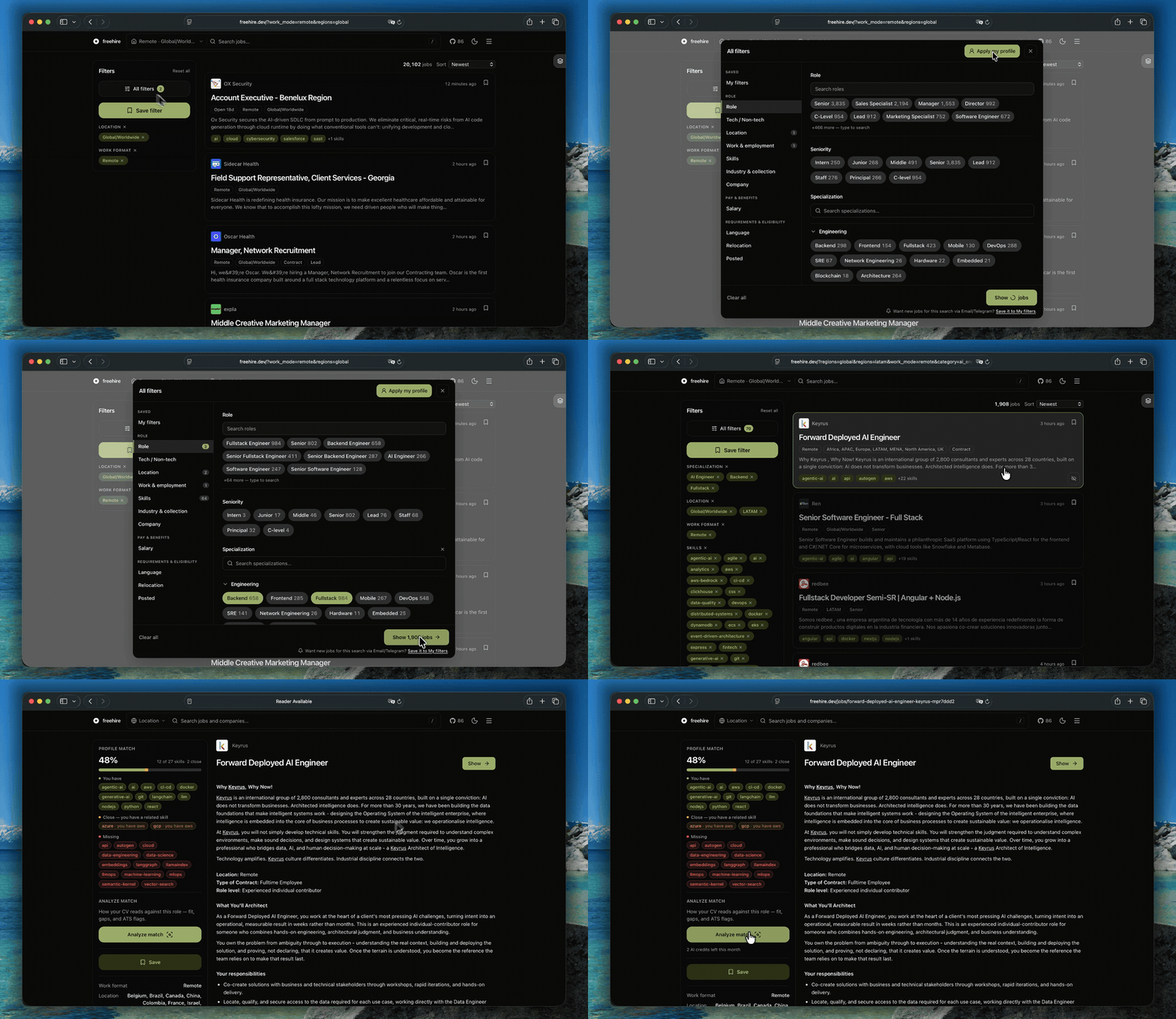
Why freehire?
- Straight from the source. Every listing is crawled directly from a company's own ATS — Workday, Greenhouse, Lever, Ashby, iCIMS and a long tail of others — and links to the original posting. No recruiter reposts, no aggregator middlemen, no dead links.
- One schema, deduplicated. The same role posted to three boards collapses into one entry: every posting is normalized into a single shape and deduplicated on a stable key.
- Search that understands jobs. Faceted full-text search over region, work mode, seniority, skills and salary — derived from curated dictionaries, never guessed.
- Actually open. MIT-licensed and self-hostable, pipeline and data both in the open. Adding a company is one line of YAML.
- Yours to build on. A clean HTTP API, a CLI, Telegram digests, and a whole workspace on top of the catalogue — see Beyond the catalogue. Use the hosted site, run your own, or build on top.
Aggregating 3.3M+ live postings from 294,000+ companies across 92 ATS platforms and a long tail of aggregators and direct feeds — 225 live sources in all, see Sources for the full breakdown.
If freehire saves you time — or you just like the idea of jobs straight from the source — a ⭐ helps other people find it.
Beyond the catalogue
Finding the posting is half the problem. The other half — writing the CV, sending it, and knowing what happened to it — is built on the same data, in the same repository, under the same licence.
| Find | Faceted search, curated collections, saved searches with email/Telegram digests, shared boards, market analytics, the ghost-job signal |
| Apply | CV builder with ATS-safe PDF templates, deterministic CV↔vacancy scoring, AI fit analysis, CV tailoring that invents nothing, tracer links, referrals |
| Track | An application board with stages, a mail inbox that links recruiter replies to the application they answer, an append-only event ledger, reminders |
| Ask | An in-process agent with five presets — chat, browse, profile, CV tailoring, interview rehearsal — with no shell and no minted credential |
| Build on | A keyless public API, a CLI, a form-filling browser extension, ChatGPT Actions |
Full feature reference → docs/features.md — what each one
does, where it lives in the tree, which need an LLM endpoint configured, and
which draw on AI credits.
Stack
- Go + Fiber v2 — HTTP server
- PostgreSQL + pgvector — storage, filtering, semantic embeddings
- sqlc — type-safe DB access from SQL (no ORM)
- Meilisearch — full-text and faceted job search
- langchaingo — LLM access over any OpenAI-compatible endpoint (no vendor baked in)
- SvelteKit 2 (Svelte 5 runes) + Tailwind 4 — the server-rendered frontend under
web/ - Redis — rate limiting and realtime fan-out · S3-compatible object storage — CVs, headshots, previews
- Docker Compose — local development
Quick start
make up        # build + start the whole stack in Docker:
               # api, web, postgres, meilisearch, redis, minio
curl localhost:8080/health
curl localhost:8080/api/v1/jobs
Migrations are applied automatically on first Postgres volume init
(the migrations/ folder is mounted into /docker-entrypoint-initdb.d).
Changing a migration does not re-apply to an existing volume — recreate it with
docker compose down -v && make up, or apply pending files manually with
make migrate.
If port 8080 is already taken, pick another host port:
HIRE_HOST_PORT=8090 make up
Local development
docker compose up -d db   # database only
make run                  # server on host, reads DATABASE_URL
Copy .env.example to .env and adjust as needed. JWT_SECRET is required for
the server to start; OAuth and LLM credentials are optional (the features they
gate stay disabled when unset).
Commands
make help      # list all commands
make sqlc      # regenerate code from SQL (via Docker, no local sqlc needed)
make tidy      # go mod tidy
make psql      # psql inside the DB container
make reindex   # rebuild the Meilisearch index from Postgres
make migrate   # apply migrations manually to an existing DB volume
Workers
The server only serves the API. Everything else — crawling, enrichment, indexing,
notifications — is a standalone, run-once worker meant for cron: it crawls or
drains its queue and exits. ls cmd/ for the full list; the ones you are most
likely to run:
go run ./cmd/migrate       # apply pending migrations (run before deploying code that reads new schema)
go run ./cmd/ingest sources/greenhouse.yml  # crawl one board file and upsert jobs (path also via SOURCES_FILE)
go run ./cmd/enrich        # drain the enrichment queue (LLM); needs LLM_* config
go run ./cmd/embed         # drain the semantic queue into pgvector chunks
go run ./cmd/search-drain  # push queued job writes into the live search index (run every 1-2 min)
go run ./cmd/reindex       # rebuild the Meilisearch index from Postgres (full swap)
go run ./cmd/tg-ingest     # crawl the Telegram channels in sources/telegram.yml
go run ./cmd/tg-extract    # LLM-extract vacancies from crawled Telegram posts
go run ./cmd/capture-apply-form  # fetch queued postings' ATS application forms
go run ./cmd/backfill-derive     # re-derive every deterministic column — facets, fingerprints,
                                 # slugs — in one keyset pass (follow with make reindex)
Every worker needs DATABASE_URL and exits non-zero on failure. prune is the
only hard-delete path in the system, and it is dry-run by default.
Layout
cmd/                 entry points: server + the standalone workers above
sources/             board files, one per provider (e.g. greenhouse.yml = company + board id),
                     plus a mixed custom.yml and telegram.yml (Telegram channels to crawl)
migrations/          SQL schema (source for both sqlc and initdb)
web/                 the SvelteKit frontend
extension/           the Chrome side-panel extension
design-system/       shared tokens and components, linked into web/ and extension/
internal/            ~130 domain packages; the load-bearing ones:
  config/            env configuration
  database/ db/      pgxpool pool; generated sqlc code + queries/*.sql
  handler/           HTTP handlers
  auth/              auth primitives (JWT cookie, API keys) + OAuth sign-in
  sources/           source adapters (greenhouse / lever / adzuna / …) + registry
  pipeline/          ingest runner (fetch → normalize → dedup → upsert)
  linksource/        resolves outbound job links found in Telegram posts
  telegram/          Telegram-channel crawl + LLM vacancy extraction
  enrich/            typed AI-enrichment contract + queue-draining runner
  search/ searchdrain/  Meilisearch indexing and query; incremental drain of the write queue
  embed/             semantic chunk embeddings into pgvector
  location/ classify/ skilltag/  the curated facet dictionaries — never guess, emit nothing
  ghost/             the posting-reality signal behind "is this job real?"
  jobview/           the single public wire shape of a job
  cv/ cvedit/        structured CVs + PDF rendering; cvedit is their only writer
  experience/        durable employments + evidence atoms behind every CV claim
  cvmatch/ matchanalysis/  deterministic CV↔vacancy score; the LLM fit analysis on top
  applyform/         captured ATS application forms, in the platform's own vocabulary
  userjob/ appevent/ per-user tracking (view / apply / save / stages) + the event ledger
  inbox/             recruiter mail → classify → link to an application
  assistant/         the in-process agent: turn loop, tools, transcripts
  browsertools/      relays tool frames between the agent and the browser extension
  referral/ collections/  employee referrals; curated company tags
  llm/ llmkey/       provider-agnostic LLM client + per-user spend attribution
Architecture
How the pieces fit together — the crawl-to-search topology, what each directory above is for, and walkthroughs of the three main flows (finding a job, tailoring a CV, the in-app assistant), plus the auth model, notifications and the job lifecycle: docs/architecture.md.
It is the map; the per-package AGENTS.md files it links to are the territory.
API
The catalogue is served over a public, keyless HTTP API — GET
https://freehire.me/api/v1/jobs needs no credential. All responses use
{"data": ...} (single), {"data": ..., "meta": {...}} (lists), or
{"error": msg}; jobs and companies are addressed by their public slug.
Full reference — every endpoint, its parameters, auth mode and the whole search-filter vocabulary: freehire.me/docs/api.
Sources
Live catalogue snapshot — 3,300,615 open postings across 294,282 companies, crawled from 225 live sources. Counts are open postings unless noted; a company crawled from two sources is counted under each. Every source is one of three kinds:
- ATS platforms — one adapter per multi-tenant applicant-tracking system, each serving many companies (Workday, Greenhouse, Lever, iCIMS…). 92 platforms · 157,399 companies · 2,644,796 open postings.
- Aggregators & job boards — third-party feeds that republish many companies' postings (Adzuna, trudvsem, himalayas, Telegram channels…). 100 sources · 172,884 companies · 629,571 open postings.
- Company career sites — direct single-company feeds crawled from a company's own careers page (Amazon, Apple, Google, Yandex, Sber…). 30 feeds · 59 companies · 26,222 open postings.
A source's kind is not configuration but a property of the adapter's own Go type,
so internal/sources classifies every provider without a network call.
Full per-source breakdown — every source with its own companies/open-jobs count — lives on its own page: docs/sources.md.
Adding a source
Adding a company is one entry in the provider's board file (sources/<provider>.yml,
or the mixed sources/custom.yml) — company + board (and provider when an
entry overrides the file's). Adding an ATS platform is a new adapter in
internal/sources plus one line in sources.All — every adapter speaks the same
Source interface, and cmd/ingest validates the file against the registry before
any crawl.
For most companies the platform is already supported, so adding them is just one line in the board file. Only when a company runs on an ATS we don't cover yet does it need a new provider (a new adapter). Either way, if you want a source added, start by opening an issue — name the company and its careers URL, and we'll confirm whether it's a one-line add or a new provider before any code.
Frontend
A server-rendered SvelteKit 2 app (Svelte 5 runes, Tailwind 4, adapter-node)
lives under web/ and consumes the API same-origin; a dev Vite proxy forwards
/api to the backend. Shared tokens and components come from the sibling
design-system/ package — install it before building web/ or extension/,
since it is symlinked, not copied. See web/AGENTS.md.
Browser extension
A Chrome extension puts the job-application agent in a side panel next to
whatever posting you're on: it reads the page when you ask it something, shows
a deterministic skill-coverage match against your freehire profile, and can
fill the application form for you. Source lives under extension/
(extension/AGENTS.md).
Install it from the Chrome Web Store →
Contributing
Contributions are welcome, and issues and PRs are open to everyone. No allowlist, no approval step — open one.
The easiest way to help is to add a source: one entry in a sources/ board
file, or a new adapter in internal/sources. Missing a company you would apply
to? That is a one-line PR, and it is the single most useful thing you can send.
Questions and half-formed ideas are equally welcome in Discussions — no need to polish them into an issue first. For anything large, an issue up front saves you from building the wrong thing, but nothing stops you from just opening the PR.
See CONTRIBUTING.md for the checks CI runs and AGENTS.md for the architecture and conventions.
Security
Found a vulnerability? Report it privately — see SECURITY.md. Do not open a public issue for security-sensitive reports.