
AKB — Agent Knowledge Base
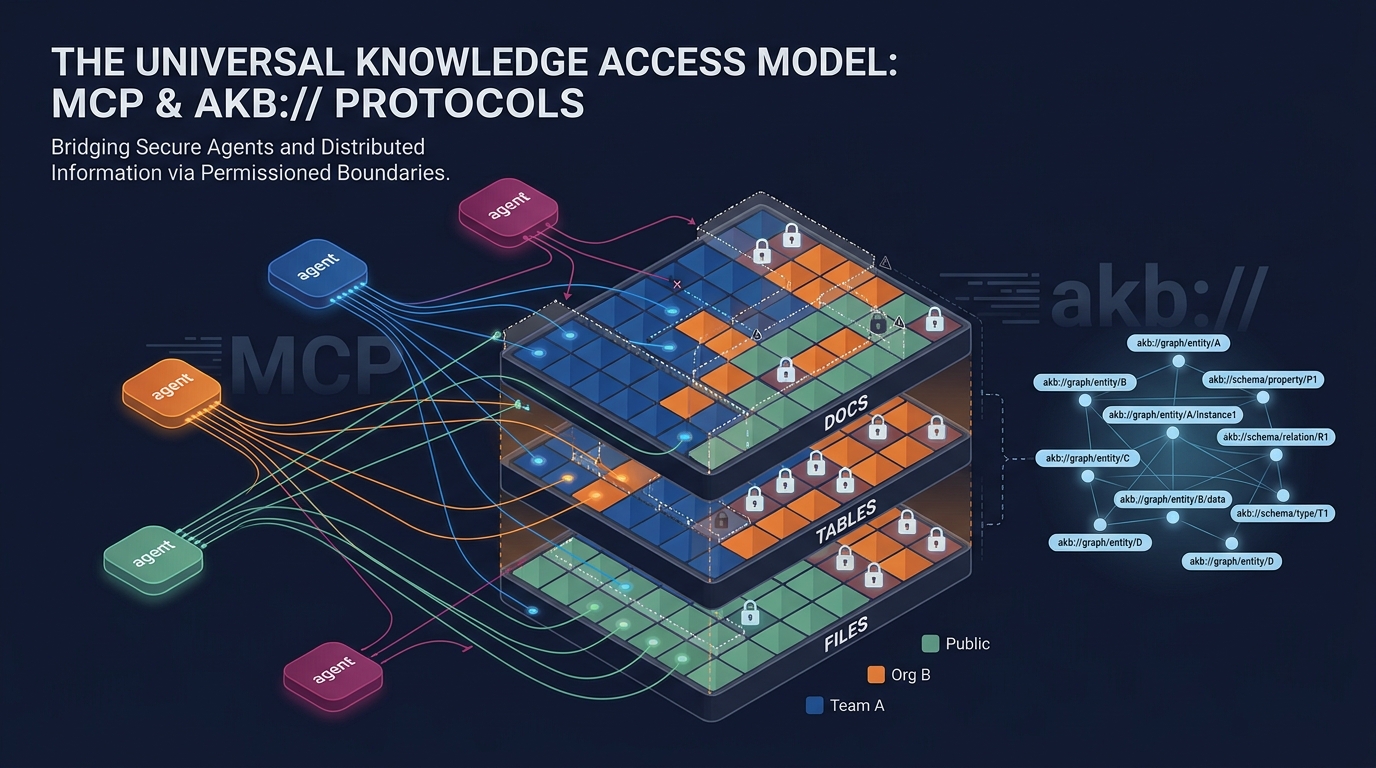
Organizational memory for AI agents. Git-backed knowledge base served over the Model Context Protocol (MCP) — agents read and write directly with hybrid semantic + keyword search, structured tables, files, and a URI graph. Drop-in alternative to Confluence / Notion for Claude Code, Cursor, Windsurf, and any MCP-aware agent.



Works with
Any agent client that speaks MCP (Streamable HTTP or stdio):
- Claude Code — CLI / VS Code / JetBrains
- Claude Desktop — macOS / Windows
- Cursor, Windsurf, Cline, Continue — via the
akb-mcpstdio proxy - Custom agents — direct HTTP
POST /mcp/with a Bearer token
The default flow uses a Personal Access Token. Deployments with the
optional MCP OAuth Resource Server path turned on (via Keycloak as
the AS — see docs/mcp-clients/web-connectors.md)
also accept Claude Code's mcp add --transport http + mcp login flow
end-to-end, without a PAT.
Plugins
Beyond raw MCP access, AKB ships ready-made agent plugins for Claude Code and Codex that wrap common vault workflows:
- akb-wiki — ingest a source (local file, web URL, GitHub PR / release / commit, Confluence page, or Jira issue) into the vault as a structured document, and answer questions from the vault with grounded, cited synthesis (read-only).
- akb-sessions — capture a coding session as structured notes: a session report plus follow-up tasks, learnings, ideas, and decisions.
- akb-claude-code — a Claude Code lifecycle bridge: hooks anchor each session to your AKB memory vault, injecting preferences and recent learnings at the start and writing a recap at the end.
/plugin marketplace add dnotitia/akb        # Claude Code
codex plugin marketplace add dnotitia/akb   # Codex
Install details and credentials: plugins/.
Try it live
A public demo runs at akb-demo.agent.seahorse.dnotitia.ai.
Browse and search a small fictional-organization knowledge base — product docs,
a company handbook, agent session notes, and an engineering wiki, cross-linked
by the URI graph — right in your browser, no signup. To wire it into your own
agent, sign up with any email (a throwaway address is fine) and point the
akb-mcp proxy at
https://akb-demo.agent.seahorse.dnotitia.ai/mcp/.
⚠️ Throwaway demo. It is public, wiped and re-seeded weekly, and runs on minimal resources with no uptime, privacy, or data guarantees. Don't put anything real or sensitive in it — treat every write as public and ephemeral. For real use, self-host in three containers.
Why AKB
Most knowledge tools are built for humans clicking through a UI. Agents need a
different shape: structured documents, semantic + keyword search in one call,
explicit relations, and full version history. AKB gives agents a single set of
tools (akb_put, akb_search, akb_browse, akb_relations, …) over a
backing store of Git bare repos and a PostgreSQL hybrid index.
Retrieval quality
Memory is only useful if the right note comes back. AKB's hybrid retrieval (dense + BM25, source-level dedup) was benchmarked on LongMemEval-S — 500 long-context questions, ~50 chat sessions per question. Recall@5 = 98.4%, with no reranker in the loop.
| System | R@5 | n | Reranker | Source |
|---|---|---|---|---|
| AKB hybrid | 98.4% | 500 | no | this repo |
| MemPalace hybrid + rerank | 98.4% | 450 | yes | MemPalace |
| gbrain hybrid | 97.6% | 500 | no | gbrain-evals |
| gbrain vector | 97.4% | 500 | no | gbrain-evals |
Methodology, per-category breakdown, and a one-command reproducible harness
live in eval/longmemeval/. The embedding model differs
across systems (AKB: bge-m3@1024), so read this as a stack-level comparison.
Design philosophy
Core stays small; flexibility comes from extension, not built-in
automation. AKB does not ship its own consolidator, summariser, or
"knowledge gardener" — instead every write emits a structured event to a
Redis Stream (akb:events). Operators wire any external consumer
(periodic synthesis bot, doc-rot reaper, weekly-digest agent, audit
trail, …) on top, with no patches to the core. The base contract is a
read/write store; opinions about what to do with the knowledge live
outside.
Architecture
┌──────────────────────────────────────────────────────────┐
│                  Access Layer                            │
│   MCP Server  │  REST API  │  Web UI                     │
├──────────────────────────────────────────────────────────┤
│                  Core Services                           │
│   Document (Put/Get)  │  Search (Hybrid: dense+BM25)     │
│   Relations (graph)   │  Session  │  Publications        │
├──────────────────────────────────────────────────────────┤
│                  Storage Layer                           │
│   Git bare repos       │  PostgreSQL 16 (text + meta SoT)│
│                        │  Vector store (driver):         │
│                        │    pgvector        (default, PG)│
│                        │    qdrant          (optional)   │
│                        │    seahorse-cloud  (managed)    │
│                        │    seahorse-db     (self-hosted)│
│                        │    seahorse-db-grpc(experimental)│
└──────────────────────────────────────────────────────────┘
PostgreSQL is the source of truth — chunk text + metadata + BM25 vocab.
The vector store is a driver-pluggable derived index holding dense
embeddings and corpus-side sparse vectors. Full vector-store loss is
recoverable from PG by setting chunks.vector_indexed_at = NULL and
letting the indexing worker re-populate.
Key Concepts
- Vault — A Git bare repo. The unit of access control and physical isolation.
- Collection — A directory inside a vault. Topical grouping of documents.
- Document — Markdown + YAML frontmatter, optimised for agent read/write.
- Hybrid Search — Dense (semantic) + BM25 (lexical) fused via RRF in one call.
- Relations —
depends_on,related_to,implementsin frontmatter form an explicit knowledge graph. - Vault isolation in
akb_sql— Enforced by PostgreSQL ACL. Each AKB user has a corresponding PG role (akb_user_<uid>) and each vault has three group roles (akb_vault_<vid>_{reader,writer,admin}).akb_sqlruns the user's SQL inside a transaction withSET LOCAL ROLE; cross-vault references return PG42501directly. No application-side regex inspects user SQL for forbidden identifiers. Seedocs/designs/pg-native-rbac/.
MCP Tools (selection)
| Tool | Description |
|---|---|
akb_list_vaults / akb_create_vault |
Vault management |
akb_put / akb_get / akb_update / akb_delete |
Document CRUD (Git commit + indexing) |
akb_put_file / akb_get_file / akb_update_file / akb_delete_file |
File attachments — proxy-side (requires local filesystem) |
akb_put_image / akb_discard_image |
Validated inline Markdown images — proxy-side in akb-mcp 2.2+ |
akb_create_table / akb_alter_table / akb_drop_table / akb_sql |
Tabular content — per-doc tables + SQL |
akb_browse |
Tree traversal (collection → docs) |
akb_search / akb_grep |
Hybrid search (dense + BM25) / literal grep |
akb_drill_down |
Section-level retrieval |
akb_relations / akb_link / akb_unlink / akb_graph |
Knowledge graph |
akb_edit / akb_diff / akb_history |
In-place edit, diff, Git history |
akb_grant / akb_revoke / akb_set_public |
Permission boundaries — per-user, per-org, public |
akb_publish / akb_unpublish |
Public publication |
Agent memory and session lifecycle are not MCP tools — they live on
the dedicated /api/v1/agent-sessions REST surface, driven by AKB
lifecycle plugins (akb-claude-code, akb-cursor, …) that hook into
the agent's own SessionStart / PreCompact / SessionEnd events. As an
agent, your own memory vault (agent-memory-{username}) is browsable
through the standard akb_search / akb_browse / akb_get tools
exactly like any other vault.
The full tool catalogue is exposed via akb_help() from any MCP client.
Inline document images from MCP
Inline images are hidden document attachments, not browsable Files. Upload a local PNG, JPEG, GIF, or WebP (maximum 10 MiB), then insert the returned Markdown without reconstructing its asset URL:
image = akb_put_image(
  parent="akb://eng/coll/specs",
  file_path="/workspace/architecture.png",
  alt_text="Request processing architecture")

akb_put(
  parent="akb://eng/coll/specs",
  title="Request Processing",
  content="# Architecture\n\n" + image.markdown)
For an existing document, use akb_get followed by a targeted
akb_edit(base_commit=...). Do not pass only the image fragment to
akb_update(content=...), which replaces the complete body. Image bytes are
immutable: replacing an image means uploading a new one and editing the
Markdown reference. Remove an image by deleting its Markdown expression; use
akb_discard_image only for an upload that never reached a successful document
commit. Run akb_help(topic="images") for retention and publication behavior.
The image tools require both the matching backend release and akb-mcp 2.2 or
newer. For upgrades, deploy the backend first, then publish/install the proxy
and restart existing MCP processes so they load the updated tool list.
Document Format
Every vault resource has a location-aware AKB URI — the canonical handle used by every tool and stored in relations. As of 0.3.0:
akb://{vault}                                          vault root (browse target)
akb://{vault}/coll/{coll_path}                         collection (browse target)
akb://{vault}[/coll/{coll_path}]/doc/{filename}        document
akb://{vault}[/coll/{coll_path}]/table/{name}          table
akb://{vault}[/coll/{coll_path}]/file/{uuid}           file
The /coll/{coll_path} segment is omitted for resources at the vault
root. Walking up a URI to its parent collection is a pure string
operation — paste the parent into akb_browse(uri=...) to list
siblings without an extra lookup.
---
title: "Payment API v2 migration plan"
type: plan              # note | report | decision | spec | plan | session | task | reference
status: active          # draft | active | archived | superseded
tags: [payments, api]
domain: engineering
summary: "REST → gRPC transition plan."
depends_on: ["akb://eng/coll/specs/doc/payment-api-v2.md"]
related_to: ["akb://eng/coll/meetings/doc/2026-05-01-payments.md"]
---

# Payment API v2 migration plan
...
Open Knowledge Format (OKF) compatible
A vault is stored as a git tree of .md + YAML-frontmatter files whose
identity is the path — the same model as Google Cloud's
Open Knowledge Format
(OKF v0.1), which AKB independently arrived at before the spec existed.
AKB-authored bundles satisfy all three OKF MUST rules, and AKB can export any
vault as a conformant OKF bundle (documents, plus tables/files as concept docs)
and validate any bundle:
python -m app.cli okf-export --from-git /data/vaults/_worktrees/<vault> \
    --vault <vault> --out ./okf-out/
python -m app.cli okf-validate ./okf-out/
OKF and AKB are complementary — OKF standardizes how knowledge is written
down; AKB stores, versions, searches, governs, and serves it to agents. See
okf/ for the mapping and a sample bundle.
Quick Start
AKB ships as a 3-container stack (PostgreSQL with pgvector + backend +
frontend). For semantic (dense) search you bring an OpenAI-compatible
embedding endpoint (OpenAI, OpenRouter, self-hosted vLLM/TEI, etc.). It is
not strictly required: with no embed endpoint (or during an outage) the
pgvector and Qdrant drivers degrade to BM25-only lexical search rather
than returning nothing — dense is genuinely optional end-to-end (the
seahorse-db driver is the exception; see Vector store below). Prefer
running a separate Qdrant cluster, or pointing at Seahorse? See Vector
store below.
# 1. Configure
cp config/app.yaml.example   config/app.yaml
cp config/secret.yaml.example config/secret.yaml
$EDITOR config/secret.yaml   # set embed_api_key and replace system_hmac_secret

# Generate the installation's persistent RSA-3072 local-session keyset.
# This directory is gitignored; back it up with the other installation secrets.
cd backend
uv run python -m app.cli generate-local-session-keyset \
  --output-dir ../config/local-session
cd ..

# 2. Run
docker compose up -d

# 3. Provision the designated recovery administrator (local mode)
#    The password is read from stdin and is never printed by AKB.
docker compose exec -T backend python -m app.cli provision-recovery-admin local \
  --username recovery-admin --email [email protected] \
  --password-file - < /secure/operator/recovery-admin.password

# 4. Open
open http://localhost:3000
config/app.yaml and config/secret.yaml are the single source of runtime
configuration — no environment variables are read by the backend. Mount the
config/ directory at /etc/akb/ in any deployment.
Ordinary registration always creates a non-admin account, including on an
empty database. Administrator bootstrap is available only through the
operator CLI; there is no unauthenticated HTTP bootstrap endpoint. The CLI
profile must match auth_mode:
# Local: have AKB generate the password only when an operator-owned output
# file is explicitly requested. A new file is created with mode 0600 and the
# password is not written to stdout, stderr, logs, or application config.
python -m app.cli provision-recovery-admin local \
  --username recovery-admin --email [email protected] \
  --generate-password-file /secure/operator/recovery-admin.password

# SSO: pre-bind the product administrator to the exact external identity.
# Username and email are snapshots; issuer + subject are the identity key.
python -m app.cli provision-recovery-admin sso \
  --username recovery-admin --email [email protected] \
  --issuer https://issuer.example.com/realms/akb \
  --subject exact-provider-subject
The same exact identity is idempotent. A different designation, an existing
username/email, or an already-bound external identity fails closed. The SSO
command stores no usable local password and does not contact the identity
provider. Generated output files are create-only and never overwritten; for a
retry after the file exists, pass that file back with --password-file.
Open /admin for the separate product-administration surface. In local
mode it accepts the provisioned local administrator and returns the same
local-session-rs256-v2 profile used by local human authentication, but it
refuses non-admin accounts. In sso mode local credentials are absent:
/admin uses a dedicated confidential akb-admin Keycloak client with PKCE
and nonce, then accepts only the exact pre-bound (issuer, subject) whose AKB
account is still active and is_admin=true.
In SSO mode the same /admin surface can configure a built-in upstream IdP,
save it disabled, inspect its exact broker redirect URI, and enable or disable
its ordinary-login option without redeploying AKB. The option becomes a usable
button only when the server-side browser-session capability is ready. Client
secrets are write-only, and an enabled provider must be disabled before
reconfiguration.
See the SSO provider guide and the first reference
integration, Keycloak OIDC behind Keycloak.
The dedicated admin callback stores no Keycloak access, refresh, or ID token.
It creates a short-lived opaque HttpOnly admin cookie plus a CSRF token;
PostgreSQL stores only their hashes plus the exact identity snapshot, and
rechecks the account, unchanged external binding, and admin flag on every
request. Its one-time OIDC state is also bound to a short-lived HttpOnly cookie
so a callback copied into another browser fails before token exchange.
Configure keycloak_admin_client_secret, register
<public_base_url>/api/v1/admin/auth/keycloak/callback and
<public_base_url>/admin in the dedicated client, and keep the admin client ID
out of every API/MCP resource-client path. Browser-facing AKB and Keycloak URLs
must use HTTPS outside the explicit loopback development exception.
Ordinary SSO login uses the separate akb-web client. The browser receives
only an opaque HttpOnly AKB session plus a readable CSRF value; SSO does not
mint an AKB user JWT. AKB encrypts the Keycloak refresh/ID token set with the
independent sso_browser_session_encryption_key and never persists an access
token. The client must map Keycloak's identity_provider user-session note
into both ID and access tokens with oidc-usersessionmodel-note-mapper; AKB
binds that signed broker alias to the selected enabled provider on callback
and every refresh. Production HTTPS cookies use the browser-enforced __Host- prefix,
Secure, no Domain, and Path=/; loopback HTTP uses isolated development
names. Generate the key as 32 random bytes encoded with unpadded base64url and
keep it stable across restarts. See the Keycloak boundary
for refresh, logout, and back-channel revocation details.
Local login issues only the versioned local-session-rs256-v2 profile:
RS256 with an installation-owned RSA-3072 key, an RFC 7638 kid, exact
deployment issuer/audience, jti, and a public-only JWKS at
GET /api/v1/auth/jwks. AKB never chooses a verifier from an untrusted token
alg header. Upgrading from an HS256 release is an intentional forced-login
boundary: generate and persist the v2 keyset before rollout, set
jwt_algorithm: RS256, and restart all backends together. Existing HS256 user
sessions then receive 401 and must sign in again; PATs and service keys are not
revoked. The old jwt_secret may be retained for one release only as migration
input for short-lived internal HMAC capabilities, or renamed unchanged to
system_hmac_secret; it is never accepted as human-session signing material.
For routine v2 key rotation, generate a new directory while retaining the current public JWKS, publish the new immutable Secret/config revision, and roll every backend to that exact pair:
cd backend
uv run python -m app.cli generate-local-session-keyset \
  --output-dir /secure/akb/local-session-next \
  --retain-jwks /secure/akb/local-session-current/jwks.json
Keep a retained public key for at least jwt_expire_hours plus rollout skew,
then remove it in a later coordinated keyset revision. Restoring the previous
private/JWKS pair is the rollback; never overwrite key files in place.
Vector store (driver-pluggable)
Hybrid search (dense + BM25 sparse, RRF-fused) runs through a driver interface. Five drivers ship; pick at config time:
pgvector(default) — uses the same Postgres container that holds application data. The pgvector/pgvector image pre-installs the extension; the driver creates a separatevector_indexschema, so the mainchunkstable stays plain PostgreSQL. RRF fusion runs application-side. No external service to operate.qdrant— runs a separate Qdrant container; native RRF via the Query API. Useful when you already operate Qdrant or want to scale the vector store independently of Postgres.seahorse-cloud— points at a managed Seahorse Cloud table over its BFF management API + per-table data-plane host (Bearer auth). No infrastructure to run on your side; you provision a table in the Seahorse console (or let the driver auto-create one) and AKB stores its chunks there. Native RRF, server-side BM25. Seedocs/vector-store-seahorse.mdfor the end-to-end setup walkthrough (sign-up → token → schema → config).seahorse-db— points at a self-hosted SeahorseDB cluster via its Coral coordinator HTTP API. You run Coral + Writer + Reader(s) + Redis + Kafka + a sparse-embedding server yourself (the SeahorseDB monorepo'sdeploy/docker-compose.ymlbrings up a minimal single-box stack). Native dense+sparse hybrid. Unlike the other drivers it does not support BM25-only fallback when the embed API is down (its sparse path is server-side and structurally coupled to a live embed step) — keep an embedding endpoint reachable for this driver.seahorse-db-grpc(experimental) — same Coral coordinator asseahorse-db, sameseahorsedb_*settings, but talks gRPC instead of REST/JSONL. Coral merges axum + tonic onto a single listener so the port doesn't change; only the wire format does. Trades the JSON parsing path (and a class of foot-guns like INT64 sign mismatch and Arrow JSON decoder edge cases) for typed protobuf messages and an Arrow IPC streaming result. Prefer the REST driver for production until the gRPC variant clears its own QPS / recall benchmark. Same CRUD parity with REST (passes the same 25-scenario hybrid e2e), but it has not yet had the production-scale exposure the REST driver has.
Switching drivers is a config edit (no schema migration on the main DB):
# Default flow targets pgvector.
docker compose up

# Qdrant:
docker compose -f docker-compose.yaml -f docker-compose.qdrant.yaml up
$EDITOR config/app.yaml     # vector_store_driver: qdrant
                            # vector_url: http://qdrant:6333

# Seahorse Cloud (managed; full guide in docs/vector-store-seahorse.md):
docker compose up           # no extra container needed
$EDITOR config/app.yaml     # vector_store_driver: seahorse-cloud
                            # seahorse_cloud_tenant_uuid: <your tenant>
                            # seahorse_cloud_table_name: <your table>
$EDITOR config/secret.yaml  # seahorse_cloud_token: shsk_<...>

# SeahorseDB (self-hosted cluster reached via the Coral coordinator):
docker compose up           # run the SeahorseDB stack separately
$EDITOR config/app.yaml     # vector_store_driver: seahorse-db
                            # seahorsedb_coordinator_url: http://localhost:3003
                            # seahorsedb_table_name: akb_chunks
Embedding model + dimensions are also fully pluggable via
embed_base_url / embed_model / embed_dimensions — the codebase has
no hard-coded model. For pgvector with HNSW, keep embed_dimensions ≤ 2000
(or 4000 with halfvec); larger models fall back to exact scan.
Qdrant / Seahorse (cloud or db) have no such limit (Qdrant up to 65536,
Seahorse up to its table-defined dim).
LLM features (optional)
LLM is only used by the metadata_worker to auto-tag documents imported via
external git mirroring. Core CRUD/search works without it. To enable, set
llm_base_url / llm_model in app.yaml and llm_api_key in secret.yaml.
Standalone deployments default to model_api_governance_mode: external_metering
and may point embedding, chat, and rerank at any compatible provider. A managed
control plane can instead set platform_hard plus an exact
platform_gateway_base_url. In that mode AKB fails startup if an active model
route points anywhere else or lacks a credential, and every model call carries
a caller-generated Idempotency-Key for durable gateway reservation/settlement.
Gateway policy or budget denials are never fanned out into per-item retries.
Event fanout (optional)
The PG events outbox is always written. Set redis_url in app.yaml to
have the events_publisher worker drain the outbox to a Redis Stream
(akb:events) so external services can subscribe via XREAD / consumer
groups. Leave blank to disable; events still accumulate in PG and you can
build an SSE endpoint on top of the LISTEN/NOTIFY trigger without Redis.
Audit log (optional)
Off by default. Set audit.enabled: true in app.yaml to emit a structured,
append-only, hash-chained JSON-lines audit log at the MCP dispatch
chokepoint — every read, write, and auth denial, uniformly. AKB is a
producer only: it does not store, query, or retain audit data; your SIEM
(Splunk/QRadar/Elastic) scrapes the stream and owns retention under its own
compliance regime. Each line carries a monotonic seq plus
sha256(prev ‖ line), so the chain can be verified for dropped or altered
lines and re-seeds from disk across restarts. Optionally hand the daily
rolled file off to a WORM object-storage bucket (audit.bucket —
provision with Object Lock and a write-only key for a true immutable trail);
the local buffer is pruned only after a confirmed upload. Capture is
best-effort and never raises into the serving path. See
config/app.yaml.example for the full audit: block.
Production deployment
For Kubernetes, see deploy/k8s/README.md. The
deploy/k8s/ directory contains a generic kustomize base; provide your
own registry, hostname, and TLS issuer via the documented env vars or an
operator-private overlay under deploy/k8s/internal/.
Project Structure
akb/
├── backend/                  # Python 3.14 / FastAPI / asyncpg / GitPython
│   ├── app/
│   │   ├── api/routes/       # REST endpoints
│   │   ├── services/         # Business logic + workers
│   │   └── db/               # PostgreSQL schema + migrations
│   ├── mcp_server/           # Streamable HTTP MCP server
│   └── tests/                # E2E shell tests
├── frontend/                 # React 19 + TypeScript + Vite + Tailwind
├── packages/
│   ├── akb-client/           # REST SDK boundary (npm: @akb/client)
│   └── akb-mcp-client/       # stdio ↔ HTTP MCP proxy (npm: akb-mcp)
├── agents/                   # Reference Python agent runtime (think/act loop over MCP)
├── plugins/                  # Claude Code / Codex agent plugins (ingest, query, session capture, lifecycle)
├── templates/                # Doc templates (ADR, PRD, runbook, …) and vault profiles
├── okf/                      # Open Knowledge Format interop: positioning + sample bundle
├── design-system/            # Frontend design system docs
├── config/
│   ├── app.yaml.example      # Non-secret runtime settings
│   └── secret.yaml.example   # API keys, passwords (gitignored when not .example)
├── deploy/
│   └── k8s/                  # Generic kustomize base for Kubernetes
└── docker-compose.yaml       # 3-container local stack (postgres + backend + frontend)
Tech Stack
- Backend: Python 3.14, FastAPI, Uvicorn, asyncpg, GitPython, MCP SDK
- Database: PostgreSQL 16 (main DB needs no extension; the same pgvector/pgvector image hosts the optional vector_index schema)
- Vector store: driver-pluggable (pgvector default; Qdrant, Seahorse Cloud, or self-hosted SeahorseDB optional — hybrid dense + BM25 sparse, RRF fusion; BM25-only fallback when embed is down)
- Event stream (optional): PG
eventsoutbox + Redis Streams fanout - Audit log (optional): hash-chained append-only JSONL at the MCP dispatch point + optional WORM S3 handoff; producer-only (SIEM owns retention)
- Frontend: React 19, TypeScript, Vite, Tailwind CSS v4, Radix UI
- Auth: JWT + Personal Access Tokens (PATs)
- MCP: Streamable HTTP (backend) + stdio proxy (
akb-mcpon npm)
Versioning
AKB follows SemVer. The product version lives in
backend/pyproject.toml ([project].version) and is mirrored to
frontend/package.json via scripts/bump-version.sh <x.y.z>. Each
deploy/k8s/deploy.sh run tags the Docker images with both the explicit
version (:${VERSION}) and :latest, so historical builds remain
pullable for rollback.
packages/akb-mcp-client (the akb-mcp npm proxy) follows its own npm
semver lifecycle and is not tied to the product version.
License
The AKB backend, frontend, and deployment manifests are licensed under the Business Source License 1.1 — source-available, with an Additional Use Grant that permits production use (commercial or non-commercial) up to a seat-count threshold, automatically converting to Apache License 2.0 four years after each version's first public release.
The npm akb-mcp proxy (packages/akb-mcp-client/) is separately
licensed under the MIT License so it can be freely embedded in any
agent client without restriction.
Free production use of the backend — you may deploy AKB in
production, commercial or not, provided your aggregate deployment
serves fewer than 100 Named Seats (distinct human user accounts in
the users table, per deployment; service accounts and
90-day-inactive accounts excluded — see LICENSE for the
precise definition).
Commercial license required for any of:
- Production use of the backend at or above 100 Named Seats.
- Offering AKB (modified or not) as a hosted service, on-premises product, embedded component, or rebranded distribution to third parties — regardless of seat count.
Trademarks — "AKB", "Dnotitia", and "Seahorse" are trademarks of Dnotitia, Inc. The software license does not grant trademark rights. Forks and derivative works must be distributed under a different name. See TRADEMARKS.md.
For commercial licensing, the rationale behind the BSL transition, or trademark permission requests, see LICENSE-CHANGE.md or contact [email protected].
Security
Found a vulnerability? See SECURITY.md — please report privately, not via public issues.
Contributing
See CONTRIBUTING.md.