
 # StreamCore
### Realtime media infrastructure for AI-powered applications
**Talk to your AI over WebRTC — with interruption, streaming speech, and NAT traversal handled.**
# StreamCore
### Realtime media infrastructure for AI-powered applications
**Talk to your AI over WebRTC — with interruption, streaming speech, and NAT traversal handled.**One Go binary. Bring your own agent. [](https://github.com/streamcoreai/streamcore-server/actions/workflows/ci.yml) [](./go.mod) [](https://www.rfc-editor.org/rfc/rfc9725.html) [](./LICENSE) [](https://github.com/streamcoreai/streamcore-server/stargazers) [](https://discord.gg/xKGFaGWawT) [](https://x.com/jasonshen_) [**Quick start**](#quick-start) · [**Docs**](./docs/) · [**Demo**](#demo) · [**SDKs**](#sdks-and-examples) · [**Roadmap**](./docs/roadmap.md) · [**Discord**](https://discord.gg/xKGFaGWawT) · [简体中文](./README.zh-CN.md)
Anyone can demo a voice agent. Then a real caller talks over it, pauses mid-sentence, dials in from behind a firewall that blocks UDP, or waits three seconds for the first word — and the demo stops being a product.
StreamCore is the layer that handles all of that. It owns the latency-sensitive media path between your users and your AI: WebRTC transport, adaptive turn-taking, barge-in, streaming STT/LLM/TTS, NAT traversal, session state, and realtime events — across browsers, phones, backends, telephony, and embedded devices.
What it deliberately does not own is your agent. Keep your prompts, tools, models, and business logic exactly where they are — four supported ways, no fork required.
Built with it: voice agents, realtime copilots, live translation, AI-hosted audio rooms, embedded voice devices, and phone applications.
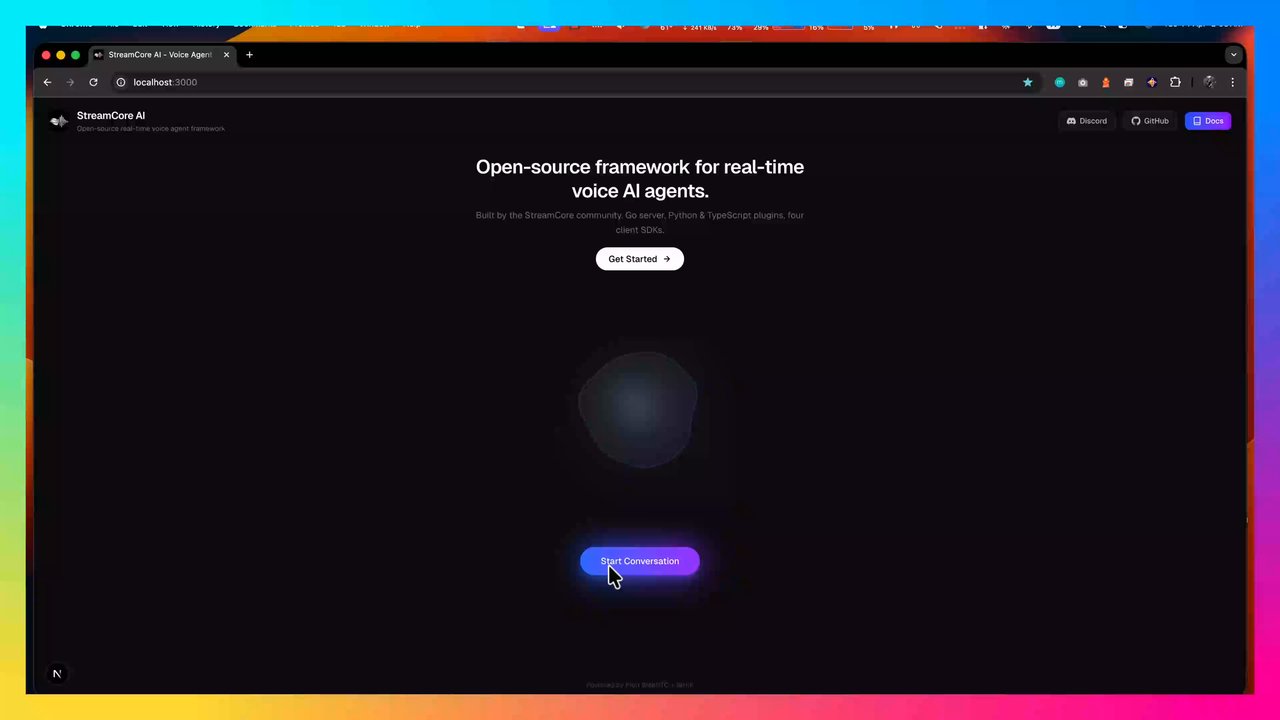
Demo
Quick start
Two terminals, five minutes, and you are talking to it. Needs Go 1.25+ (or Docker) and API keys for an STT, LLM, and TTS provider. No keys? Run it fully local with Ollama + VibeVoice.
cp config.toml.example config.toml   # add your provider credentials
go run .
The server listens on :8080; clients connect to http://localhost:8080/whip.
Then talk to it from a browser:
git clone https://github.com/streamcoreai/examples.git
cd examples/typescript && npm install && npm run dev
Open http://localhost:3000 and start talking.
Docker, TURN ports, and production notes: Quick start guide.
What you get
| Transport | WebRTC audio over WHIP (RFC 9725) — one HTTP POST, no signaling socket. Opus/RTP both ways |
| Connectivity | Built-in Pion STUN/TURN on UDP and TCP 3478 — no external coturn. A network handover or NAT rebind is recovered by ICE restart on the same session, so the conversation survives it |
| Turn-taking | Adaptive VAD that tracks each call's noise floor, plus a debounce that merges mid-sentence pauses into one turn |
| Interruption | Barge-in that ducks agent audio, filters backchannels ("mm-hm"), and cancels in-flight LLM and TTS on a confirmed interrupt |
| Streaming | Streaming STT → streaming LLM → chunk-streaming TTS, so audio starts before synthesis finishes |
| Sessions & events | Server-generated session IDs, multi-peer sessions, DataChannel events for transcript, response, state, and per-turn latency |
| Reach | Browser, mobile, backend, CLI, SIP telephony, and ESP32 endpoints |
Full capability list: Capabilities.
Not built yet
Listed so the table above stays honest — unticked items are real gaps today, not soon-shipping promises. Ticked ones shipped recently and stay listed for a release or two so you can see what moved:
- [x] Session reconnection (server) — a dropped connection recovers on the same session via ICE restart, so the conversation and the running pipeline survive it
- [x] Client-driven reconnection — the TypeScript, React Native, Go and Rust SDKs recover a network change automatically: ICE restart first, then a resume redial if the connection failed
- [x] Session resume — a drop past the point ICE restart can help is recovered by redialling with a single-use token, reattaching to the running conversation. Every SDK runs restart-then-resume as one ladder, so a backgrounded phone rejoins the same conversation
- [x] Panic recovery — a panic in one call's goroutines now ends that call alone: it recovers, logs the stack, and the session is reaped like any other ended call
- [x] Session cap —
server.max_sessionsbounds live sessions globally; past it,POST /whipreturns 503 withRetry-After. Resumes are exempt - [x] Env-var secrets — every API key and secret can come from the environment (
OPENAI_API_KEY,STREAMCORE_JWT_SECRET, …) instead ofconfig.toml. See Configuration - [ ] Metrics export —
/healthand timing events exist, no Prometheus/OpenTelemetry - [ ] Structured logging —
log.Printftext today, no JSON logs carryingsession_id - [ ] Versioned releases — a Docker image ships to GHCR on each GitHub release, but no version in the binary and no tagged standalone binaries yet
- [ ] Horizontal scaling — sessions live in process memory, so the server is single-node; reconnection and resume need sticky routing or an external store to work behind a load balancer
- [x] HTTP agent endpoint —
llm.provider = "agent"POSTs each turn to an agent you host in any language; replies stream back as speech - [ ] Persistent memory — the built-in runtime forgets callers between sessions; BYO agents can already persist their own
Full TODO list, including ecosystem items: Roadmap / TODO. Want one of these? Say so in Discord — demand reorders the list.
Bring your own agent
StreamCore starts one layer below prompt-and-tool frameworks: the media path. Your intelligence stays yours, five ways —
- Tool call — plugins (Python/TS/JS) or native Go tools call into your existing backend
- Your agent — set
llm.provider = "agent"and each turn is POSTed to an HTTP endpoint you host, in any language - Your models — point
llm.provider = "ollama"at any Ollama-compatible URL you run - Your code — implement one small Go interface; the whole media path works unchanged
- Built in — or use StreamCore's optional agent runtime with tools, skills, RAG, and history
Details and code: Bring your own agent · Agent runtime.
Providers: Deepgram, AssemblyAI, OpenAI, Cartesia, ElevenLabs, MiniMax, Speechify, Ollama, VibeVoice (local), xAI Grok Voice (speech-to-speech), pgvector/Supabase for retrieval. See Providers.
Documentation
| Page | What's in it |
|---|---|
| Quick start | Docker, TURN ports, connecting a client, wiring your backend, fully-local setup |
| Capabilities | What the runtime does today, endpoints, AI integrations |
| Bring your own agent | Five ways to own the intelligence, including the HTTP agent endpoint and the llm.Client interface |
| Agent runtime | Plugins, skills, RAG, document ingestion |
| Providers | Grok speech-to-speech, MiniMax, local VibeVoice, per-provider caveats |
| Configuration | Full annotated config.toml reference |
| Protocol | WHIP signaling, DataChannel events, auth |
| Architecture | Media flow, why Go, package layout |
SDKs and examples
Connect from anywhere — every SDK speaks the same WHIP + DataChannel protocol:




](https://github.com/streamcoreai/streamcore-server/actions/workflows/ci.yml)
](./LICENSE)
React Native / Expo (@streamcore/react-native-sdk) is built but not yet published to npm.
Plugin SDKs: @streamcore/plugin and streamcore-plugin in plugin-sdk. Runnable browser, CLI, and TUI apps: examples.
Sponsors & Supporters
Thank you! Interested in sponsoring? Reach out for logo placement on GitHub + demo page.
Contributing
Read CONTRIBUTING.md first — it covers running the server locally, the four checks CI runs before you push, and the extra care the timing-sensitive media path needs. Good places to start: good first issue and help wanted.
Client SDKs, the SIP bridge, examples, and the ESP32 firmware live in their own repos under streamcoreai — send those changes there.
Security
Found a vulnerability? Don't open a public issue — report it privately through the Security tab. SECURITY.md covers scope, response targets, and the settings that matter on a public address — JWT auth on /whip above all.
Star history
License
Apache 2.0. See LICENSE.