


Integrated Sandbox for AI Coding Agents
h5i (pronounced high-five) gives coding agents a complete, disposable development environment inside a single security boundary. The agent, workspace, shell, dependencies, dev server, and browser all run together inside the sandbox, while your host files and credentials stay outside. You can securely share web apps running inside the sandbox with others over an end-to-end encrypted P2P connection or a browser-ready demo link.
| 🛡️ Run coding agents in secure sandboxes | 🌐 Test web apps in isolated browsers |
| 🔗 Share demo services securely with others | 🧾 Review agent changes and activity |
h5i gives you:
- A self-contained sandbox with multiple isolation tiers for the agent, toolchain, dependencies, and browser
- Lightweight OS-level isolation that starts in under 200 ms, with filesystem, syscall, and network controls
- Rootless containers for portable, image-based environments
- MicroVM isolation with a separate kernel when stronger boundaries matter
- Isolated browsers that agents can securely control from inside the sandbox
- Chromium for broad compatibility with modern web applications
- h5i-browser-light, a pure-Rust, single-process engine using 7.4× less peak memory than Chromium
- Securely share dev servers running inside local sandboxes over the internet
- End-to-end encrypted P2P sharing when both sides use h5i
- Browser-ready demo links for everyone else, with expiring grants, revocation, and ingress receipts
- Reviewable patches and execution logs showing what changed, what ran, and what was denied
Local-first. No hosted sandbox. No SaaS account required.
Install
curl -fsSL https://h5i.dev/install.sh | sh
# if you would rather not add a domain to the chain:
# curl -fsSL https://raw.githubusercontent.com/h5i-dev/h5i/main/install.sh | sh
Or build from source:
cargo install --path .
Two optional runtimes add tiers on top of either: rootless Podman gives
you container, and microsandbox (msb)
gives you microvm on a host with hardware virtualization (/dev/kvm
on Linux, Apple Silicon on macOS).
Use it
Create a sandboxed
h5i box create <name> --profile agent-claude            # a sandboxed Git worktree from this repository
h5i box create <name> --profile agent-claude --pr 1234  # a sandbox from pull request #1234
Run a single command
h5i box run <name> -- cargo test # one command; the exit code passes through
Work in it interactively
h5i box shell <name>             # an interactive confined session
                                 # every command is policy-enforced and recorded:
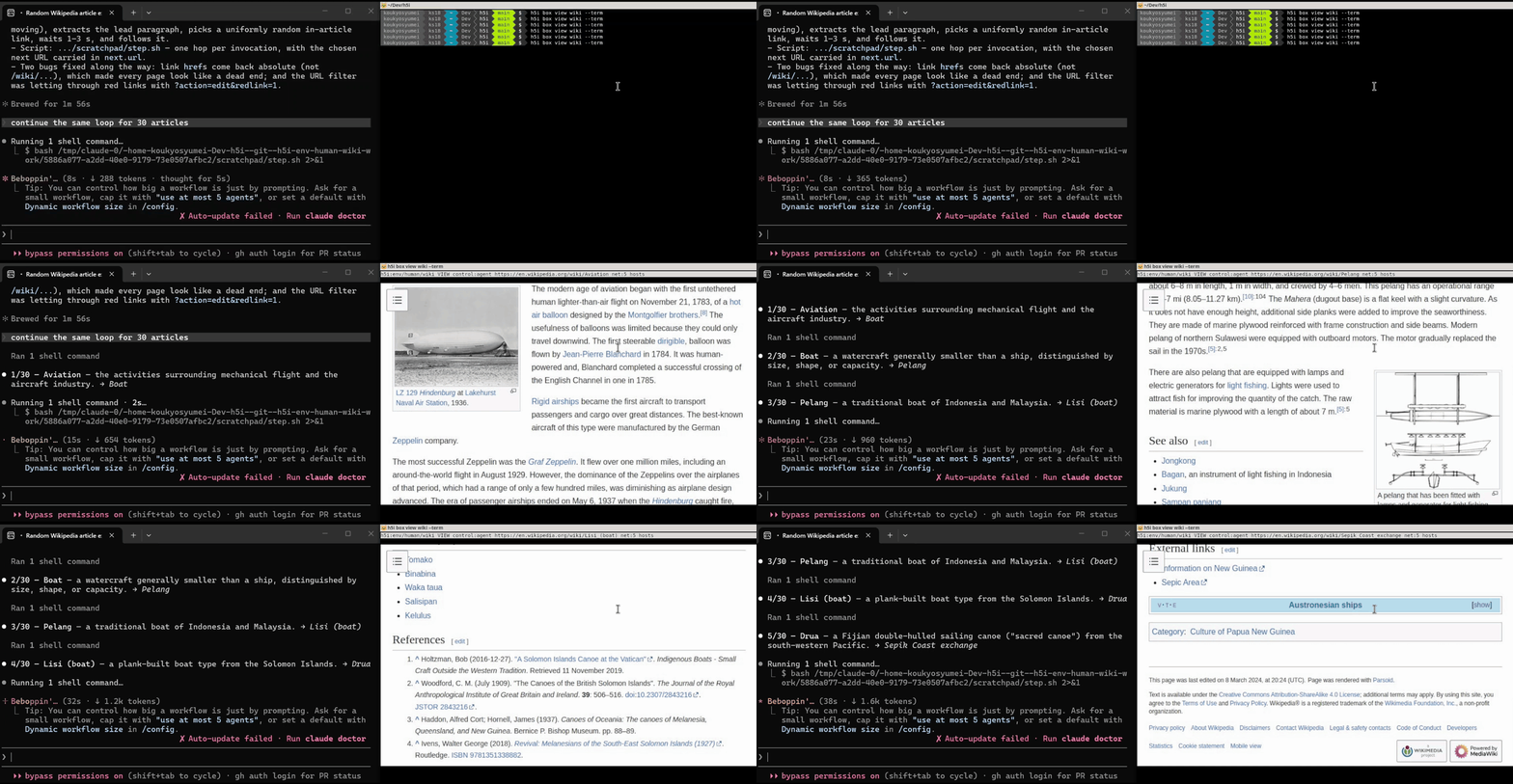
Watch the browser it drives
h5i box view <name>              # the box's page, on a forward only your host can reach
h5i box view <name> --term       # draw it in this terminal instead (needs kitty)
Review the work, then take it
h5i box propose <name>           # freeze the worktree into a reviewable snapshot
h5i box apply   <name>           # merge that snapshot onto the parent branch
Share the web app running inside the box
h5i box share <name> --port 3000 # end-to-end encrypted P2P sharing
h5i box share <name> --port 3000 --tunnel # browser-ready demo link

# For P2P sharing, the recipient connects with the generated ticket:
h5i join <ticket>
Keep the record of what happened
h5i box export <name>            # freeze the box and write a bundle you can read
# → h5i-export/<name>/patch.diff    the change, path-validated
#   h5i-export/<name>/report.md     what ran, what was denied, what was redacted
#   h5i-export/<name>/receipt.json  the records, with the enforced policy digest
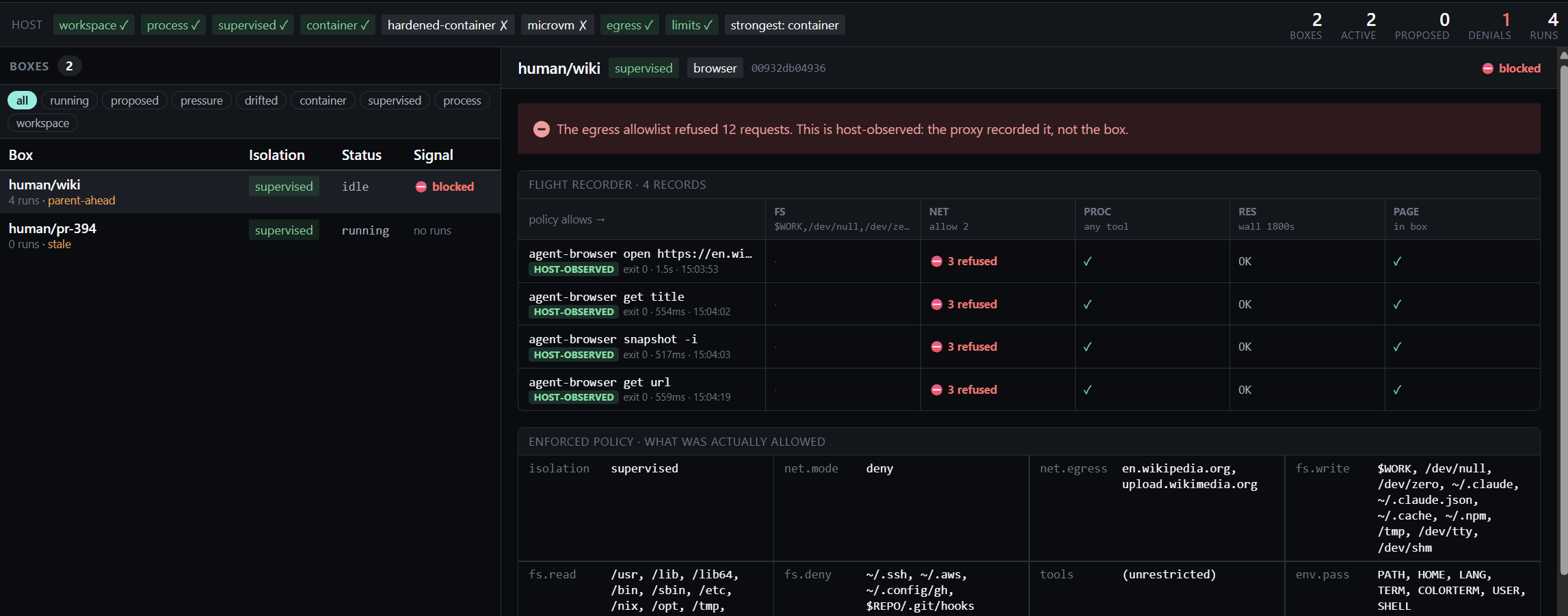
See where your boxes stand
h5i box ls                       # every box on this clone, and how far each has drifted
h5i box status <name>            # the policy that was actually enforced
h5i box diff <name>              # what changed against the pinned base
Throw a box away
h5i box rm <name> # prune the worktree, delete its branches, erase its manifest
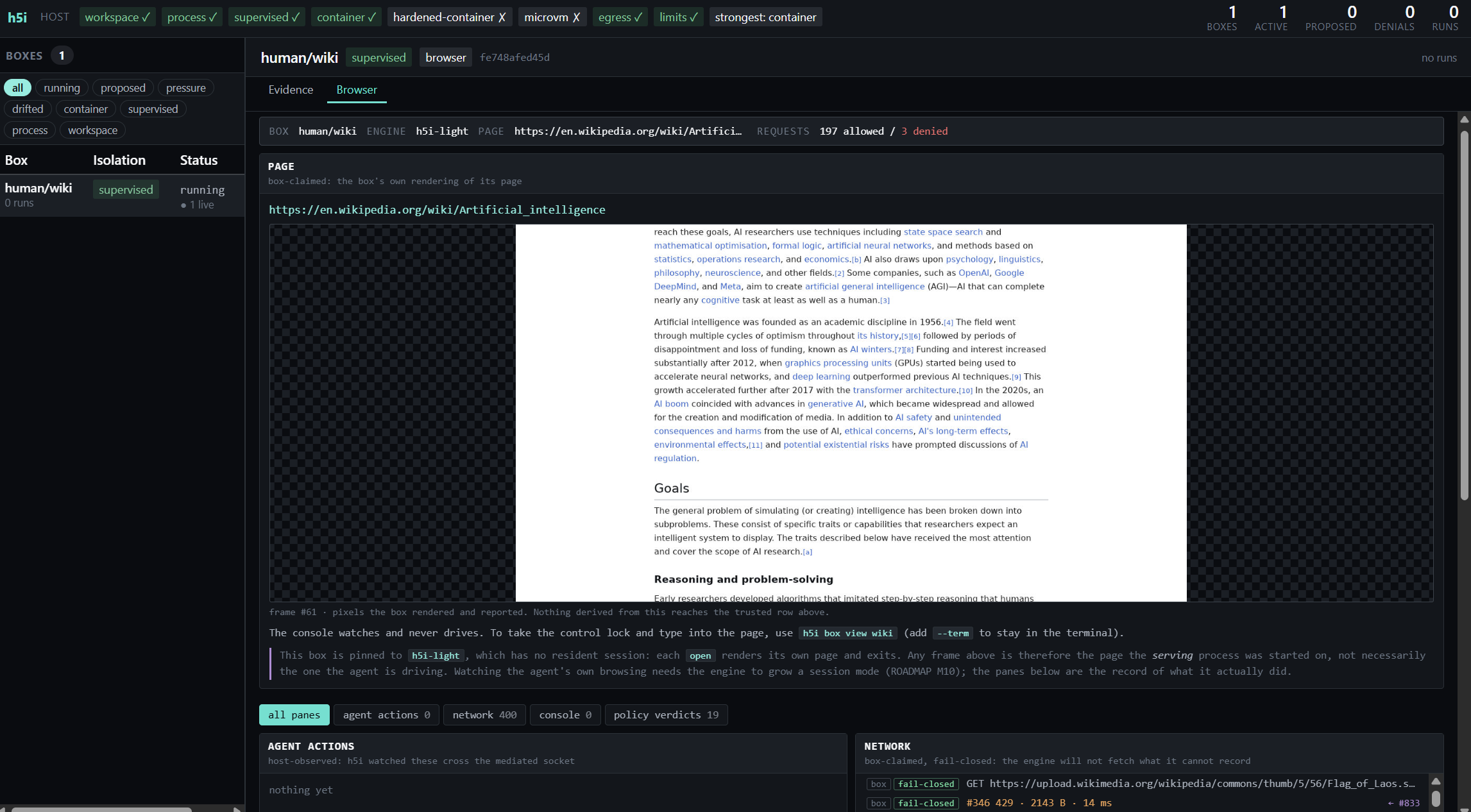
Watch the whole fleet in a browser
h5i ui # the whole fleet on one screen, read-only
What confinement means here
h5i box probe reports the tiers your host can run. h5i never silently
downgrades: an unsatisfiable request fails closed.
| Tier | What enforces it |
|---|---|
workspace |
a separate git worktree, no confinement |
process |
Landlock filesystem allowlist, seccomp deny-list, namespaces, rlimits |
supervised |
all of the above, plus a private network namespace with an nftables egress allowlist pinned to resolved IPs, DNS pinned by hosts file, and a seccomp-notify socket gate |
container |
rootless Podman, read-only rootfs, dropped capabilities, a portable image, and an HTTP/HTTPS proxy allowlist |
microvm |
a hardware-isolated guest with its own kernel, booted by microsandbox (msb) from the same OCI images, with the egress allowlist evaluated by the VM's network stack |
microvm is the strongest tier and the only one that does not share the host kernel. It requires msb, hardware virtualization (/dev/kvm or Apple Silicon), and an image; otherwise, it is refused, never downgraded.
No credentials enter a box. A runtime-scoped host proxy injects model API keys outside the boundary, preventing cross-runtime access. Each box receives a one-time copy of HOME state that is never written back.
Skill
The agent-facing interface is a skill, and the binary carries it:
h5i skill install                # writes it where your runtime looks
h5i skill show policy            # or just read a page
npx skills add h5i-dev/h5i       # if you do not have the binary yet
Documentation
- ROADMAP.md: where this is going, and what was cut to get there
- Official Website: project overview, Slides
- MANUAL.md /
man h5i: full command reference - CONTRIBUTING.md: we welcome contributions of any kind
h5i man > ~/.local/share/man/man1/h5i.1: install the man page (generated from the CLI)
What h5i does not claim
- It cannot stop an agent from putting your code in a prompt. Containment keeps the agent off your machine. Model egress is a separate control.
- The kernel is shared, below
microvm. Podman and the kernel tiers are good against a runaway agent and careless dependency code, not against a targeted kernel exploit.isolation=microvmis the answer to that, and it needs a host with virtualization and an image — so it is opt-in, not the default you get by typingh5i box. - The container tier's egress scoping is L7. Its allowlist is a proxy, so
it binds proxy-respecting tooling only.
supervisedandmicrovmenforce at L3/L4 and do not have that hole.
License
Apache-2.0. See LICENSE.
Contributors