

Strands Robots
Control, simulate, and train robots with natural language






Strands Docs ◆ MuJoCo ◆ NVIDIA GR00T ◆ LeRobot ◆ Robots Sim ◆ Project Board
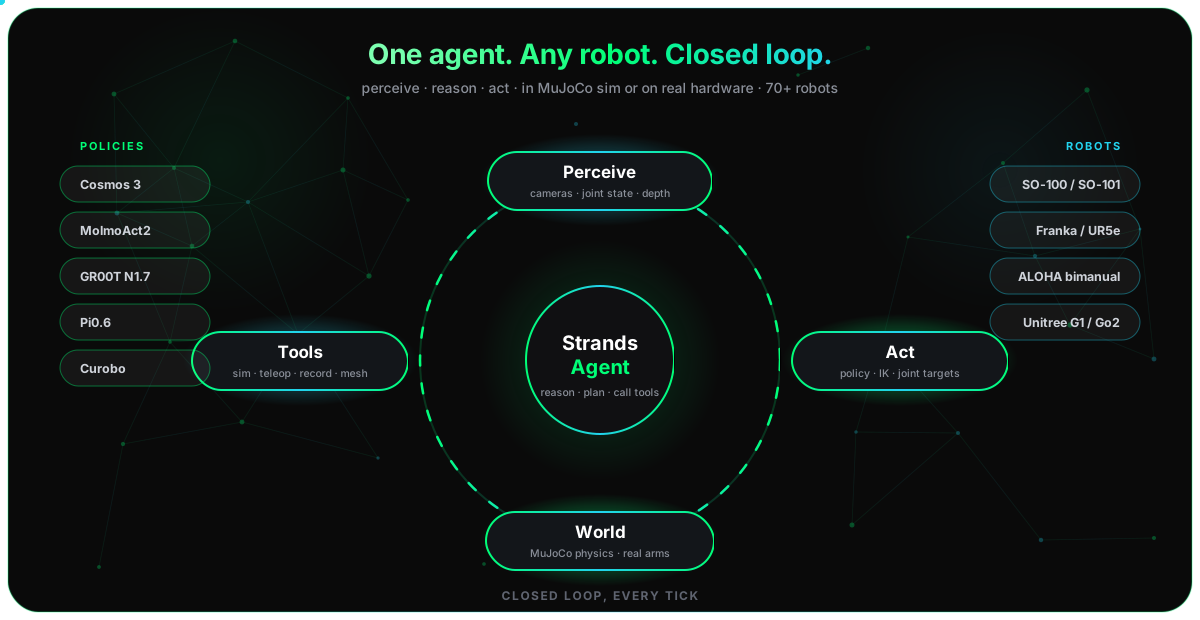
strands-robots gives a Strands Agent
hands. One Robot() call returns a MuJoCo simulation (default - no GPU, no
hardware) or a real robot - same code, same natural-language control, both
auto-joined to a peer-to-peer mesh.
from strands import Agent
from strands_robots import Robot

robot = Robot("so100")              # MuJoCo sim by default; mode="real" for hardware
Agent(tools=[robot])("pick up the red cube")
One agent, the whole robotics loop
Teleoperate a real arm to collect demos, fine-tune a policy on them, run it in sim and on hardware, hand work to a fleet peer, and expose it all on ROS 2 - one library, one mental model. Every line below is a distinct capability:
from strands import Agent
from strands_robots import Robot
from strands_robots.tools import train_policy

# 1. TELEOPERATE a real SO-101 with its leader arm and RECORD demos as a
#    LeRobotDataset (one prompt drives cameras + teleop + recording).
follower = Robot("so101", mode="real", port="/dev/ttyACM0",
                 cameras={"front": {"type": "opencv", "index_or_path": "/dev/video0"}})
follower.attach_teleop("so101_leader", port="/dev/ttyACM1", id="leader")
Agent(tools=[follower])(
    "start_recording(repo_id='me/pick', root='/tmp/pick', fps=30, "
    "task='pick up the cube'); teleoperate for 60s; stop_recording"
)

# 2. POST-TUNE a policy on those demos (LoRA fine-tune; GPU box).
train_policy(action="train", provider="lerobot_local",
             dataset_root="/tmp/pick", base_model="lerobot/smolvla_base",
             output_dir="/tmp/pick_ckpt", method="lora", steps=20000)

# 3. RUN the tuned checkpoint - same policy on a MuJoCo twin AND the real arm.
twin = Robot("so101")                                              # sim twin, no hardware
twin.run_policy(robot_name="so101", policy_provider="lerobot_local",
                policy_config={"pretrained_name_or_path": "/tmp/pick_ckpt"}, duration=10.0)
follower.start_task("pick up the cube", policy_provider="lerobot_local",
                    policy_port=None, duration=10.0)               # real arm, in-process

# 4. COORDINATE a fleet - tell a mesh peer to assist, in natural language.
follower.mesh.tell(follower.mesh.peers[0]["peer_id"], "hold the tray steady")

# 5. EXPOSE the running sim on ROS 2 - rviz / nav2 / any ros2 node can subscribe.
from strands_robots.simulation import Simulation
sim = Simulation(ros2_bridge=True); sim.create_world(); sim.add_robot("so101")
sim.step(100)   # publishes /so101/joint_states + camera image_raw on the ROS 2 graph
| Step | Capability | Surface |
|---|---|---|
| 1 | Teleop + dataset recording | Robot(mode="real"), attach_teleop, start_recording |
| 2 | Policy post-tuning | train_policy (LeRobot / GR00T trainers) |
| 3 | Sim + hardware policy rollout | run_policy (sim), start_task (hardware) |
| 4 | Fleet coordination | robot.mesh.tell / robot_mesh tool |
| 5 | ROS 2 interop | Simulation(ros2_bridge=True), use_ros |
Steps 1 and 3-real need hardware; step 2 needs a GPU. Everything runs in sim with no hardware (
Robot("so101")), so you can exercise the whole loop today.
Why strands-robots
- Sim-first, safe by default.
Robot("so100")spins up a MuJoCo world. You never accidentally drive real servos -mode="real"is an explicit opt-in. - 70+ robots, 8 categories. Arms, humanoids, quadrupeds, hands, drones, bimanual rigs - resolved from a single registry with auto-download of assets.
- Any policy. VLA models (NVIDIA GR00T, LeRobot ACT/Pi0/SmolVLA/Diffusion), plus classical motion planners, MPC, and scripted controllers behind one ABC.
- Mesh networking built in. Every robot is a Zenoh peer.
tell()another robot what to do; broadcast an E-STOP; bridge to AWS IoT Core for fleets. - 67-action simulation tool. World building, physics, rendering, domain
randomization, procedural terrain (
create_world(terrain="rough"|"stairs"|"pyramid"|"slope")for locomotion), and LeRobotDataset recording - all agent-callable. - ROS 2 interop. Observe + command any ROS 2 graph (
use_ros), act as a robot with no rclpy (use_rtps), or expose a running sim as a ROS node. - One mental model. Sim and hardware share the same policy interface, the same mesh, and the same natural-language control surface.
How it works
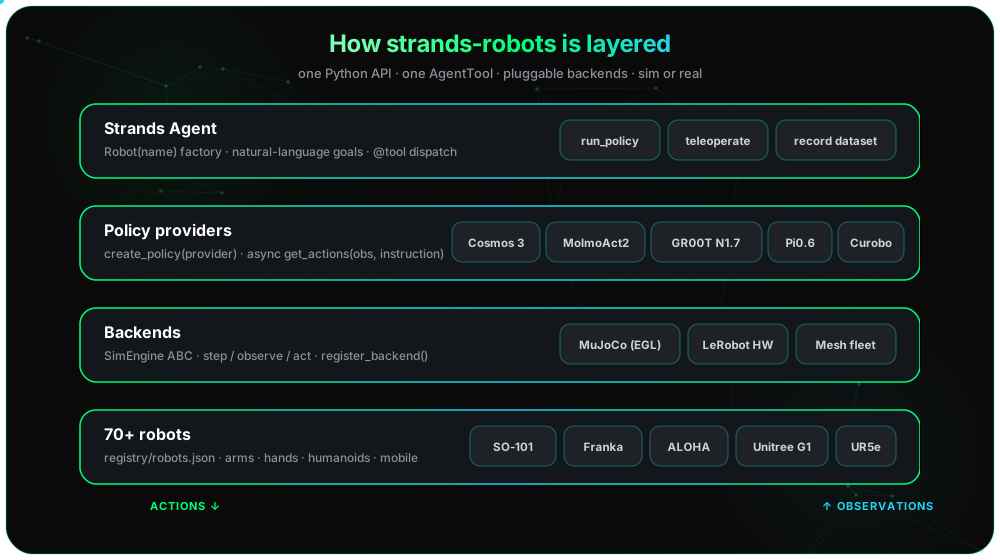
graph LR
    A[Natural Language<br/>'Pick up the red block'] --> B[Strands Agent]
    B --> C[Robot<br/>sim or real]
    C --> D[Policy Provider<br/>GR00T / Cosmos 3 / LeRobot / planner / mock]
    D --> E[Action Chunk]
    E --> F[MuJoCo Sim<br/>or Hardware]
    F -->|observation| C

    classDef input fill:#2ea44f,stroke:#1b7735,color:#fff
    classDef agent fill:#0969da,stroke:#044289,color:#fff
    classDef policy fill:#8250df,stroke:#5a32a3,color:#fff
    classDef hardware fill:#bf8700,stroke:#875e00,color:#fff

    class A input
    class B,C agent
    class D,E policy
    class F hardware
Installation
Examples use uv (curl -LsSf https://astral.sh/uv/install.sh | sh); plain pip works too.
uv pip install strands-robots
The base install is light (numpy, opencv-headless, Pillow). Pull in only the extras you need:
| Extra | Installs | Use for |
|---|---|---|
sim-mujoco |
MuJoCo, robot_descriptions, imageio, mink + qpsolvers[daqp] | Simulation (recommended starting point). mink/qpsolvers are the differential-IK solver behind the move_to Cartesian transport primitive; qpsolvers ships no solver of its own, so the [daqp] backend extra is declared with it. |
sim-newton |
Newton, Warp, MuJoCo-Warp, trimesh | GPU-native simulation (NVIDIA GPU; batched envs, headless ray-traced render) |
sim-isaac |
usd-core, imageio (Isaac Sim installed separately) | NVIDIA Isaac Sim backend - photorealistic RTX rendering, synthetic data, GPU-batched sensors, USD-native scenes. Install Isaac Sim itself separately: via its pip wheels on Python 3.12 (isaacsim[all,extscache] from pypi.nvidia.com - see the caveats in docs/simulation/isaac.md), the Omniverse Launcher, Isaac Lab, or the NGC docker image. This extra pulls only the pip-installable Python helpers. (NVIDIA RTX GPU; GPU-only, not in [all].) |
sim-gs |
gsplat, plyfile, torch | 3D Gaussian Splatting hybrid rendering (strands_robots.rendering): composite any sim backend's robot over a captured photoreal 3DGS scene. gsplat ships as a source dist that JIT-compiles CUDA kernels via nvcc on first use - probe with strands_robots.rendering.gsplat_rasterizer_available(); the zero-GPU PanoramaBackground works without this extra. (CUDA GPU; GPU-only, not in [all].) |
lerobot |
LeRobot | Real hardware, local VLA inference, dataset recording |
molmoact2 |
LeRobot + transformers, peft, scipy | MolmoAct2 transformers-native VLA (resolves from PyPI via lerobot >= 0.6) |
groot-service |
pyzmq, msgpack | NVIDIA GR00T inference client |
cosmos3-service |
websockets, msgpack | NVIDIA Cosmos 3 policy-server client |
curobo |
(empty; install cuRobo from source) | In-process collision-aware motion planning (CUDA GPU) |
wbc |
onnxruntime | GR00T Whole-Body-Control (SONIC) humanoid locomotion - in-process ONNX, no GPU |
motionbricks |
torch + vector-quantize-pytorch, pytorch-lightning, hydra-core (install motionbricks from source) |
NVIDIA MotionBricks generative kinematic motion for the G1 - in-process torch, composes with wbc |
mesh |
eclipse-zenoh, json5 | Peer-to-peer robot mesh |
mesh-iot |
awsiotsdk, awscrt, boto3 | AWS IoT Core mesh transport for fleets |
device-connect |
device-connect-edge, device-connect-agent-tools | Device-aware networking - discovery, RPC, events, safety (falls back to the built-in mesh if absent) |
benchmark-libero |
libero | LIBERO benchmark evaluation |
all |
everything above except the GPU-only sim-isaac / sim-gs extras |
Kitchen sink |
# Most users start here:
uv pip install "strands-robots[sim-mujoco]"

# Real hardware + local policies:
uv pip install "strands-robots[sim-mujoco,lerobot]"

# MolmoAct2 VLA (transformers-native; resolves from PyPI via lerobot >= 0.6):
uv pip install "strands-robots[molmoact2]"

# Everything:
uv pip install "strands-robots[all]"
The Isaac Sim GPU backend is a built-in, in-tree peer of mujoco and
newton (it lives at strands_robots.simulation.isaac). Its pip-installable
helpers ship in the sim-isaac extra, but the Isaac Sim runtime itself (~30 GB)
is provisioned separately - via its own pip wheels on Python 3.12
(pip install 'isaacsim[all,extscache]==6.0.*' --extra-index-url https://pypi.nvidia.com,
with coverage/EULA caveats documented in
docs/simulation/isaac.md), the Omniverse
Launcher, Isaac Lab, or the NGC docker image. Install the helpers with
pip install 'strands-robots[sim-isaac]', then select the backend with
create_simulation("isaac") - see
Simulation (MuJoCo) and
docs/simulation/isaac.md.
From source:
git clone https://github.com/strands-labs/robots
cd robots
uv pip install -e ".[all,dev]"
Quick starts
Simulation (no GPU, no hardware)
from strands import Agent
from strands_robots import Robot

robot = Robot("so100") # MuJoCo simulation
agent = Agent(tools=[robot])
agent("Wave the arm using the mock policy for 200 steps, then render a top-down view")
Robot("so100") returns a Simulation instance - the full 67-action
simulation AgentTool. Drive it in natural language through an Agent, call its
methods directly (robot.render(camera_name="topdown")), or dispatch an action
by calling it (robot(action="render", camera_name="topdown")). See
Simulation.
Note:
Robot("so100")already creates the world and adds the robot for you. Do not callcreate_world()again on the returned instance - it will error with "World already exists." Thecreate_world()/add_robot()sequence shown in Simulation (MuJoCo) is for the low-levelSimulation(...)constructor, which starts empty.
Real hardware + GR00T
from strands import Agent
from strands_robots import Robot, gr00t_inference

robot = Robot(
    "so101",
    mode="real",
    cameras={
        "front": {"type": "opencv", "index_or_path": "/dev/video0", "fps": 30},
        "wrist": {"type": "opencv", "index_or_path": "/dev/video2", "fps": 30},
    },
    port="/dev/ttyACM0",
    data_config="so100_dualcam",
)

agent = Agent(tools=[robot, gr00t_inference])

# Start the GR00T inference service (Docker, Jetson/x86 GPU)
agent.tool.gr00t_inference(
    action="start",
    checkpoint_path="/data/checkpoints/model",
    port=8000,
    data_config="so100_dualcam",
)

agent("Use so101 to pick up the red block with the GR00T policy on port 8000")
Local LeRobot policy (no inference server)
from strands_robots import create_policy

# Direct HuggingFace inference - ACT, Pi0, SmolVLA, Diffusion, ...
policy = create_policy("lerobot/act_aloha_sim_transfer_cube_human")
Teleoperation (leader arms, gamepads, WASD)
Drive any real robot - or a simulation - from one or more LeRobot
teleoperators. Teleoperator() mirrors the Robot() factory; attach_teleop()
+ teleoperate() run the control loop.
from strands_robots import Robot, Teleoperator

# Leader arm -> follower arm (both speak {motor}.pos -> zero config)
follower = Robot("so101", mode="real", port="/dev/ttyACM0")
follower.attach_teleop("so101_leader", port="/dev/ttyACM1", id="leader")
follower.teleoperate()                       # Ctrl+C or stop_teleoperate()

# Earth Rover Mini+ with WASD keys (velocity keys -> zero config)
rover = Robot("earthrover_mini_plus", mode="real", robot_ip="192.168.1.151")
rover.attach_teleop("keyboard_rover")        # W/A/S/D
rover.teleoperate(block=True, duration=30)

# Cross-vocabulary or sim teleop -> supply a map_fn(action) -> action
robot.attach_teleop("keyboard_ee", map_fn=my_ik)   # EE deltas -> joint .pos
robot.teleoperate(publish=True)              # also stream over the mesh
17 teleoperators (so100/so101/koch/omx/openarm leaders, bi_* leaders,
gamepad, keyboard, keyboard_ee, keyboard_rover, phone,
reachy2_teleoperator, unitree_g1, homunculus arm/glove) drive 14 robots.
Zero-config when action keys match; otherwise pass map_fn. Full matrix +
recipes: Teleoperation docs.
Recording & streaming datasets
The physical-AI data loop, end to end: record a LeRobotDataset from sim or
hardware, stream it straight back for eval/training (no full download), and
optionally dump it to a mutable Hugging Face Storage Bucket. Needs the
lerobot extra (which bundles datasets + av + torchcodec).
from strands import Agent
from strands_robots import Robot

sim = Robot("so100", mesh=False)
agent = Agent(tools=[sim])

# 1. COLLECT — one natural-language prompt drives scene + cameras + policy + record.
agent(
    "Create a world with the so100 robot, add a red cube and a front camera, "
    "start recording (repo_id='local/demo', root='/tmp/demo', fps=30, "
    "overwrite=True, task='pick up the red cube'), run the mock policy for "
    "60 steps, then stop recording."
)

# 2. STREAM — read it back lazily; camera frames decode on the fly from the MP4
#    shards, state/action from parquet. Nothing is re-materialized to disk.
reader = sim.stream_dataset("local/demo", root="/tmp/demo", shuffle=False)
for frame in reader:
    frame["observation.images.front"]   # (3, H, W) tensor, decoded from video
    frame["observation.state"]          # joint vector
    frame["action"]
    break
stream_dataset() is the in-process read counterpart to
start_recording/stop_recording. For full training, the upstream trainer uses
the same engine — lerobot-train --policy.type=act --dataset.repo_id=... --dataset.streaming=true --num_workers=4
(the lerobot-train entry point wraps python -m lerobot.scripts.lerobot_train;
flags are draccus --dotted.key=value form).
Verify episode integrity. A recording's ground truth is the parquet under
meta/episodes/, not the count a model narrates while collecting. Collect
episodes with a deterministic Python loop (one run_policy(..., n_episodes=1)
plus save_episode() per episode) rather than trusting a model to count its own
tool calls, then confirm the dataset holds the episodes you intended - in-process
or from the shell:
sim.verify_dataset_episodes(expected=20) # reads parquet; status="error" on a mega-episode
# exit 0 = pass, 1 = fail, so it drops straight into CI as a dataset gate
strands-robots verify-dataset /tmp/demo --expected 20
This catches the "mega-episode" corruption class - a run that buffered every
frame into one episode_index=0 episode while reporting 20/20 - plus
meta/info.json vs parquet drift and zero-length episodes.
Dump to a Storage Bucket during collection (mutable, Xet-deduplicated — the Phase 1/2 collection target that avoids git-LFS history bloat) with one kwarg:
sim.stop_recording(bucket="your-org/robot-fave") # → hf://buckets/your-org/robot-fave/demo
Requires the hf CLI with the buckets/sync subcommands
(pip install -U "huggingface_hub>=1.5" + hf auth login — those subcommands
first ship in 1.5.0; every earlier release, including 1.0–1.4.x, installs an
hf entry point without them).
The bucket read side (stream_dataset(..., repo_type="bucket")) needs
strands-robots >= 0.5.1, so upgrade with -U rather than a bare
pip install "strands-robots[...]" — pip reports Requirement already satisfied
against a pre-existing older release and upgrades nothing, and on 0.4.1 the read
raises TypeError: open() got an unexpected keyword argument 'repo_type'.
Any on-disk dataset directory can be synced (or daily re-synced) without a live
recording session — one recorded earlier in the process, or on hardware via
lerobot-record:
from strands_robots import sync_dataset_to_bucket

sync_dataset_to_bucket("/tmp/demo", "your-org/robot-fave")
# → {"status": "success", "bucket_uri": "hf://buckets/your-org/robot-fave/demo"}
run_id defaults to the directory name; pass run_id="nightly" to choose the
bucket subpath, and delete=True for mirror semantics.
Proprio-only / no video (e.g. edge devices without a torchcodec wheel):
sim.stream_dataset(repo_id, drop_videos=True, delta_timestamps={...}) streams
state/action only and never touches the video decoder. drop_videos=True
requires a delta_timestamps with at least one non-video key (e.g.
{"observation.state": [0.0], "action": [0.0]}) - without one, every feature
including video would stream, so the call raises ValueError instead of
silently no-opping.
macOS note (zero-touch). torchcodec links ffmpeg via
@rpath, and Homebrew's ffmpeg (/opt/homebrew/lib) is not on the default dyld search path — so video decode would normally fail withLibrary not loaded: @rpath/libavutil.NN.dylib. Onimport strands_robotswe auto-detect this and put Homebrew's ffmpeg onDYLD_FALLBACK_LIBRARY_PATH(re-exec'ing the interpreter once for a plain script run; never inside Jupyter/REPL/pytest, where it just prints the one-lineexportto run). It's a no-op off macOS, without torchcodec, or when the var is already set. Disable withSTRANDS_ROBOTS_NO_DYLD_SHIM=1. Seeexamples/06_agent_collect_and_stream.py.
See also Recording & datasets for the DatasetRecorder
direct API and append/resume workflow.
The Robot() factory
Robot() is a factory, not a wrapper - you get the real backend instance back
with all its methods.
Robot("so100")                       # mode="sim"  (default, safe)
Robot("so100", mode="real")          # explicit hardware opt-in
Robot("so100", mode="auto")          # probe USB for servos, fall back to sim
Robot("my_arm", urdf_path="arm.xml") # bring your own MJCF/URDF
| Parameter | Type | Default | Description |
|---|---|---|---|
name |
str |
required | Robot name or alias (see Supported robots) |
mode |
str |
"sim" |
"sim", "real", or "auto" (case-insensitive) |
backend |
str |
"mujoco" |
Sim backend: "mujoco", "newton", or "isaac" (all built-in; isaac needs the sim-isaac extra) |
urdf_path |
str |
None |
Explicit MJCF/URDF path (skips registry lookup) |
cameras |
dict |
None |
Camera config (mode="real" only) |
position |
list[float] |
[0,0,0] |
Spawn position in the sim world |
data_config |
str |
name | Observation/action schema name |
mesh |
bool |
True |
Auto-join the Zenoh mesh |
Safety/validation rules:
- Defaults to sim. Real hardware is always an explicit mode="real".
- cameras= is rejected in sim mode - add sim cameras via the add_camera
action after creation.
- Unknown robot names raise ValueError unless you pass urdf_path=.
- STRANDS_ROBOT_MODE overrides detection; a typo'd value logs a warning
and falls back to sim.
Supported robots
70+ robots across 8 categories, resolved from
registry/robots.json. Assets
(MJCF + meshes) auto-download from
robot_descriptions
/ MuJoCo Menagerie on
first use. List them at runtime with from strands_robots import list_robots; list_robots().
| Category | Count | Robots |
|---|---|---|
| Arm | 22 | so100, so101, koch, omx, panda, fr3, fr3_v2, ur5e, ur10e, xarm7, kinova_gen3, kuka_iiwa, sawyer, piper, yam, z1, vx300s, wx250s, arx_l5, openarm, hope_jr, dynamixel_2r |
| Humanoid | 18 | unitree_g1, unitree_h1, unitree_h1_2, apollo, talos, reachy2, rby1, fourier_n1, booster_t1, adam_lite, asimov_v0, cassie, elf2, jvrc, op3, open_duck_mini, toddlerbot_2xc, toddlerbot_2xm |
| Mobile | 13 | spot, go1, unitree_go2, unitree_a1, aliengo, anymal_b, anymal_c, stretch, stretch3, lekiwi, tiago_dual, earthrover, robot_soccer_kit |
| Hand | 8 | shadow_hand, shadow_dexee, allegro_hand, leap_hand, ability_hand, aero_hand, robotiq_2f85, robotiq_2f85_v4 |
| Bimanual | 3 | aloha, bi_openarm, trossen_wxai |
| Aerial | 2 | crazyflie, skydio_x2 |
| Expressive | 1 | reachy_mini |
| Mobile manip | 1 | google_robot |
Hardware-capable (drivable with mode="real" via LeRobot): so100,
so101, koch, omx, hope_jr, aloha, bi_openarm, reachy2,
unitree_g1, lekiwi, earthrover. All are simulatable.
Adding a robot
There are two paths, depending on whether the robot needs project-specific metadata:
- Standard
robot_descriptionsrobot (zero config). Any MJCF robot shipped by robot_descriptions resolves automatically without arobots.jsonentry - the asset is discovered and downloaded on first use:
```python from strands_robots import Robot, list_discoverable
sim = Robot("iiwa14") # discovered, not in robots.json print(list_discoverable()) # the MJCF long tail you can load directly ```
A curated robots.json entry always wins over discovery, so overriding a
discovered robot later is non-breaking.
- Custom or metadata-rich robot. If the robot needs a non-default joint
count, hardware port, aliases, scene tweaks, or local mesh overrides, add a
curated entry. For a robot that belongs in the shipped catalog, add it to
registry/robots.jsonand open a PR. For a machine-local robot, register it at runtime instead of editing the package:
```python from strands_robots.registry import register_robot
register_robot(name="my_arm", model_xml="my_arm.xml", asset_dir="~/robots/my_arm", joints=7, category="arm") ```
Tools reference
Import any of these and pass to Agent(tools=[...]). Each is a Strands
AgentTool returning {"status", "content"}.
| Tool | Purpose |
|---|---|
Robot(...) |
Universal robot - sim or hardware, natural-language + async control |
run_policy |
Multi-episode policy rollout with per-episode eval + dataset recording |
train_policy |
Post-tune (fine-tune) a policy on a recorded dataset (LeRobot / GR00T trainers, full or LoRA) |
use_lerobot |
Universal LeRobot bridge - call ANY lerobot module/class/config directly (like use_aws wraps boto3) |
lerobot_train |
Thin local wrapper over the lerobot-train CLI (the engine behind train_policy) |
robot_mesh |
Coordinate robots over the Zenoh mesh (tell, broadcast, E-STOP) |
use_ros |
Bridge to any ROS 2 graph - list/echo/publish topics, call services (in-process rclpy) |
use_rtps |
Join a ROS 2 graph as a DDS participant - publish/echo topics, act as a robot (pure cyclonedds, no rclpy, all ROS 2 distros) |
gr00t_inference |
Manage NVIDIA GR00T inference services (Docker lifecycle) |
lerobot_camera |
OpenCV / RealSense camera discovery, capture, record |
lerobot_calibrate |
List, view, back up, restore LeRobot calibrations |
lerobot_teleoperate |
Record demonstrations, replay episodes |
pose_tool |
Store, recall, and execute named robot poses |
harness_memory |
Persist task solution traces + global success rules / failure models across agent sessions (Harness-VLA-style memory) |
serial_tool |
Low-level Feetech servo / raw serial communication |
download_assets |
Pre-fetch robot MJCF + meshes into the asset cache |
agent.tool.gr00t_inference(
    action="start",
    checkpoint_path="/data/checkpoints/model",
    port=8000,
    use_tensorrt=True,
    vit_dtype="fp8",     # ViT:  fp16 | fp8
    llm_dtype="nvfp4",   # LLM:  fp16 | nvfp4 | fp8
    dit_dtype="fp8",     # DiT:  fp16 | fp8
)
Policy providers
All policies implement one ABC - async get_actions(observation, instruction, **kwargs).
The interface is deliberately agnostic about how actions are produced, so it
fits both VLA models and classical controllers.
from strands_robots import create_policy

create_policy("mock")                                  # sinusoidal test actions
create_policy("groot", port=5555)                      # NVIDIA GR00T via ZMQ
create_policy("zmq://localhost:5555")                  # same, by URL
create_policy("cosmos3", embodiment="droid", port=8000)  # NVIDIA Cosmos 3 via WebSocket
create_policy("lerobot/act_aloha_sim_transfer_cube")   # local HF inference
| Provider | Backend | Notes |
|---|---|---|
mock |
none | Sinusoidal trajectories; requires_images=False (~10x faster) |
groot |
NVIDIA GR00T N1.5/N1.6/N1.7 | Service mode (ZMQ to a Docker container) or local in-process (model_path=) |
cosmos3 |
NVIDIA Cosmos 3 omnimodal VLA | Service mode (WebSocket to a Cosmos Framework RoboLab policy server); embodiments: droid, umi, av, bridge |
lerobot_local |
HuggingFace | Direct ACT / Pi0 / SmolVLA / Diffusion inference, no server |
lerobot_async |
HuggingFace via gRPC | Offload a LeRobot policy to a remote PolicyServer over lerobot's native async-inference gRPC transport (edge/light robot host) |
remote |
any policy, over WebSocket | Drop-in client that forwards observations to a remote PolicyServer and returns its action chunk: create_policy("remote", endpoint="ws://gpu-box:8765") (or the smart string create_policy("ws://gpu-box:8765")). For a light robot host with a GPU box elsewhere; mirrors the server policy's RTC support |
vera |
MIT VERA (DFoT/WAN planner + Jacobian IDM) | Two-stage video-to-action over a WebSocket GPU server (Docker); PushT + MimicGen, IK for eef-delta arms. Git-only (not on PyPI, no extra): pip install 'vera @ git+https://github.com/sizhe-li/VERA.git' plus websockets msgpack numpy |
classDiagram
    class Policy {
        <<abstract>>
        +get_actions(obs, instruction, **kwargs)
        +set_robot_state_keys(keys)
        +requires_images
        +reset(seed)
        +provider_name
    }
    class Gr00tPolicy
    class Cosmos3Policy
    class LerobotLocalPolicy
    class MockPolicy
    class YourPolicy
    Policy <|-- Gr00tPolicy
    Policy <|-- Cosmos3Policy
    Policy <|-- LerobotLocalPolicy
    Policy <|-- MockPolicy
    Policy <|-- YourPolicy
Security:
lerobot_localloads HuggingFace models withtrust_remote_code=True(arbitrary code execution). You must opt in withexport STRANDS_TRUST_REMOTE_CODE=1. Only load models you trust.
Cosmos 3 (NVIDIA omnimodal VLA - service mode)
nvidia/Cosmos3-Nano-Policy-DROID via a self-contained WebSocket client (cosmos3 / c3 / cosmos3://host:port); no openpi-client dep, no numpy<2 pin, so it composes with lerobot in one env.
uv sync --all-extras --group=cu130-train --group=policy-server
python -m cosmos_framework.scripts.action_policy_server_robolab \
    --checkpoint-path nvidia/Cosmos3-Nano-Policy-DROID --port 8000
curl http://localhost:8000/healthz   # -> 200 when ready (~4 min cold)
uv pip install -e '.[sim-mujoco]'
uv pip install 'strands-robots[cosmos3-service]'
from strands_robots.policies import create_policy

policy = create_policy("cosmos3", embodiment="droid", port=8000)
policy.set_robot_state_keys([f"joint_{i}" for i in range(7)] + ["gripper"])
chunk = policy.get_actions_sync(observation, "pick up the cube")
# chunk == [{"joint_0": .., ..., "gripper": ..}, ...]  (one dict per timestep)
policy = create_policy(
    "cosmos3", embodiment="droid", port=8000,
    observation_mapping={
        "wrist":     "observation/wrist_image_left",
        "exterior":  "observation/exterior_image_1_left",
        "exterior2": "observation/exterior_image_2_left",
    },
)
MUJOCO_GL=egl python examples/vla/cosmos3_sim_rollout.py --record /tmp/c3.mp4
Non-VLA policies (motion planners, MPC, scripted)
The same interface fits cuRobo, MoveIt2, OMPL, MPC, and pure-IK / scripted
trajectories - anything mapping (observation, goal) to joint targets.
Non-VLA providers set requires_images = False (skip camera rendering) and
read their goal from well-known **kwargs keys instead of parsing the
instruction string:
| Key | Type | Meaning |
|---|---|---|
target_pose |
list[float] |
Cartesian goal [x, y, z, qw, qx, qy, qz] in base frame |
target_joints |
dict[str, float] |
Joint-space goal keyed by joint name (rad / m) |
world_update |
dict \| None |
Per-call world refresh for collision-aware planners |
Providers MUST ignore unknown **kwargs rather than raising, so callers can
pass shared keys across providers without coupling to a backend.
from typing import Any
from strands_robots.policies import Policy, register_policy, create_policy


class ReachPolicy(Policy):
    """Linear interpolation from current joint state to target_joints."""

    def __init__(self, steps: int = 32, **_: Any) -> None:
        self._keys: list[str] = []
        self._steps = steps

    @property
    def provider_name(self) -> str:
        return "reach"

    @property
    def requires_images(self) -> bool:
        return False  # joint-state only -- skip camera rendering

    def set_robot_state_keys(self, robot_state_keys: list[str]) -> None:
        self._keys = list(robot_state_keys)

    async def get_actions(self, observation_dict, instruction, **kwargs):
        target = kwargs.get("target_joints")
        if target is None:
            raise ValueError("ReachPolicy requires target_joints kwarg")
        state = observation_dict.get("observation.state", [0.0] * len(self._keys))
        out = []
        for s in range(1, self._steps + 1):
            alpha = s / self._steps
            out.append({k: (1 - alpha) * state[i] + alpha * target[k]
                        for i, k in enumerate(self._keys)})
        return out


register_policy("reach", lambda: ReachPolicy, aliases=["lerp"])
policy = create_policy("reach")
from strands_robots.policies import create_policy

# Collision-aware planning (GPU, in-process); plan is cached, streamed per tick.
policy = create_policy("curobo", robot_config="franka.yml", action_horizon=16)
actions = policy.get_actions_sync(
    {"observation.state": [0.0, -0.79, 0.0, -2.36, 0.0, 1.57, 0.79]},
    "reach for the red block",                  # ignored by planners
    target_pose=[0.5, 0.0, 0.4, 1.0, 0.0, 0.0, 0.0],
)
Training providers
create_trainer is the training-side peer of create_policy: the provider
name is the same one used for inference, so create_policy("groot") and
create_trainer("groot") refer to one provider. It returns a Trainer you
drive with a TrainSpec, and the train_policy tool wraps this same factory
for agent-callable post-tuning.
from strands_robots.training import create_trainer, TrainSpec

# Imitation / post-tuning on a recorded LeRobotDataset:
trainer = create_trainer("lerobot_local")
trainer.train(TrainSpec(dataset_root="/tmp/pick", base_model="lerobot/smolvla_base",
                        output_dir="/tmp/pick_ckpt", method="lora", steps=20000))

# From-scratch reinforcement learning in sim (no dataset):
ppo = create_trainer("ppo")   # or create_trainer("fast_sac")
| Provider | Kind | Notes |
|---|---|---|
lerobot_local |
Imitation / post-tuning | LeRobot fine-tune (full or LoRA) on a LeRobotDataset |
groot |
Imitation / post-tuning | NVIDIA GR00T fine-tune; needs an embodiment tag |
cosmos3 |
Imitation / post-tuning | NVIDIA Cosmos 3 fine-tune (multi-node HSDP capable) |
mock |
Imitation (test) | No-op trainer for tests and dry runs |
ppo |
Reinforcement learning | On-policy PPO; pairs with VecSimEnv for parallel rollouts |
fast_sac |
Reinforcement learning | Off-policy Soft Actor-Critic |
The RL trainers (ppo, fast_sac) subclass BaseRLAlgo and share the same
validate -> prepare -> train -> export lifecycle as the imitation trainers.
They collect trajectories through VecSimEnv (N independent SimEnv as one
batched env) and score with BaseRLAlgo.evaluate(). The training package stays
torch-free until an RL provider is resolved on first use.
Simulation (MuJoCo)
Robot("so100") (sim mode) returns a Simulation - a MuJoCo-backed AgentTool
exposing 67 actions for world composition, physics, rendering, policy
execution, and dataset recording. Build it directly when you want full control:
from strands_robots.simulation import Simulation

sim = Simulation(tool_name="sim", mesh=False)
sim.create_world()
sim.add_robot(name="arm", data_config="so100")
sim.add_object(name="cube", shape="box", position=[0.3, 0, 0.05])
sim.add_camera(name="topdown", position=[0, 0, 1.5], target=[0, 0, 0])

# Wrist camera: mount ON the gripper body so it tracks the arm like the real
# SO101/SO100 hardware cam. position/target are in the body's LOCAL frame.
# Body names are namespaced "<robot>/<body>" (e.g. "arm/gripper").
sim.add_camera(name="wrist", position=[0, -0.05, 0], target=[0, -0.15, 0],
               parent_body="arm/gripper")

sim.run_policy(robot_name="arm", policy_provider="mock", n_steps=200,
               control_frequency=50.0)

frame = sim.render(camera_name="topdown")   # {status, content:[text, image]}
Self-healing: unknown parameters are rejected with "Unknown parameter X for action Y. Valid: [...]", missing required params produce "Action X requires parameter Y.", and vectors/dtypes are validated before MuJoCo sees them - so the agent learns the contract without crashing the process.
Third-party backends. create_simulation(name) discovers backends beyond
the built-in mujoco/newton/isaac registry via Python
entry points.
A sibling package registers its SimEngine subclasses under the
strands_robots.backends group in its pyproject.toml, and they become
available on pip install without patching this package:
[project.entry-points."strands_robots.backends"]
my_engine = "my_pkg.backend:MyEngine"
Built-in backends always take precedence over plugins of the same name, plugin
discovery is lazy (it never slows cold import), and list_backends() returns
the merged builtin + plugin set. Requesting a known-but-uninstalled plugin
backend (e.g. create_simulation("isaac") without the plugin) raises a
ValueError carrying the exact install hint. See
docs/simulation/isaac.md for the Isaac Sim
backend's install, usage, config, and STRANDS_ISAAC_* env vars.
Mesh networking
Every Robot() and Simulation() is automatically a peer on a local Zenoh
mesh - no setup. Peers on the same host discover each other out of the box
(gossip scouting plus a shared local endpoint), sharing a single ref-counted
zenoh.Session per process. Cross-host discovery is deliberately explicit:
point peers at each other with ZENOH_CONNECT (e.g. tcp/10.0.0.1:7447).
Multicast scouting is off by default - it lets any device on the LAN
enumerate and attract the fleet - and is opt-in via
STRANDS_MESH_MULTICAST=true, which logs a loud warning.
from strands_robots import Robot

a = Robot("so100")              # auto-joins the mesh
b = Robot("so100")              # second peer (another process)
print(a.mesh.peers)             # list[dict] - discovers b
print(a.mesh.peers_by_id[b.peer_id])   # dict[peer_id -> info] for O(1) lookup
info = a.mesh.get_peer(b.peer_id)      # None-safe single lookup

a.mesh.tell(b.peer_id, "pick up the cube")
a.mesh.emergency_stop()         # broadcast E-STOP, audited to disk
tell() routes to hardware and sim peers. Each payload is forwarded to
the sink that reads it: constructor extras (model_path, server_address,
...) via policy_config, and the per-call goal (target_pose,
target_joints, world_update) via policy_kwargs, which the runner hands
to every get_actions() call. So a planner-style policy on a sim peer sees
the goal payload it needs:
a.mesh.tell(
    b.peer_id,
    "reach for the red block",
    policy_provider="curobo",
    target_pose=[0.3, 0.0, 0.4, 1.0, 0.0, 0.0, 0.0],
    robot_name="arm_left",      # disambiguate in multi-robot sims
    duration=10.0,
)
Expose the mesh to an agent with the robot_mesh tool (peers, status,
tell, send, broadcast, stop, emergency_stop, subscribe, watch,
inbox). Disable globally with STRANDS_MESH=false or per-robot with
Robot("so100", mesh=False). Install with uv pip install "strands-robots[mesh]".
For frictionless single-machine experiments, set STRANDS_MESH_LOCAL_DEV=1 -
one env var that runs the mesh without mTLS/ACL on localhost. It defaults the
auth mode to none and satisfies the insecure-acknowledgement second
factor by itself, so you don't also need STRANDS_MESH_I_KNOW_THIS_IS_INSECURE=1.
An explicit STRANDS_MESH_AUTH_MODE=mtls still wins. Never set
STRANDS_MESH_LOCAL_DEV on a shared or production network.
AWS IoT Core transport (fleets)
For robots across networks, bridge the mesh to AWS IoT Core over MQTT5/mTLS,
with Device Shadow mirroring, S3 camera offload, and account-wide Fleet
Provisioning. Hardened with CA pinning, strict thing-name validation,
deny-by-default IoT policy scoping, and a safety audit log.
Install with uv pip install "strands-robots[mesh-iot]". See the
Configuration matrix for the STRANDS_MESH_* knobs.
ROS 2 interoperability
strands-robots speaks ROS 2 from four complementary angles - a Strands agent can
observe, command, be, and expose a ROS 2 system. Full guide:
ROS 2 Integration / docs/ros2-integration.md.
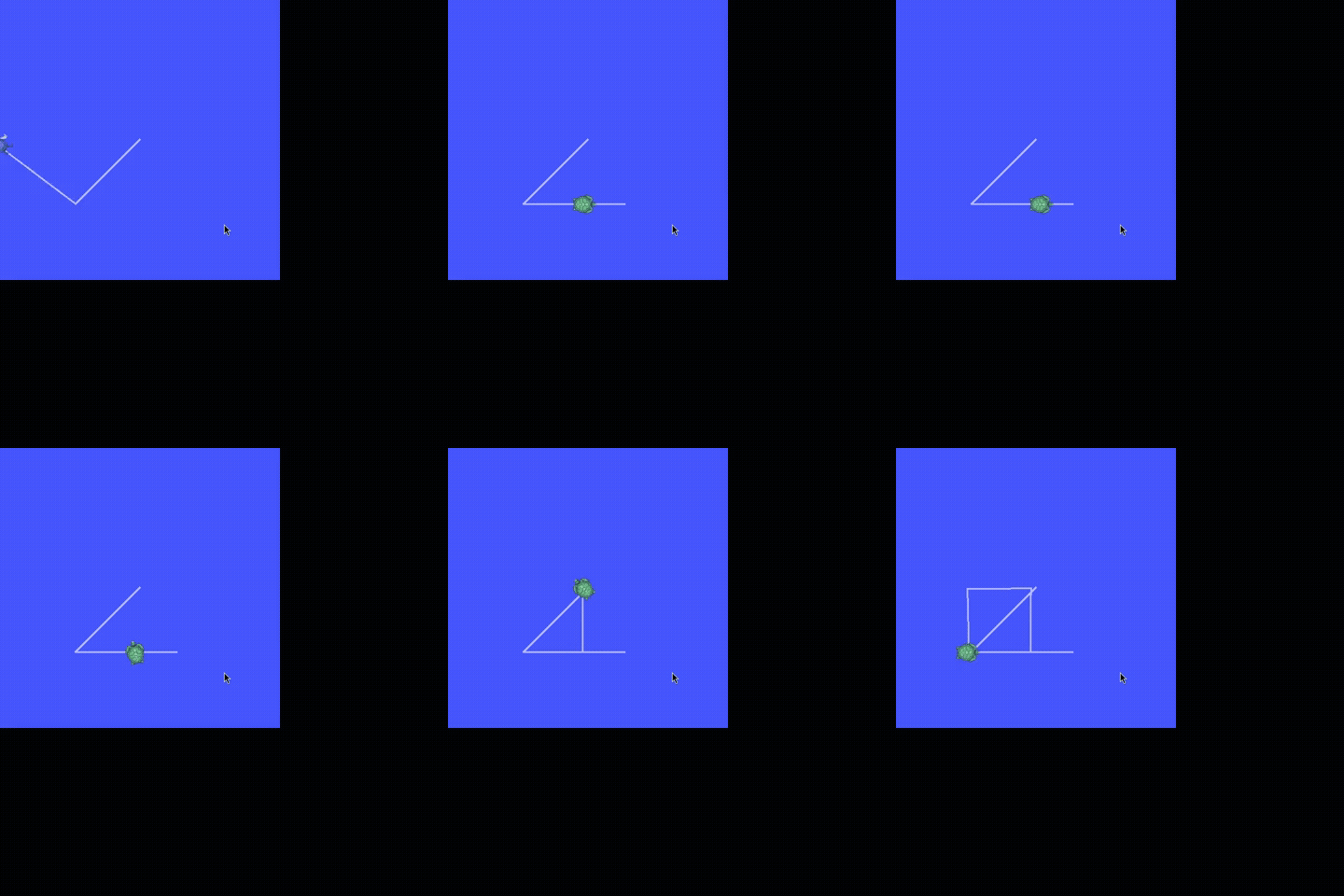
A Strands agent (Claude Opus via Amazon Bedrock) given the use_ros tool drives
a real ROS 2 turtlesim in a closed-loop square - reading pose, correcting
heading, re-driving - over 43 in-process tool calls. Runnable:
examples/ros2/use_ros/.
| Surface | What it does | Backend | Needs sourced ROS 2 |
|---|---|---|---|
use_ros |
List/echo/publish topics, call services on any ROS 2 graph | in-process rclpy |
yes |
use_rtps |
Join a graph as a DDS peer and act as a robot (publish topics a real stack consumes) | pure cyclonedds (pip) |
no - macOS/CI/Jetson, all distros |
RosBridgedRobot |
Drive a cmd_vel/odom ROS 2 base as a first-class strands Robot |
use_ros |
yes |
SimEngine(ros2_bridge=True) |
Publish a running MuJoCo sim's joint_states + camera image_raw so rviz/nav2/agents can subscribe |
rclpy |
yes |
# Observe + command a live ROS 2 graph, in plain English:
from strands import Agent
from strands_robots.tools import use_ros
Agent(tools=[use_ros])("list the topics, drive /turtle1 forward, confirm the pose changed")

# Or expose a simulation as a ROS 2 node any tool can subscribe to:
from strands_robots.simulation import Simulation
sim = Simulation(ros2_bridge=True)
sim.create_world(); sim.add_robot("so101")
sim.step(10)   # publishes /so101/joint_states + camera image_raw on the ROS 2 domain
rclpy ships with a sourced ROS 2 distro (not on PyPI). The [ros2] extra adds
only the pip-installable cyclonedds binding that use_rtps uses - so the
pure-RTPS path needs no ROS install at all. Every surface degrades to a clear,
structured error when its backend is unavailable; the default install never
touches ROS 2.
Configuration
Environment variables
| Variable | Description | Default |
|---|---|---|
STRANDS_ROBOT_MODE |
Robot() factory mode: sim / real / auto |
sim |
STRANDS_ASSETS_DIR |
Robot model asset cache directory | ~/.strands_robots/assets/ |
STRANDS_MEMORY_DIR |
Harness memory store (harness_memory tool: task solution traces + global success rules / failure models) |
~/.strands_robots/memory/ |
STRANDS_ROBOTS_RENDER_ROOT |
Sandbox directory that Simulation.render(output_path=...) may write into |
~/.strands_robots/renders/ |
STRANDS_ROBOTS_RENDER_ALLOW_ABS |
Set 1 to allow render(output_path=...) to write absolute paths outside the render sandbox |
unset |
STRANDS_ROBOTS_RENDER_MAX_BYTES |
Max PNG size render(output_path=...) will persist |
52428800 (50 MB) |
STRANDS_ROBOTS_VIDEO_ROOT |
Opt-in sandbox for video/recording output paths (run_policy(video=...), start_cameras_recording). Unset = absolute paths allowed (historic contract); set to confine writes |
unset |
STRANDS_ROBOTS_VIDEO_ALLOW_ABS |
Set 1 to re-permit absolute paths when STRANDS_ROBOTS_VIDEO_ROOT is set |
unset |
STRANDS_TRUST_REMOTE_CODE |
Set 1 to allow HF trust_remote_code for lerobot_local |
unset |
STRANDS_ROBOTS_NO_DYLD_SHIM |
Set 1 to disable the macOS auto-fix that puts Homebrew ffmpeg on the dyld path for torchcodec video streaming (see Recording & streaming datasets) |
unset |
MUJOCO_GL |
MuJoCo GL backend (egl, osmesa, glfw) |
auto |
STRANDS_ISAAC_HEADLESS |
Isaac Sim backend: run without a GUI. On (1/true/yes/on) = headless, off (0/false/no/off) = windowed, any other spelling is refused. Overrides IsaacConfig(headless=...) (#2062) |
unset (config default true) |
STRANDS_ISAAC_RTX_PATHTRACING |
Isaac Sim backend: on (1/true/yes/on) enables RTX path-tracing (photorealistic, slow) instead of the default render mode; off leaves the render mode alone, any other spelling is refused |
unset |
STRANDS_ISAAC_NUCLEUS_URL |
Isaac Sim backend: override the Omniverse Nucleus asset-server URL | unset (Isaac default) |
GROOT_API_TOKEN |
API token for the GR00T inference service | unset |
STRANDS_MESH |
Opt a bare Robot() into the Zenoh mesh: true/1/yes turns it on. false/0/no is a hard kill switch that also overrides an explicit mesh=True |
unset (mesh off) |
STRANDS_MESH_LOCAL_DEV |
Set 1 for a one-var localhost preset (auth none, no second factor needed) |
unset |
STRANDS_ROS2_BRIDGE_I_KNOW_THIS_IS_INSECURE |
Second factor to expose a Robot(ros2_transport="rtps") inbound joint_command surface with no dds_security_config (DDS Security). Truthy: 1/true/yes |
unset |
strands-robots[sim-isaac])
These are read by the built-in, in-tree Isaac Sim backend
(`pip install 'strands-robots[sim-isaac]'`) when it builds its
`IsaacConfig`. An explicit `create_simulation("isaac", ...)` kwarg wins for
`nucleus_url`; the two switches override their field whenever they are set
([#2062](https://github.com/strands-labs/robots/issues/2062)). Both switches
accept `1`/`true`/`yes`/`on` and `0`/`false`/`no`/`off` (case-insensitive,
surrounding whitespace ignored); unset or empty leaves the field alone and any
other spelling is refused. See
[`docs/simulation/isaac.md`](docs/simulation/isaac.md).
| Variable | Description | Default |
|----------|-------------|---------|
| `STRANDS_ISAAC_NUCLEUS_URL` | Override the Omniverse Nucleus server URL (when `nucleus_url` is not passed) | unset (Isaac defaults) |
| `STRANDS_ISAAC_HEADLESS` | On forces headless; off forces a window | unset (uses `headless` kwarg) |
| `STRANDS_ISAAC_RTX_PATHTRACING` | On forces `render_mode="rtx_pathtracing"`; off leaves `render_mode` alone | unset |
Benchmark / diagnostic env vars (LIBERO, GR00T bisection)
| Variable | Description | Default |
|----------|-------------|---------|
| `STRANDS_LIBERO_ACTION_LOG` / `_MAX` | Per-step OSC controller diagnostics | unset / `50` |
| `STRANDS_LIBERO_STATE_LOG` / `_MAX` | Per-step state values fed to GR00T | unset / `50` |
| `STRANDS_GROOT_WIRE_LOG` / `_MAX_CALLS` | Directory to dump pre/post inference payloads to, e.g. `/tmp/groot-wire`, to verify LOCAL vs SERVICE parity | unset / `10` |
Asset cache
~/.strands_robots/
└── assets/           # auto-downloaded MJCF + meshes
    ├── trs_so_arm100/
    ├── franka_emika_panda/
    └── ...
Clear with rm -rf ~/.strands_robots/assets/; relocate with
export STRANDS_ASSETS_DIR=/path/to/dir.
Benchmarks
strands-robots ships a LIBERO
benchmark integration on the MuJoCo backend - byte-equivalent to upstream
LIBERO at the model level, reaching success_rate >= 0.92 on libero-10/SCENE5.
Register declarative benchmarks from file and evaluate policies via the
list_benchmarks, register_benchmark_from_file, and evaluate_benchmark
simulation actions. Install with uv pip install "strands-robots[benchmark-libero]".
Project structure
strands_robots/
├── __init__.py            # Lazy-loaded public API (Robot, Simulation, policies)
├── robot.py               # Robot() factory (sim/real/auto dispatch)
├── hardware_robot.py      # HardwareRobot - async LeRobot control
├── policies/
│   ├── base.py            # Policy ABC
│   ├── factory.py         # create_policy() + runtime registration
│   ├── mock.py            # MockPolicy (non-VLA reference)
│   ├── groot/             # NVIDIA GR00T (ZMQ/HTTP client + data configs)
│   └── lerobot_local/     # Direct HuggingFace inference (RTC, processors)
├── registry/              # robots.json (70+) + policies.json + loaders
├── simulation/
│   ├── base.py            # SimEngine ABC
│   ├── factory.py         # create_simulation() + backend registry
│   ├── models.py          # SimWorld / SimRobot / SimObject / SimCamera
│   └── mujoco/            # MuJoCo backend (67-action AgentTool)
├── rendering/             # Hybrid rendering: CameraParams, backgrounds (panorama/3DGS),
│                          #   HybridCompositor, encode_clip / mjpeg_frames
├── mesh/                  # Zenoh mesh: core, sensors, input, audit, transport, iot
├── benchmarks/libero/     # LIBERO suite + BDDL parser + adapter
└── tools/                 # gr00t_inference, lerobot_*, pose, serial, robot_mesh
Development
uv pip install -e ".[all,dev]"

hatch run test          # unit tests
hatch run test-integ    # integration tests (GPU + model weights)
hatch run lint          # ruff check + format --check + mypy
hatch run format        # ruff check --fix + ruff format
Python 3.12+ required. See AGENTS.md for conventions and the accumulated code-review learnings.
Security
Found a vulnerability? Do not open a public issue. Follow the disclosure process in SECURITY.md (AWS VDP / HackerOne).
Note the trust_remote_code gate on lerobot_local (see
Policy providers) and the mesh CA-pinning / thing-name
validation controls in the Configuration matrix.
Contributing
Issues and PRs welcome. Track work on the Strands Labs - Robots project board; it is the source of truth for roadmap and follow-ups.
License
Apache-2.0 - see LICENSE.