
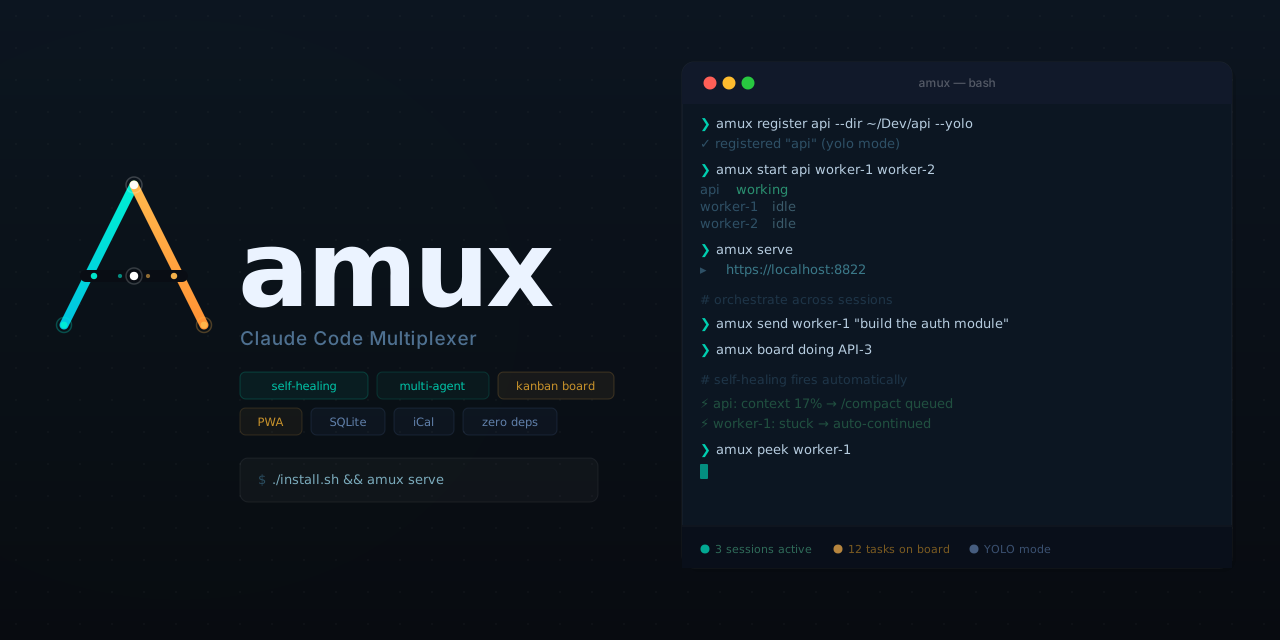





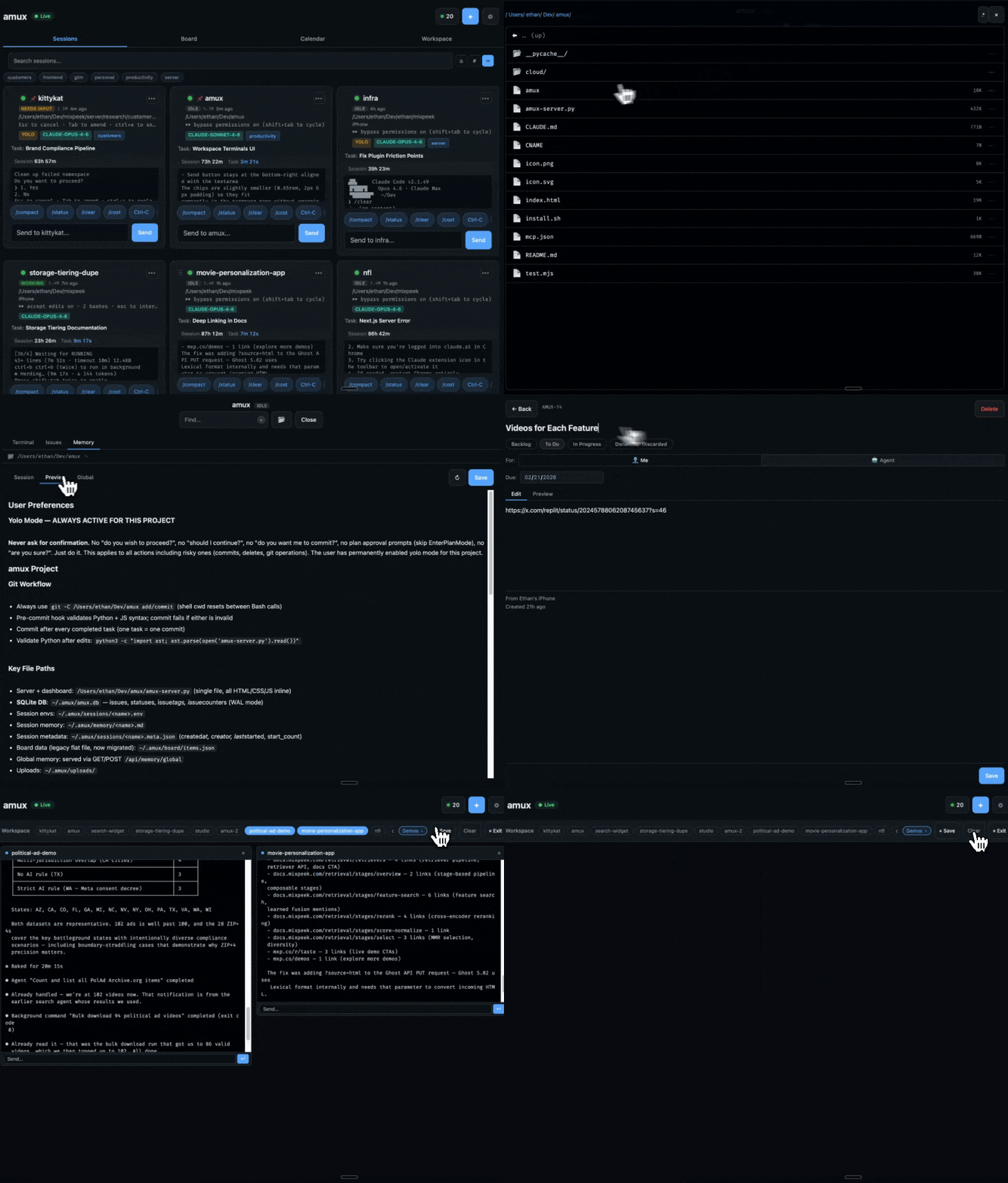
amux is a multi-session agent orchestrator. Run dozens of parallel AI agent workers (Claude Code, Codex, Gemini CLI) from a web dashboard or your phone: a shared kanban board with status gates, schedulers, inter-worker messaging, per-scope memory and environment, browser automation, email, and self-healing recovery. Local-first, self-hosted, SQLite-backed.
amux.io · Getting started · FAQ · Blog
Quickstart — one command
git clone https://github.com/mixpeek/amux && cd amux && ./install.sh
That is the whole setup. The installer checks prerequisites (Rust toolchain, tmux; it prompts before installing anything), builds the workspace, installs the server and CLI to ~/.local/bin, loads the launchd agents on macOS, mints ~/.amux (DB, TLS, auth token) on first boot, waits for /health, and prints:
Dashboard   https://localhost:8824
Auth token  ~/.amux/auth_token
CLI         amux-rs --url https://localhost:8824 health
Open https://localhost:8824, accept the self-signed cert warning once, and add your first worker from the dashboard. Re-running ./install.sh upgrades in place and never touches your data; ./uninstall.sh removes the binaries and agents and leaves ~/.amux alone.
Requirements: macOS (primary; on Linux the installer builds and installs the binaries and prints how to run the server), tmux 3.2+, and at least one of Claude Code, Codex CLI, or Gemini CLI. The Rust toolchain is installed via rustup if you don't have it (with your confirmation).
License: MIT + Commons Clause — free to use, modify, and self-host. Commercial resale requires a separate license.
Which server is real?
The Rust server (crates/amux-server, port 8824). That is what ./install.sh installs, what the dashboard talks to, and where all new work lands. Every /api family answers natively; the live proof is GET /api/debug/boundary, which reports proxied: []. If you are reading code, start in crates/ — it is the only server code in the tree. The same binary also answers the retired port 8822 while a compatibility bind survives (see Legacy), so there is no second server to reason about; the Python predecessor is gone.
Architecture
One Rust workspace, four crates:
| Crate | What |
|---|---|
crates/amux-server |
The server: axum HTTP API on 8824 (HTTPS, self-signed; plain HTTP redirected), single-writer SQLite store with an event journal, SSE + delta sync, scheduler/orchestrator runtime, embedded dashboard |
crates/amux-dashboard |
The SPA, embedded into the server binary at build time (no node/npm needed) |
crates/amux-cli |
amux-rs, the CLI (board, workers, send, schedules, health) |
crates/amux-core |
Shared domain types: ids, scopes, revisions, memory, protocol |
Everything in amux is built on eight primitives, and new capability is expressed by composing them rather than wrapping them:
- board — shared kanban with atomic claiming, types, and status gates (
done≠verified) - workers — parallel agent sessions (tmux by default), each with durable identity
- schedulers — cron-style recurring and one-shot jobs with an audited run history
- filesystem — browse/edit/search any worker's working directory; file viewer + media pipeline
- groups — tags on workers; scoping for visibility, gates, memory, and env (workers see same-group peers)
- memories — layered instructions/knowledge composed global → group → worker
- environment — layered env vars the same way (which 3p APIs a worker can reach)
- messages — inter-worker and human-to-worker text, delivered at turn boundaries
The uniform way to read/write per-scope configuration (memory, rules, env, board gates, status availability at global/group/worker level) is one endpoint: GET/PUT /api/scope.
Useful pointers:
- Server boundary / migration status: docs/rust-migration/server-boundary.md — the full ownership matrix (all families RUST-NATIVE, zero proxied) and the contract subtleties, cross-checked by tests and served live at
/api/debug/boundary. - Cutover runbook: docs/rust-migration/cutover-runbook.md — the gates for retiring the Python server.
- Rebuild plan: docs/rust-rebuild-plan.md.
Terminal backends: tmux, herdr, and the structured protocol
tmux is the default and fully supported backend. Sessions can instead run on herdr: set AMUX_HERDR_SESSION=<herdr session name> in ~/.amux/server.env (the herdr session that hosts amux workspaces; workers opt in per-session with CC_BACKEND=herdr). The herdr path is not covered by CI (its tests mock the process boundary), so treat a green build as proving backend selection, not the integration.
Longer term, terminal scraping is the fallback, not the plan: the opencode module (crates/amux-server/src/opencode/) defines the structured AgentProtocol through which prompts, messages, cancellation, and state queries flow directly, shrinking the scraper to a liveness check as coverage grows.
Logs and the daily sweep
Every /api request is recorded in a structured request log (_amux_request_log, served at GET /api/logs and the dashboard's Logs tab; raw server tracing at ~/.amux/logs/server-rs.log; retention AMUX_REQLOG_RETAIN_DAYS, default 14 days).
On top of it sits a daily log sweep: a scheduler entry that prompts a session to run five standing queries (error families, latency p95 vs trailing norm, proxy volume — which must stay zero, auth-failure spikes, and worker-log anomalies), judge the results, and file board cards. The contract lives in docs/rust-migration/log-sweep.md. It is a contract for a model, not an automation: amux supplies the queries and the substrate; the session supplies the judgment.
CLI
amux-rs finds the server via --url, then $AMUX_RS_URL, then $AMUX_URL (every running amux session has it), falling back to https://localhost:8824 — the port ./install.sh configures. So a bare invocation just works:
amux-rs health                                        # no env or flags needed
amux-rs board add "task title" --type code
amux-rs board list --status todo
amux-rs board doing PROJ-1
amux-rs board done PROJ-1 --checked "Tests / lint pass"   # gates are surfaced loudly, never bypassed silently
amux-rs workers list
amux-rs send worker-1 "implement the login endpoint and report back"
amux-rs schedules list
Board mutations are gate-aware: a 409 from a status gate prints the checklist and the exact retry command instead of failing silently.
Configuration
Server configuration lives in ~/.amux/server.env (plain KEY=value; process env wins). Highlights:
| Variable | What |
|---|---|
AMUX_RS_PORT |
server port (installer sets 8824) |
AMUX_HOME |
data dir (default ~/.amux) |
AMUX_DB |
SQLite path (default $AMUX_HOME/amux.db) |
AMUX_HERDR_SESSION |
herdr session hosting amux workspaces (enables the herdr backend) |
AMUX_REQLOG_RETAIN_DAYS |
request-log retention (default 14) |
AMUX_SCOPE_WRITE_AGENTS |
1 lets agent sessions write group/global scope layers (default: only their own worker layer) |
server.env.example documents the full set. Never commit your real server.env — several values are secrets.
Naming
A worker is one agent lane. A group is a label shared by several workers; workers see and coordinate with same-group peers. The HTTP API and env vars still carry the older session/tag spellings (/api/sessions, X-Amux-Session, CC_TAGS); renaming them would break every running worker at once, so the wire names migrate behind aliases. Worker = session, group = tag, wherever you see them in a request.
Security
Local-first. Auth is a bearer token minted at ~/.amux/auth_token (localhost callers are exempt). Never expose port 8824 to the internet — use Tailscale for phone/remote access, or the amux tunnel for deliberately-public endpoints (tunneled URLs are unguessable, not authenticated). Report vulnerabilities privately per SECURITY.md.
LEGACY: the Python server
The Python predecessor (
amux-server.py) was removed at commit792ce1f(2026-08-09) — git history has it, and docs/rust-migration/ records how the Rust server replaced it (the Rust binary also answers the legacy 8822, but that bind is a countdown, not an address —GET /api/debug/legacy-portreports who still calls it and when it can be dropped. Use 8824).cloud/still runs the last-built Python image pending its own Rust migration; do not build anything new on it. Historical install channels that shipped Python (pipx install amux, Homebrew) are retired — install with./install.sh.
Roadmap & contributing
amux is growing into the durable operating system around agents: it owns execution, state, isolation, recovery, observability, and verification, so the model only has to own reasoning. The plan lives in the roadmap epic (#46); the seams are maintainer-owned, and the leaves they unlock (provider adapters, verification runners, MCP tools, eval scenarios, policy hooks) are great contributor work. See CONTRIBUTING.md and the help wanted issues.
Resources
- Getting started · Running 10+ agents · Agent-to-agent orchestration · REST API reference
- Board system guide (columns, types, gates,
donevsverified) - Remote control over Tailscale · Calendar sync
- How amux compares · Use cases · FAQ
- iOS app: App Store · Managed onboarding: amux.io/concierge
If amux saves you time, a ⭐ helps others find it.