AEGIS
OS-level oversight for AI coding agents
Open-source monitor that shows what AI coding agents actually do on your machine — at the OS level, no agent hooks required.
AEGIS sees every AI agent on your machine — even ones that don't cooperate. It is an independent, OS-level observer that watches agent processes, file access, network activity, and behavioral anomalies in real time, regardless of how the agent was launched. Built on a CommonJS JavaScript monitoring engine, with TypeScript in the renderer and in the shared types. Open-source, local, no telemetry — everything stays on your machine.
"Kaspersky found 512 bugs in OpenClaw. So we built an EDR to monitor it."






Download · Report Bug · Feature Request · Contributing
What Does Aegis Monitor?
- Process Monitoring — Tracks 110 known AI agent signatures with parent-child tree resolution and IDE host detection.
- File System Access — Watches sensitive directories (
.ssh,.aws,.gnupg,.env, cloud configs) and 35 registered AI agent config paths for unauthorized access. - Network Activity — Logs outbound TCP connections per agent PID with reverse DNS and known-vs-unknown API endpoint classification.
- Behavioral Analysis — Applies 73 detection rules across 8 categories with rolling 10-session baselines and 4-axis anomaly scoring.
- Trust Scoring — Assigns real-time risk scores with trust grades (A+ through F) using time-decay algorithms and multi-dimensional threat assessment.
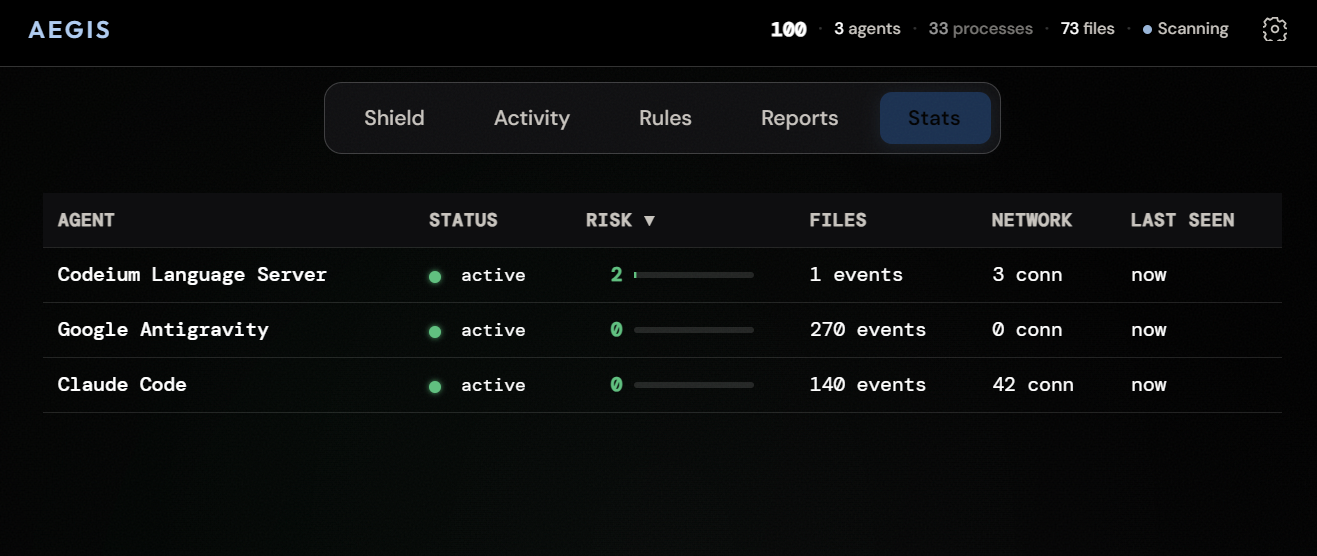
- Multi-Agent Dashboard — Displays all 110 agents in a bento-grid dashboard with sparklines, risk rings, activity feeds, and expandable agent cards.
Why Aegis?
| 512 | vulnerabilities found in OpenClaw by Kaspersky — autonomous agents ship with real security risks |
| 0 | open-source EDR tools existed for AI agents before Aegis |
| 110 | AI agent signatures in the detection database, from Claude Code to AutoGPT |
| 73 | behavioral detection rules across 8 categories, hot-reloaded on edit |
| 1075 | tests passing, 0 failures — the monitoring engine is verified on every commit |
| <2s | cold boot to full dashboard — lightweight enough to run alongside the agents it monitors |
AI agents now have deep access to your machine — files, commands, network. Every existing AI security tool is enterprise SaaS that monitors what humans send to AI. Nobody monitors what AI agents do on local machines. Aegis is the open-source answer.
Why AEGIS is different
Most AI-agent oversight tools work by hooking inside the agent itself — a Claude Code plugin, a Cursor extension, an SDK wrapper. Sage (Gen Digital), leash, and Microsoft's Agent Governance Toolkit all live in the agent's runtime. That has a structural blind spot: they only see agents that installed their hook. An agent launched a different way — a raw python autogpt.py, a binary you didn't wrap, a tool that simply doesn't cooperate — is invisible to them.
AEGIS sits at a different layer. It is an independent, OS-level observer: it watches process, file, and network activity from outside the agents, so it catches any agent on the machine regardless of how it was started or whether it wants to be watched. Hook-based tools and AEGIS are complementary — one instruments the agents that opt in, the other sees the whole machine.
Monitor-first
AEGIS is a camera, not a guard. It observes and logs — it does not block agents at the OS level today. There are no kernel hooks and no automatic enforcement. Process control (kill / suspend / resume) is manual and user-invoked only. Active blocking is on the roadmap, not in the current release. Use AEGIS for visibility, auditing, and anomaly detection — pair it with sandboxing when you need enforcement.
What It Monitors
| Layer | How |
|---|---|
| Processes | 110 known AI agent signatures, parent-child tree resolution, IDE host detection |
| Files | Watches .ssh, .aws, .gnupg, .env*, cloud configs, 35 registered AI agent config dirs |
| Network | Outbound TCP per agent PID, reverse DNS, known API endpoints vs unknown |
| Behavior | Rolling 10-session baselines, 4-axis anomaly scoring (Network/FS/Process/Baseline) |
| Local LLMs | Ollama, LM Studio, vLLM, llama.cpp runtime detection |
How It Compares
| AEGIS | Lasso / Prompt Security / PromptArmor | |
|---|---|---|
| Runs locally | Yes | Cloud |
| Open source | MIT | No |
| Free | Yes | Enterprise |
| Monitors file access | Yes | No |
| Detects local LLMs | Yes | No |
AEGIS is the only open-source, local-first AI agent monitor.
Download
From Source (all platforms)
git clone https://github.com/antropos17/Aegis.git
cd Aegis
npm install
npm start
Requires Node.js 18+ and npm 9+. Windows 10/11 recommended. macOS/Linux experimental (#37).
Try Without AI Agents
Don't have AI agents running? Demo mode lets you explore the full dashboard with simulated data — no real monitoring, no real processes.
npm run build:demo && npm start
Demo mode runs a scenario engine that cycles through four threat phases — calm → elevated → critical → reset — with up to 12 simulated AI agents (Claude Code, Copilot, Cursor, and more). File access events, network connections, anomaly scores, and risk assessments are all generated in real time so every tab and feature is fully functional.
Use it to evaluate AEGIS before deploying, demo the UI to your team, or develop new features without needing a live Windows environment.
Windows Installer
Pre-built .exe installer is coming in a future release. Track progress in Releases.
Release History
| Version | Date | Highlights |
|---|---|---|
| v0.10.0-alpha | 2026-03-09 | Code cleanup, security hardening, command palette |
| v0.9.1-alpha | 2026-03-08 | Dropdown dedup, skill paths, aegis-context optimized |
| v0.9.0-alpha | 2026-03-08 | categoryIndex, prompt-craft skill, TS migration stores |
| v0.8.2-alpha | 2026-03-08 | formatBytes TS extraction, meaningful tests, branch cleanup |
| v0.8.1-alpha | 2026-03-07 | Patch release |
| v0.8.0-alpha | 2026-03-05 | Launch readiness: CSP hardened, OpenClaw integration, README overhaul |
| v0.7.0-alpha | 2026-03-04 | YAML rulesets, 68 rules, hot-reload, 568 tests |
| v0.5.0-alpha | 2026-03-03 | Fancy UI redesign, VisTimeline, AgentGraph |
| v0.4.0-alpha | 2026-03-03 | TypeScript infrastructure, perf, refactoring |
Features
Detection — 110 agent signatures, parent chain resolution, config dir protection, per-agent risk scoring with trust grades (A+ through F), HTTP/User-Agent scoring, local LLM detection, false positive marking
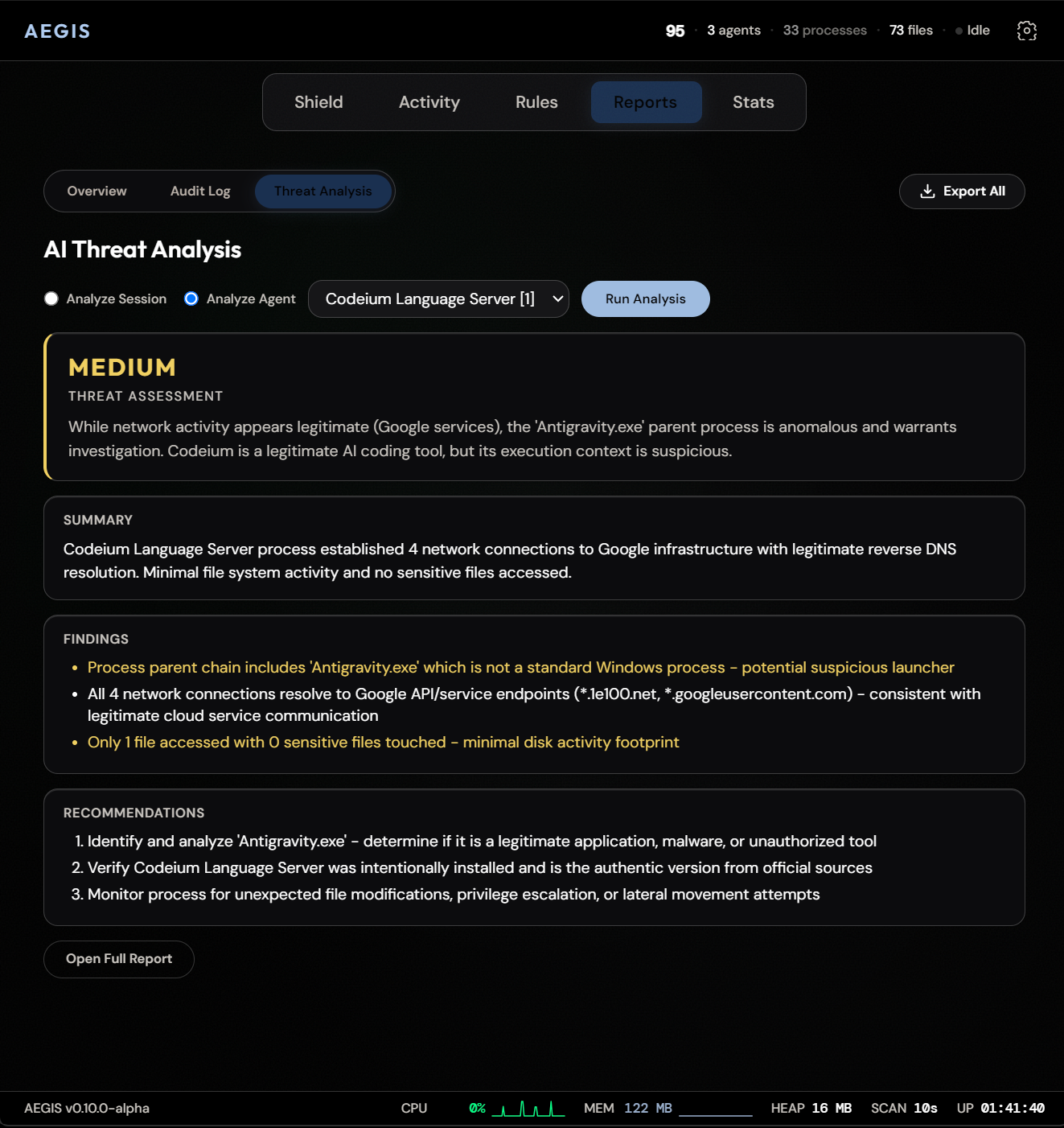
Analysis — Behavioral baselines with rolling averages, multi-dimensional anomaly detection, AI threat assessment via Anthropic API (opt-in), printable HTML threat reports
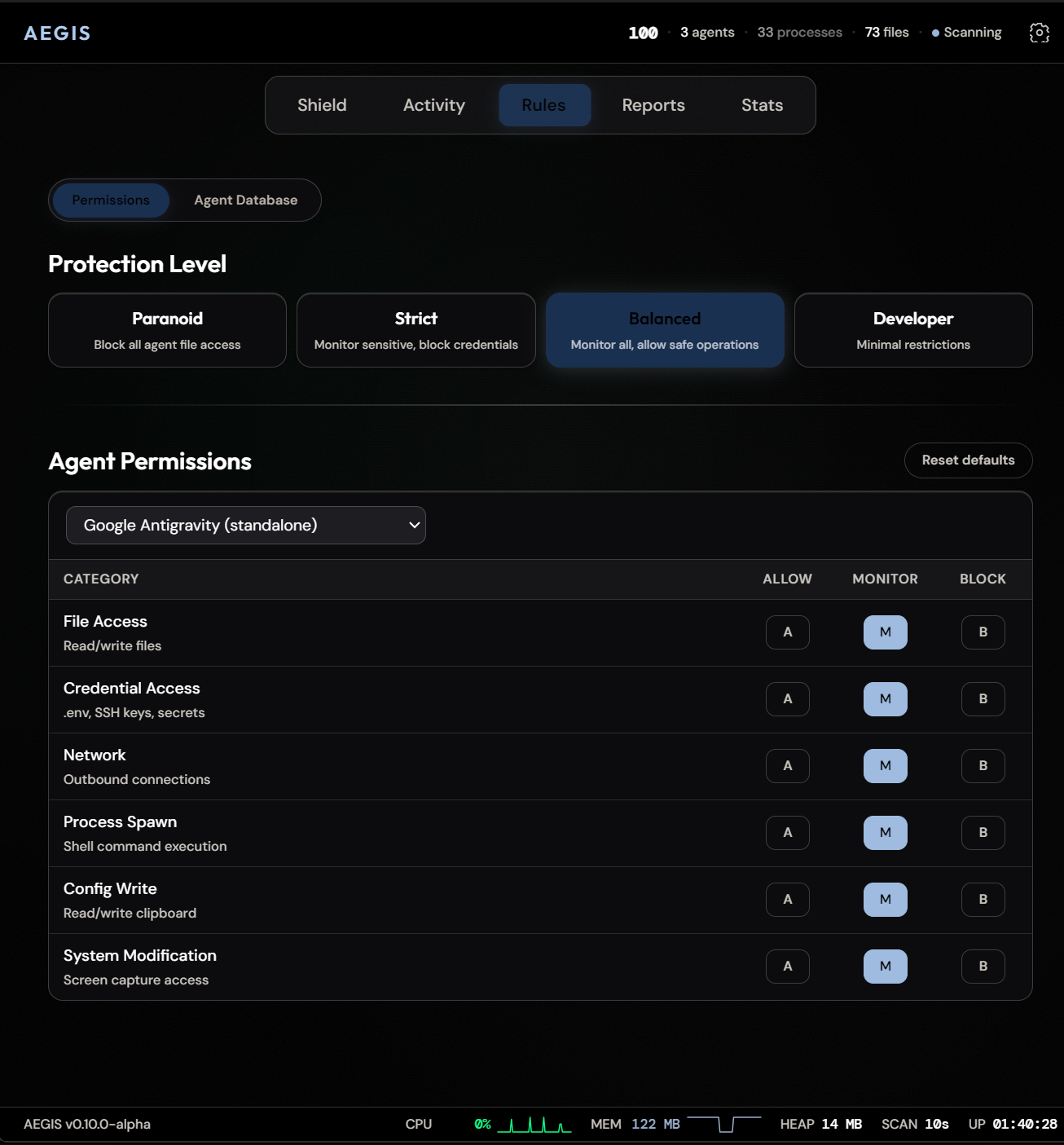
Dashboard — Bento grid dashboard — RiskRing gauge, Sparklines, TrustBadge, agent stats, activity feed with filters, session timeline, agent cards with expandable details, protection presets (Paranoid/Strict/Balanced/Developer), dark/light theme, toast notifications, OOM protection, keyboard shortcuts (Ctrl+1-4)
Export — JSON, CSV, HTML reports, one-click ZIP archive, JSONL audit logging (daily rotation, 30-day retention)
i18n — Internationalization with English base (230 strings in en.json), community translations welcome
CLI — --scan-json for scripting, --version, --help
YAML Rulesets
- 73 detection rules across 8 categories (AI config, secrets, SSH, cloud, browser, devtools, crypto, certificates)
- Validated against
rules/_schema.json; editing a ruleset hot-reloads without a restart - Extend by adding a
.yamltorules/. Rule IDs must be unique — a duplicate ID is skipped, not overridden. A newly added file is picked up on the next reload or restart, since the watcher reacts to changes in existing top-level files
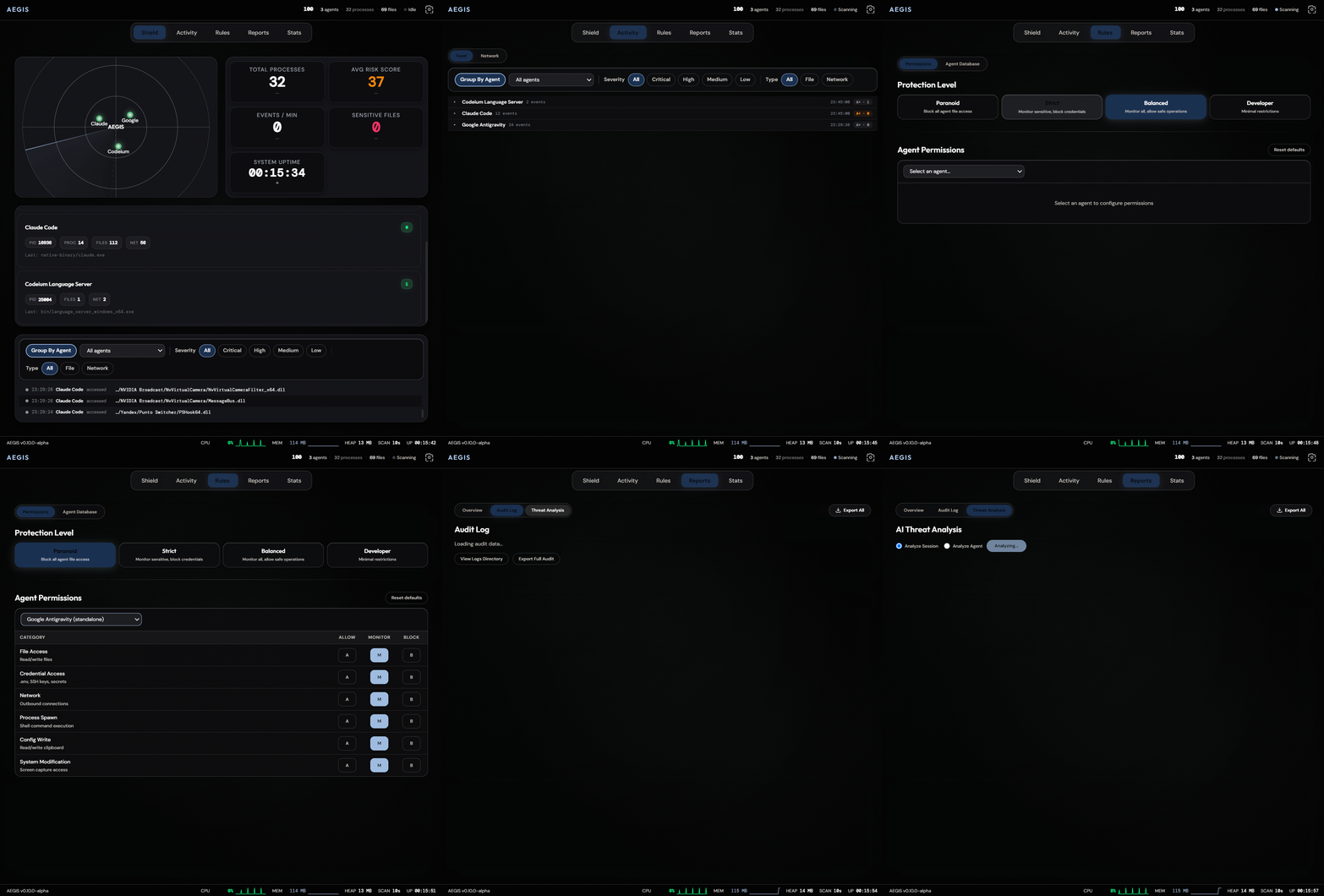
Screenshots
📸 Shield — Real-time Overview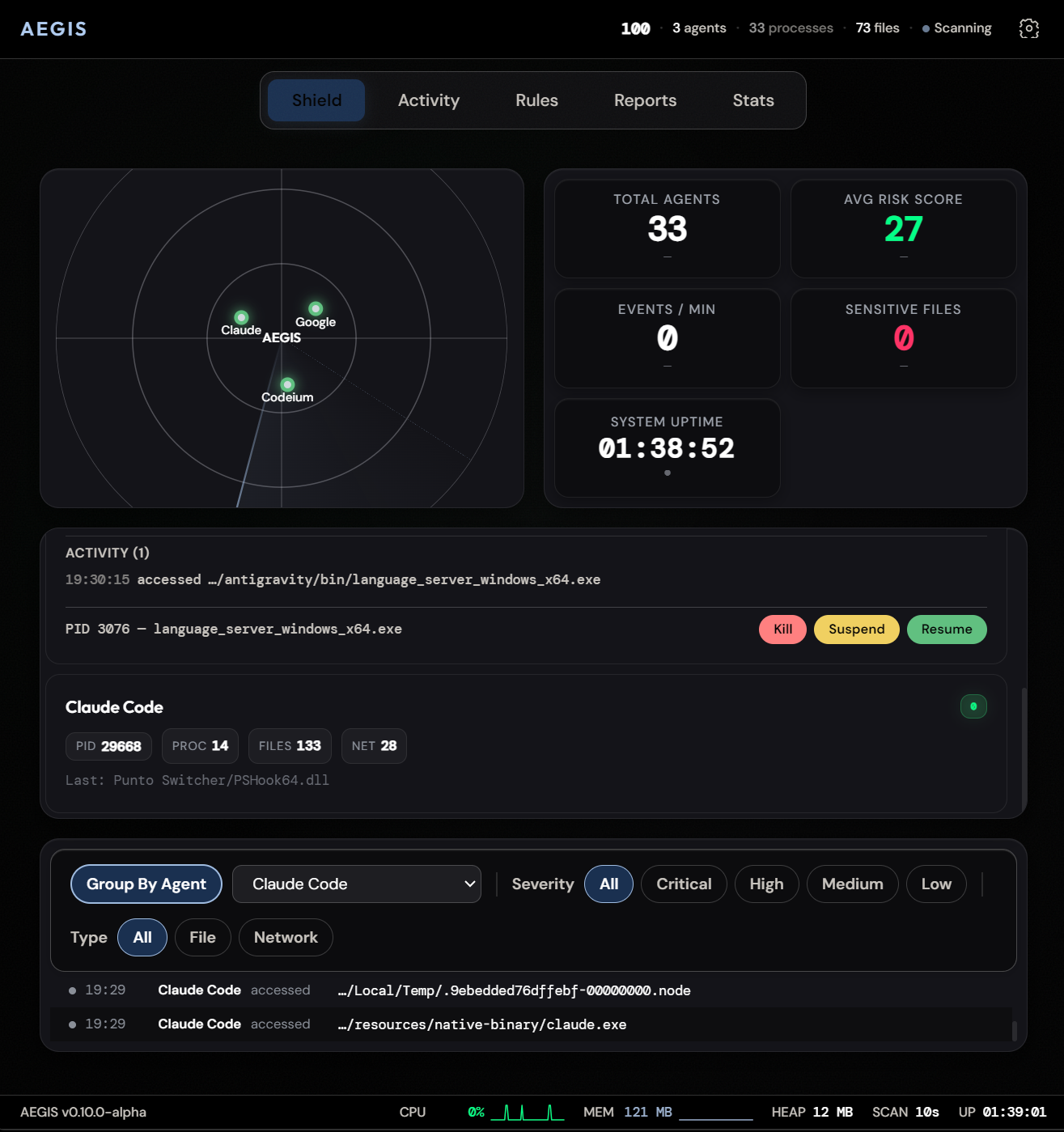 📸 Activity Feed
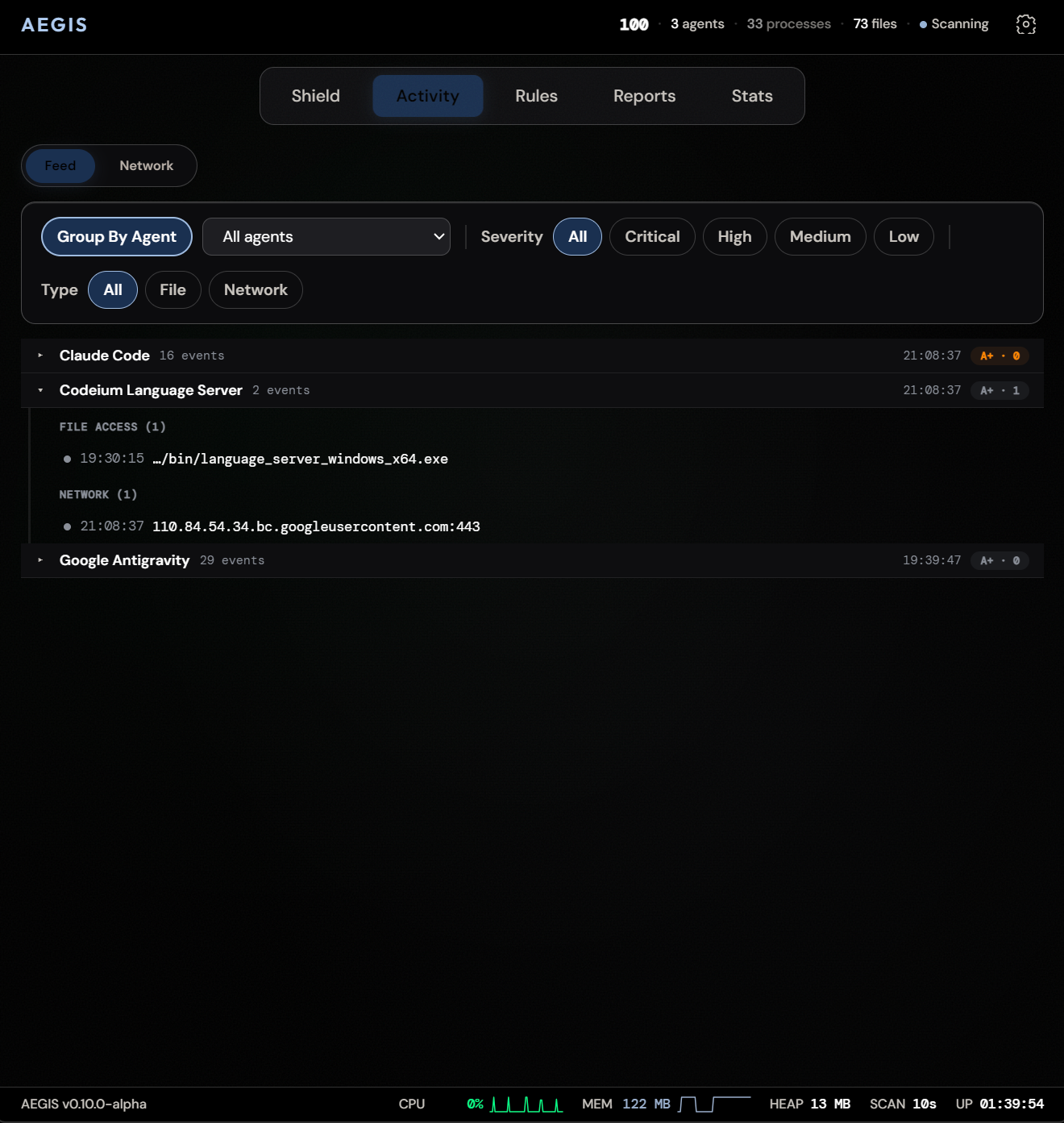 📸 Rules & Permissions
 📸 Reports & Export
 📸 Agent Statistics
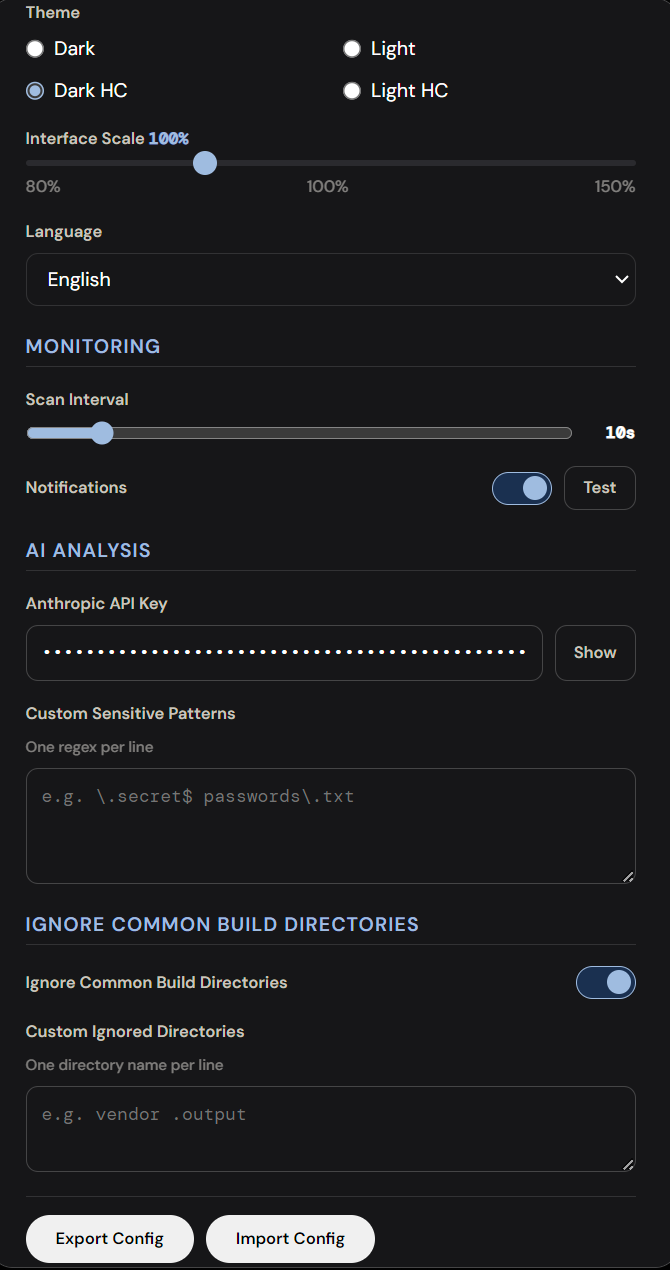
 📸 Settings
Architecture
┌─────────────┐    ┌─────────────┐    ┌─────────────┐    ┌─────────────┐
│   Process    │    │    File     │    │   Network   │    │     LLM     │
│   Scanner    │    │   Watcher   │    │   Monitor   │    │  Detector   │
│  (tasklist)  │    │ (chokidar)  │    │ (NetTCP+DNS)│    │(Ollama/LMS) │
└──────┬───────┘    └──────┬──────┘    └──────┬──────┘    └──────┬──────┘
       │                   │                  │                  │
       └───────────┬───────┴──────────┬───────┘                  │
                   │                  │                           │
            ┌──────▼──────┐    ┌──────▼──────┐                   │
            │  Baseline   │    │   Anomaly   │◄──────────────────┘
            │   Engine    │    │  Detector   │
            │(10-session) │    │  (4-axis)   │
            └──────┬──────┘    └──────┬──────┘
                   │                  │
            ┌──────▼──────┐    ┌──────▼──────┐    ┌─────────────┐
            │    Risk     │    │   Audit     │    │     CLI     │
            │   Engine    │    │   Logger    │    │ (--scan-json│
            │(time-decay) │    │  (JSONL/30d)│    │  --version) │
            └──────┬──────┘    └──────┬──────┘    └─────────────┘
                   │                  │
            ┌──────▼──────┐    ┌──────▼──────┐
            │  Dashboard  │    │ ZIP Writer  │
            │ (Svelte IPC)│    │ (export)    │
            └─────────────┘    └─────────────┘
Stack: Electron 33, Svelte 5, Vite 7, Vitest (1075 tests across 68 files). The monitoring engine is JavaScript (CommonJS); TypeScript is used in the renderer and shared types.
Agent Database
110 agents in src/shared/agent-database.json:
Coding — Claude Code, GitHub Copilot, Cursor, Windsurf, Tabnine, Amazon Q, Cody, Aider Autonomous — OpenClaw, Devin, Manus AI, OpenHands, SWE-Agent, AutoGPT, BabyAGI, CrewAI Desktop — Anthropic Computer Use, Google Gemini, Apple Intelligence, Microsoft Copilot Frameworks — LangChain, Semantic Kernel, AutoGen, MetaGPT, TaskWeaver Local LLMs — Ollama, LM Studio, vLLM, llama.cpp, LocalAI, GPT4All, Jan
Add custom agents via the UI or edit the JSON. See AGENTS.md.
Roadmap
Everything below is planned, not shipped. AEGIS today is monitor-only (see Monitor-first).
- [ ] Active blocking — enforce rules on violation (today: observe & log only)
- [ ] OS-level enforcement / kernel hooks (Windows Minifilter, macOS Endpoint Security, Linux eBPF)
- [ ] MITRE ATT&CK mapping for detection rules
- [ ] ML-based anomaly detection (today: hard-coded heuristic weights)
- [ ] TLS / encrypted-traffic visibility, with user consent (today: TCP endpoints only)
- [ ] First-class macOS & Linux support (currently experimental — #37)
- [ ] GPU monitoring for local inference detection
- [ ] Per-process file attribution (ETW, fanotify)
- [ ] Container/VM detection (Docker, WSL)
- [ ] Browser extension for web-based AI agents
- [ ] Auto-update mechanism
- [x] i18n / localization (#53)
Frequently Asked Questions
What is Aegis?
Aegis is an open-source endpoint detection and response (EDR) tool purpose-built for monitoring AI agents. It tracks processes, file access, network activity, and behavioral anomalies in real time, built on Electron 33 and Svelte 5. The monitoring engine is CommonJS JavaScript; the renderer is ES modules, and TypeScript is used in the renderer and the shared type definitions. All data stays local — no telemetry, no cloud dependency.
Why do AI agents need monitoring?
Autonomous AI agents like OpenClaw, AutoGPT, and Devin have deep access to local files, credentials, and shell commands — yet run with minimal oversight. Kaspersky's analysis found 512 bugs in OpenClaw alone. Aegis provides the missing observability layer so you can see exactly what agents do on your machine.
How is Aegis different from traditional EDR?
Traditional EDR tools (CrowdStrike, Sentinel One) monitor human-driven threats — malware, ransomware, phishing. Aegis is built specifically for AI agent behavior: it ships with 110 agent profiles, 73 detection rules tuned for agent-specific patterns, and behavioral baselines that track how each agent's activity changes over time.
Does Aegis work with MCP tools?
Yes. Aegis monitors any AI agent process running on your machine, including tools connected via the Model Context Protocol (MCP). If an MCP-connected tool spawns processes, accesses files, or makes network calls, Aegis will detect and score that activity.
Is Aegis a replacement for sandboxing?
No. Aegis is an observability layer, not a restriction layer. Sandboxes limit what agents can do; Aegis shows you what agents are doing. They are complementary — use sandboxing for enforcement and Aegis for visibility, auditing, and anomaly detection.
What agents does Aegis support?
Aegis ships with 110 agent signatures across five categories: coding assistants (Claude Code, Copilot, Cursor), autonomous agents (OpenClaw, AutoGPT, CrewAI, Devin), desktop AI (Gemini, Apple Intelligence), frameworks (LangChain, AutoGen, MetaGPT), and local LLMs (Ollama, LM Studio, llama.cpp). You can add custom agents via the UI or JSON config.
Can I use Aegis in production?
Aegis is currently at v0.10.0-alpha and is recommended for development and testing environments. The core monitoring engine is stable with 1075 tests passing, but production deployment features (auto-update, OS-level enforcement) are on the roadmap for v1.0.
Is Aegis free?
Yes. Aegis is released under the MIT license with no telemetry, no cloud requirements, and no paid tiers. The full source code is available on GitHub.
Contributors
 Antropos7 |
 Elshad Humbatli |
 Steven Melendez |
 travisbreaks |
 raye-deng |
 KJyang-0114 |
CONTRIBUTING.md · SECURITY.md · CODE_OF_CONDUCT.md
Support
If Aegis is useful to you, consider giving it a star on GitHub — it helps others discover the project.
Teams & Enterprise — Need centralized dashboards, SIEM integration, or managed deployment? We're building it. Get notified
License
Star History