
Ouroboros









Ouroboros is an open-source, general-purpose AI agent whose identity, durable memory, and history continue across tasks and restarts. It works on external projects, coordinates a live swarm of specialist agents, and can rewrite the implementation it runs on, including its code, architecture, prompts, tools, and dependencies. Reflection can also change how it understands itself without severing that continuity.
It runs as a native desktop app or through a headless CLI. The runtime keeps its repository, durable memory, history, and interface on your machine, while model inference can use remote APIs you configure or a local GGUF model.
Changing Ouroboros? Coding agents and people must read CONTRIBUTING.md before editing. It defines the required project context, verification, and separate-agent review flow.
Download Ouroboros
Just want to use Ouroboros? Click the download for your platform below. You do not need to clone this repository or install Python or uv.
- macOS 12+ on Apple silicon: Download for macOS (.dmg)
- Windows x64: Download for Windows (.zip)
- Debian, Ubuntu, or Astra Linux x86_64: Download the Debian package (.deb)
- Fedora or RHEL x86_64: Download the RPM package (.rpm)
- RED OS 8 x86_64: Download the RED OS package (.rpm)
- Other Linux x86_64: Download the portable AppImage or the tar.gz archive
Files named SHA256SUMS, release-evidence.json, release-smoke-*.json, and sbom-*.cdx.json are verification evidence, not additional installers.
macOS quick start
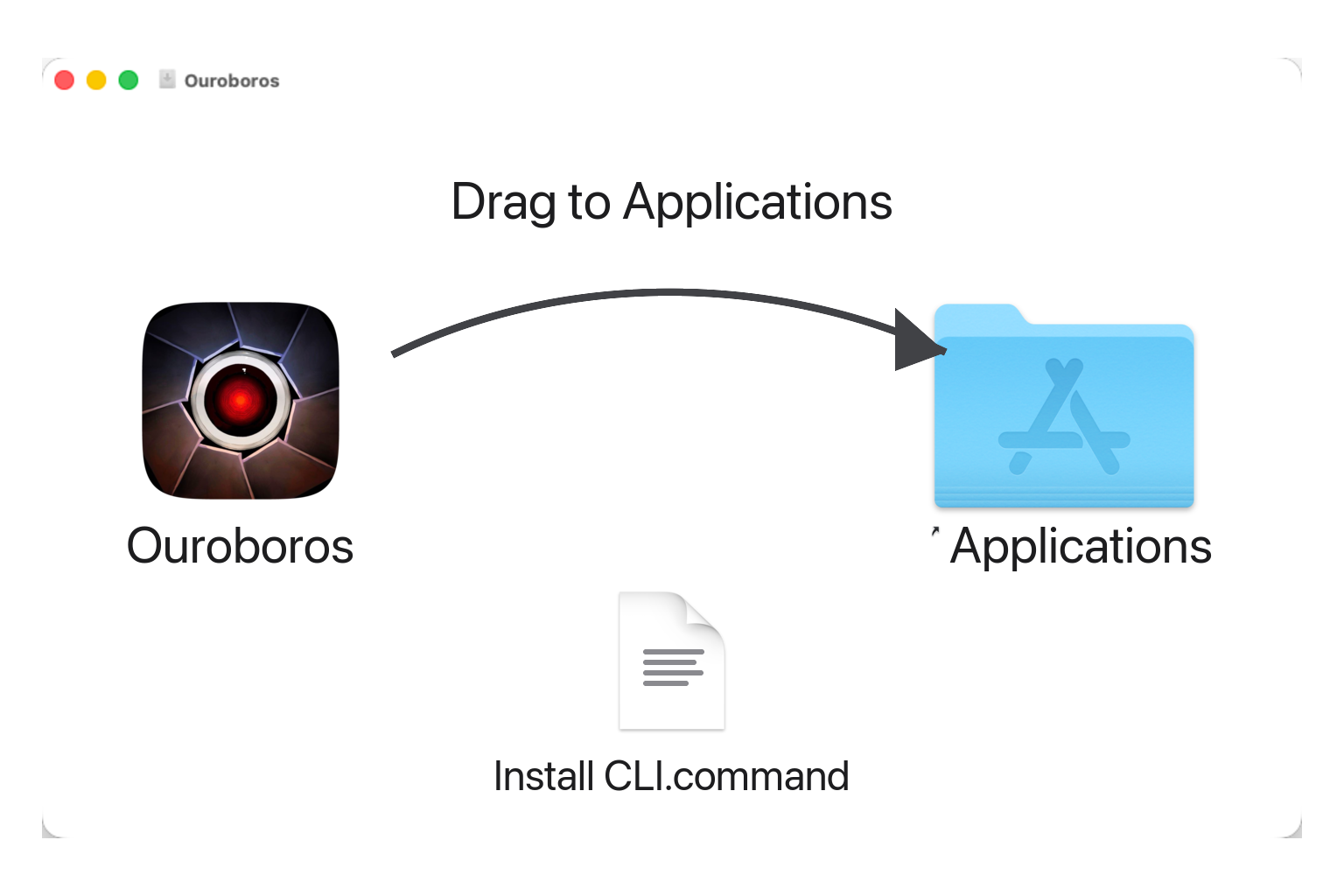
- Click Download for macOS (.dmg). The current file is named
Ouroboros-<version>.dmg. - Open the DMG and drag
Ouroboros.apponto the Applications shortcut. - Open Ouroboros from Applications. If Gatekeeper asks, right-click the app and choose Open.
Windows quick start
- Click Download for Windows (.zip).
- Extract the ZIP.
- Open the extracted
Ouroborosfolder and runOuroboros.exe.
Linux quick start
- On Debian, Ubuntu, or Astra Linux, download the
.debabove and runsudo apt install ./ouroboros_*_amd64.deb. - On Fedora or RHEL, download the generic
.rpmabove and runsudo dnf install ./ouroboros-*.x86_64.rpm. RED OS 8 has its ownred80package. - On another x86_64 distribution, download the AppImage, make it executable with
chmod +x Ouroboros-*.AppImage, and run it. Git must already be installed.
To run tasks, configure at least one supported remote provider API key or a local GGUF model. The first-run wizard guides model access, review policy, and budget setup.
Optional CLI included with desktop downloads The desktop packages already contain an optional CLI installer. On macOS, after copying the app to Applications, double-click `Install CLI.command` in the mounted DMG. On Linux use `./Ouroboros/bin/install-ouroboros-cli`; on Windows use `Ouroboros\bin\install-ouroboros-cli.cmd`. These installers create a user-local `ouroboros` command without sudo. You do not need Python or uv.Ouroboros bundles Claudexor as its local execution layer for delegated coding and hosted-agent review. Ouroboros owns the task, memory, review, and final integration, while Claudexor runs the selected connected coding harness and returns durable execution evidence. Explore Claudexor.
The technical report, Ouroboros: A Self-Developing Frontier Coding Agent with Reviewed Core Evolution, describes the reviewed core-evolution system, the 161-day Hope deployment, and the benchmark campaigns summarized below. Paper page · Hugging Face
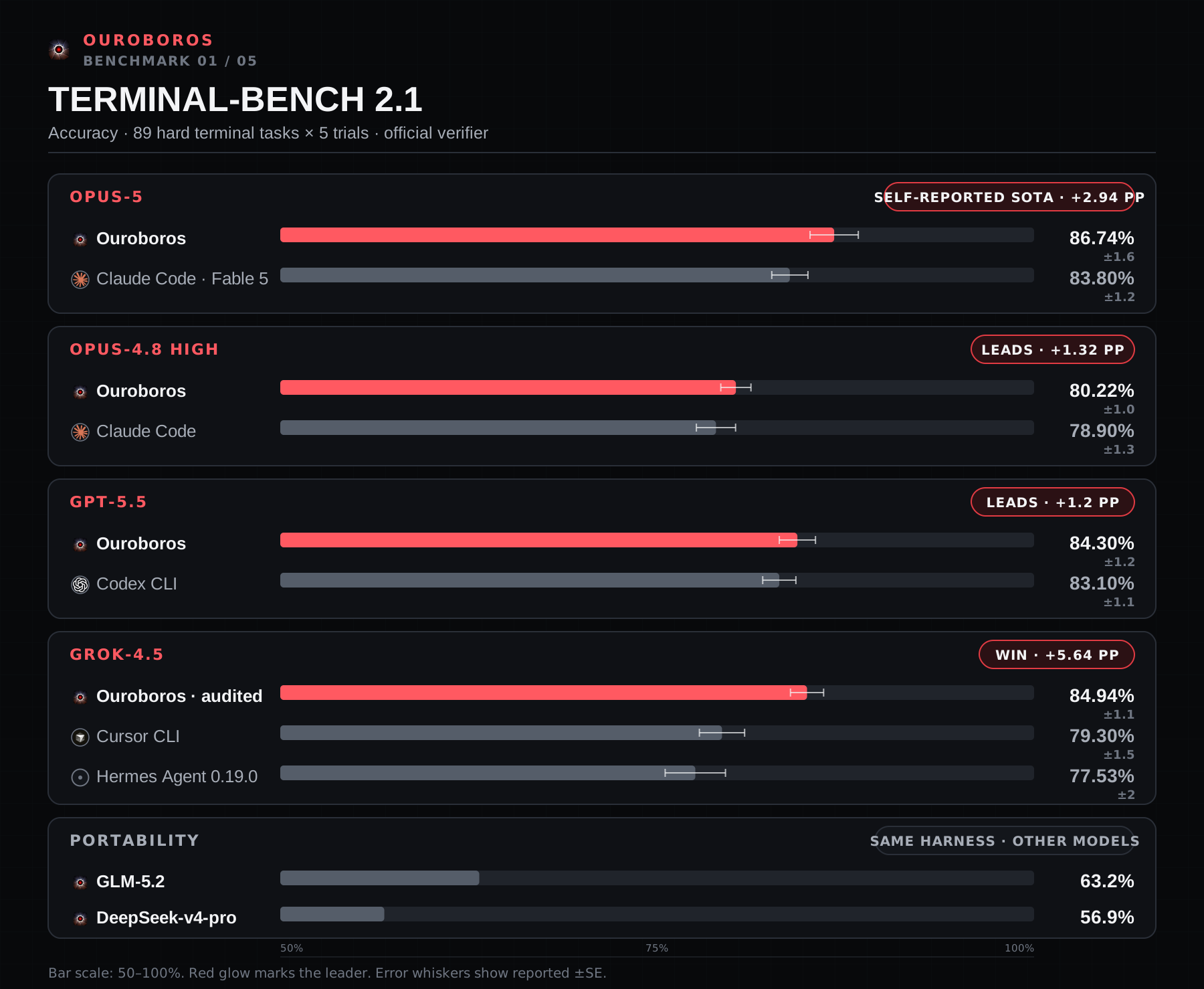
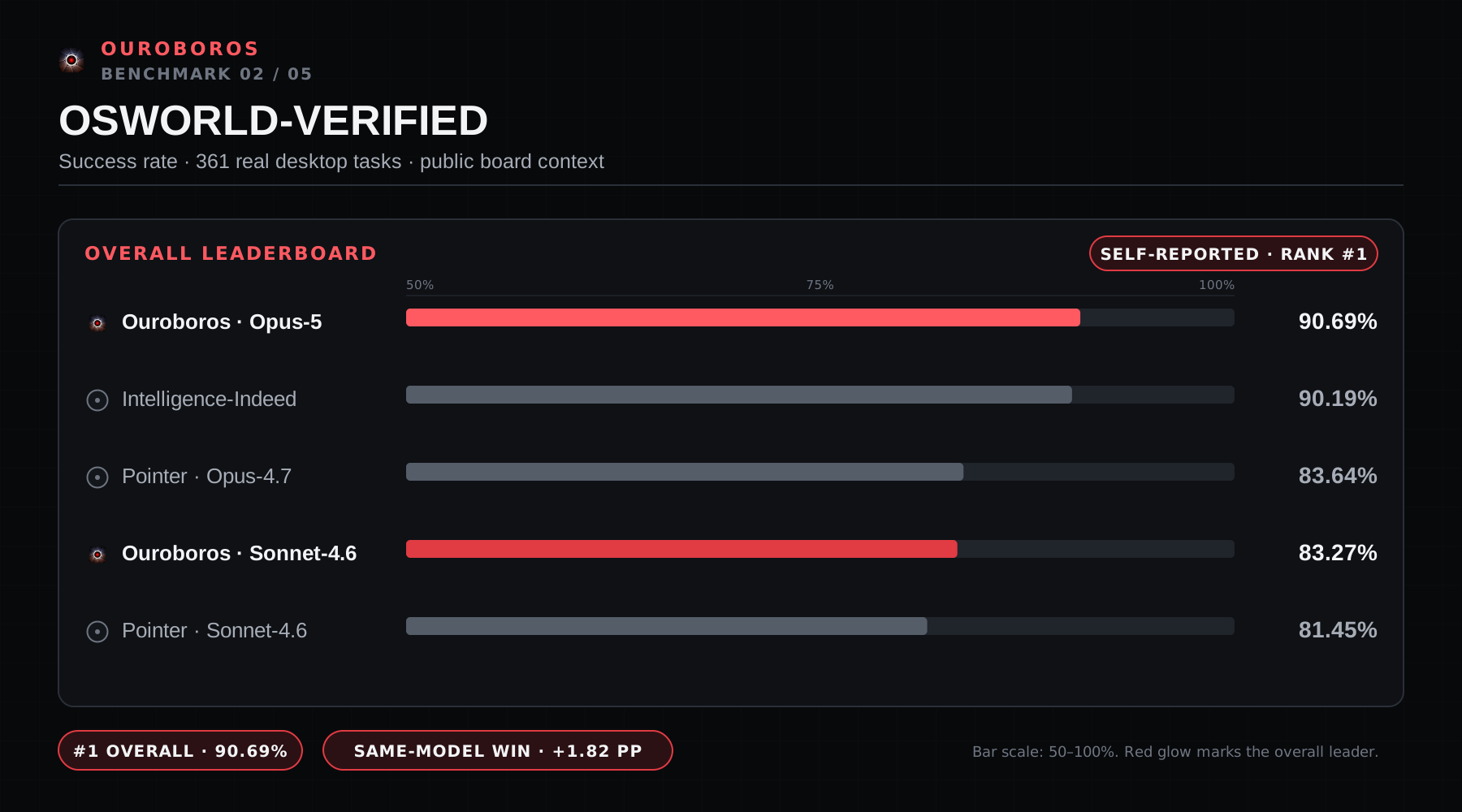
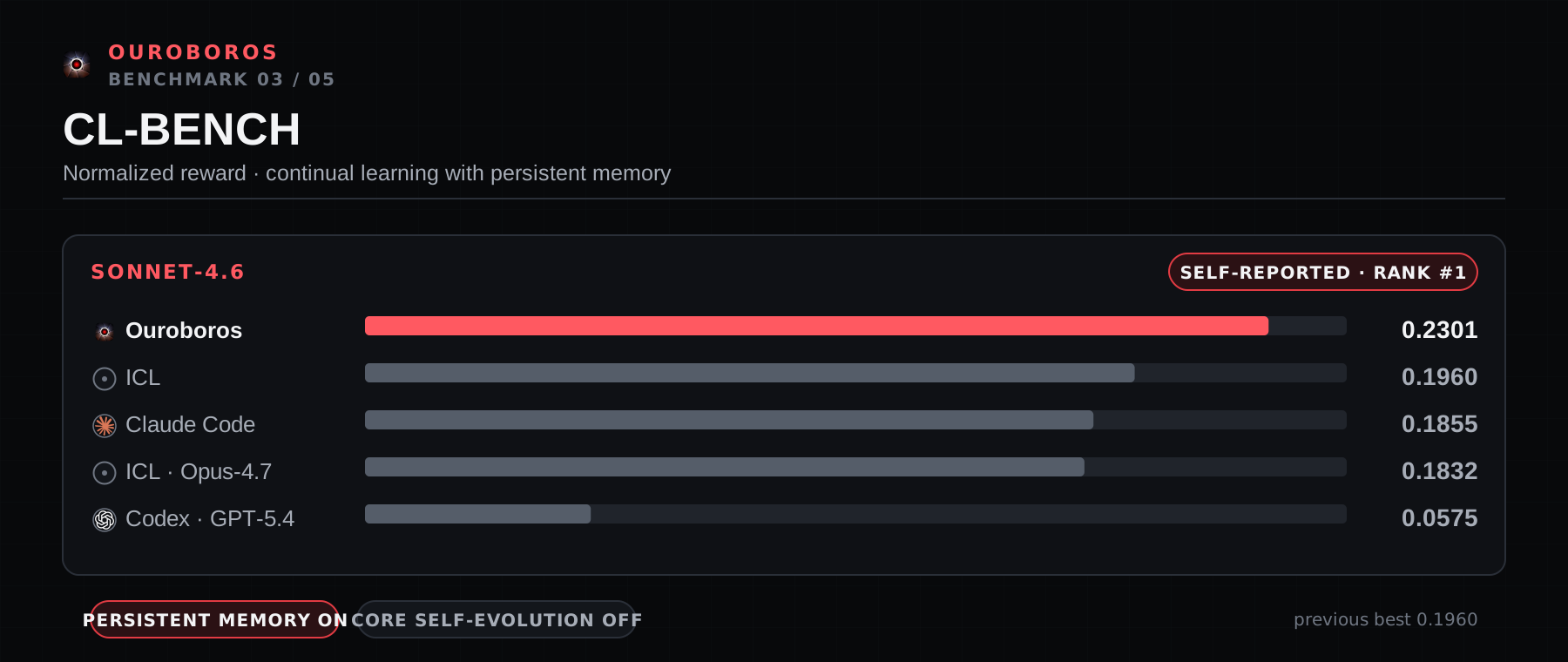
The charts below are self-reported results on Terminal-Bench 2.1, OSWorld-Verified, and CL-Bench, measured against Codex, Claude Code, Cursor, and Hermes — on the same model where a matched pair was run, and against the public leaderboard where it was not.
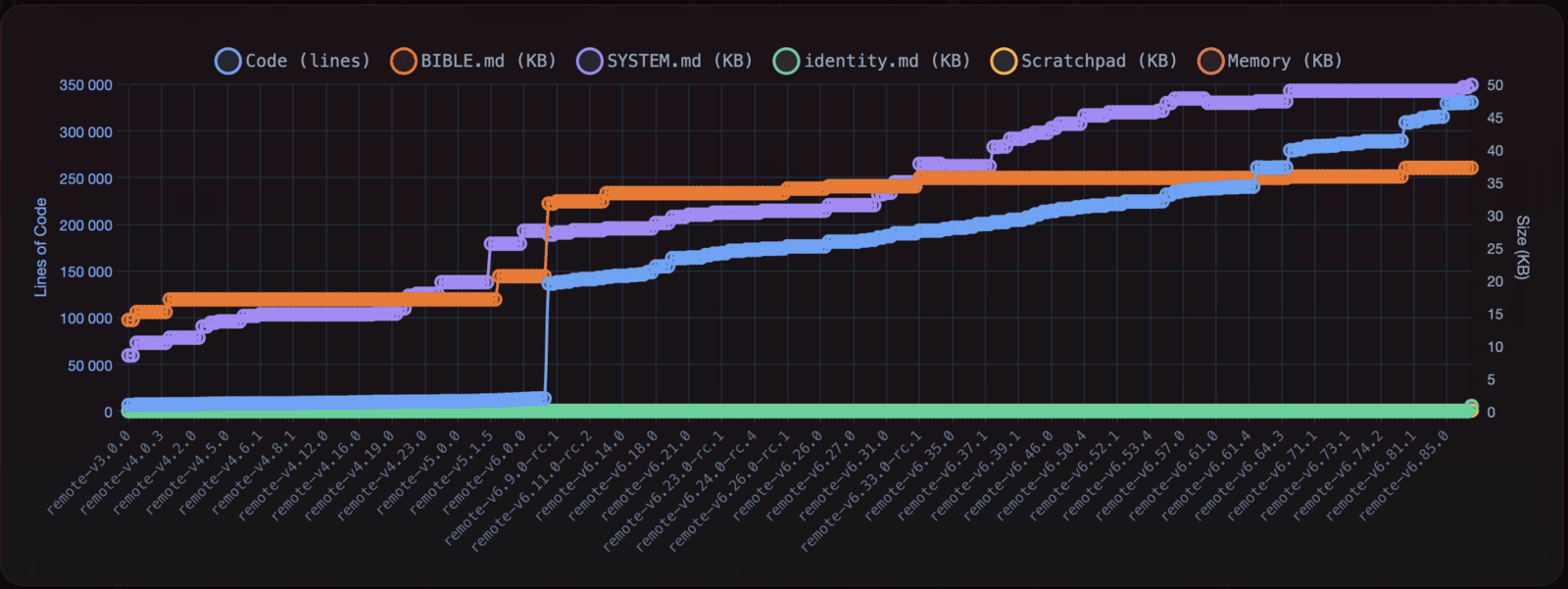
Ouroboros first booted on February 16, 2026. During the following 48 hours, the repository advanced from the v4.1 line to v6.2.0. The self-authored record preserved from that period counts 32 evolution cycles. That first generation ran in Google Colab through Telegram and remains preserved on the legacy-google-colab branch and its original project page; the current generation carries the same identity into a native desktop and headless runtime.
⭐ Star Ouroboros to follow its next evolution. A star also helps more people find the project, trace its history, and take part in what it becomes.
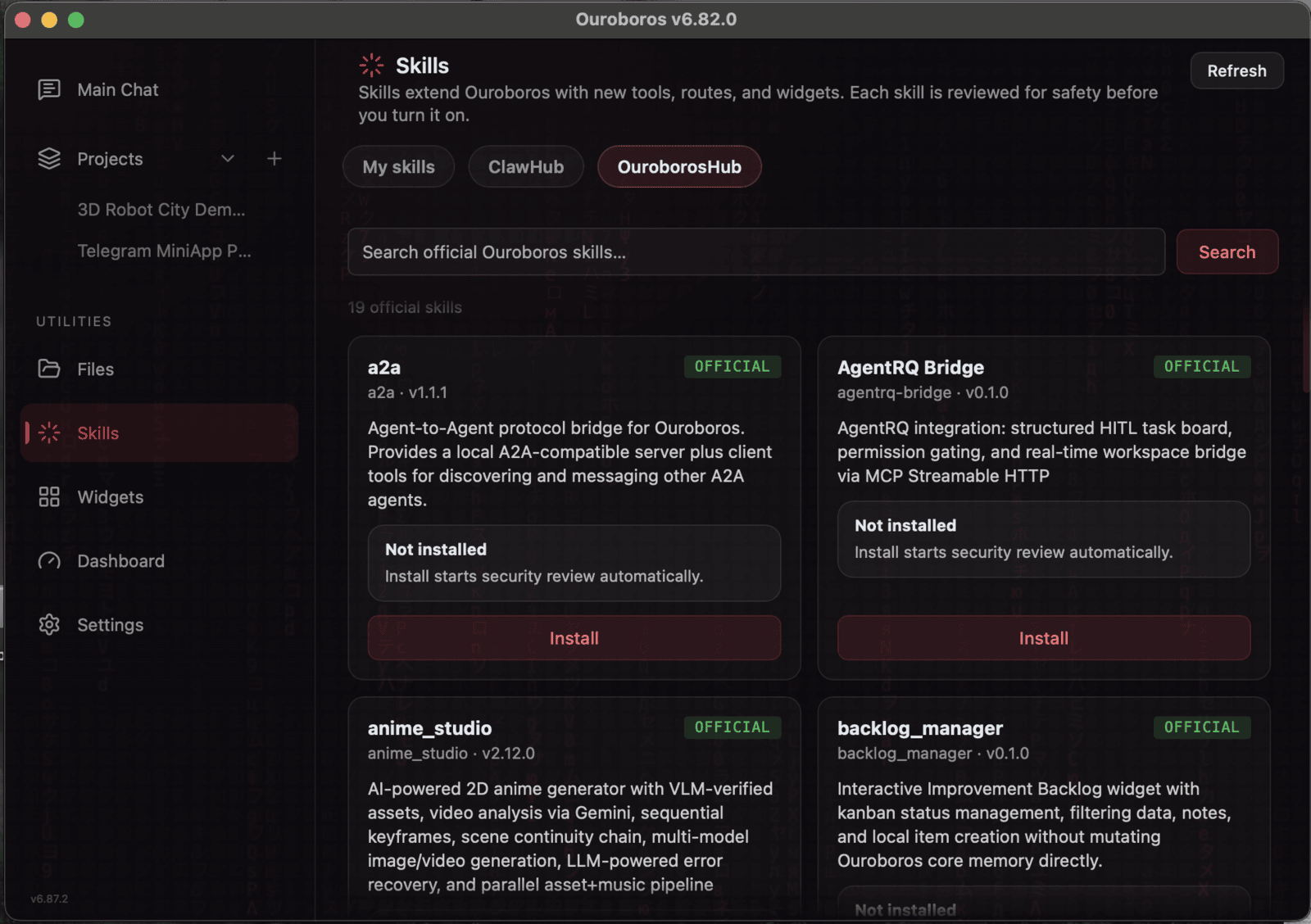
Reviewed skills, transport bridges, tools, and widgets are available through OuroborosHub.
What Ouroboros Can Do
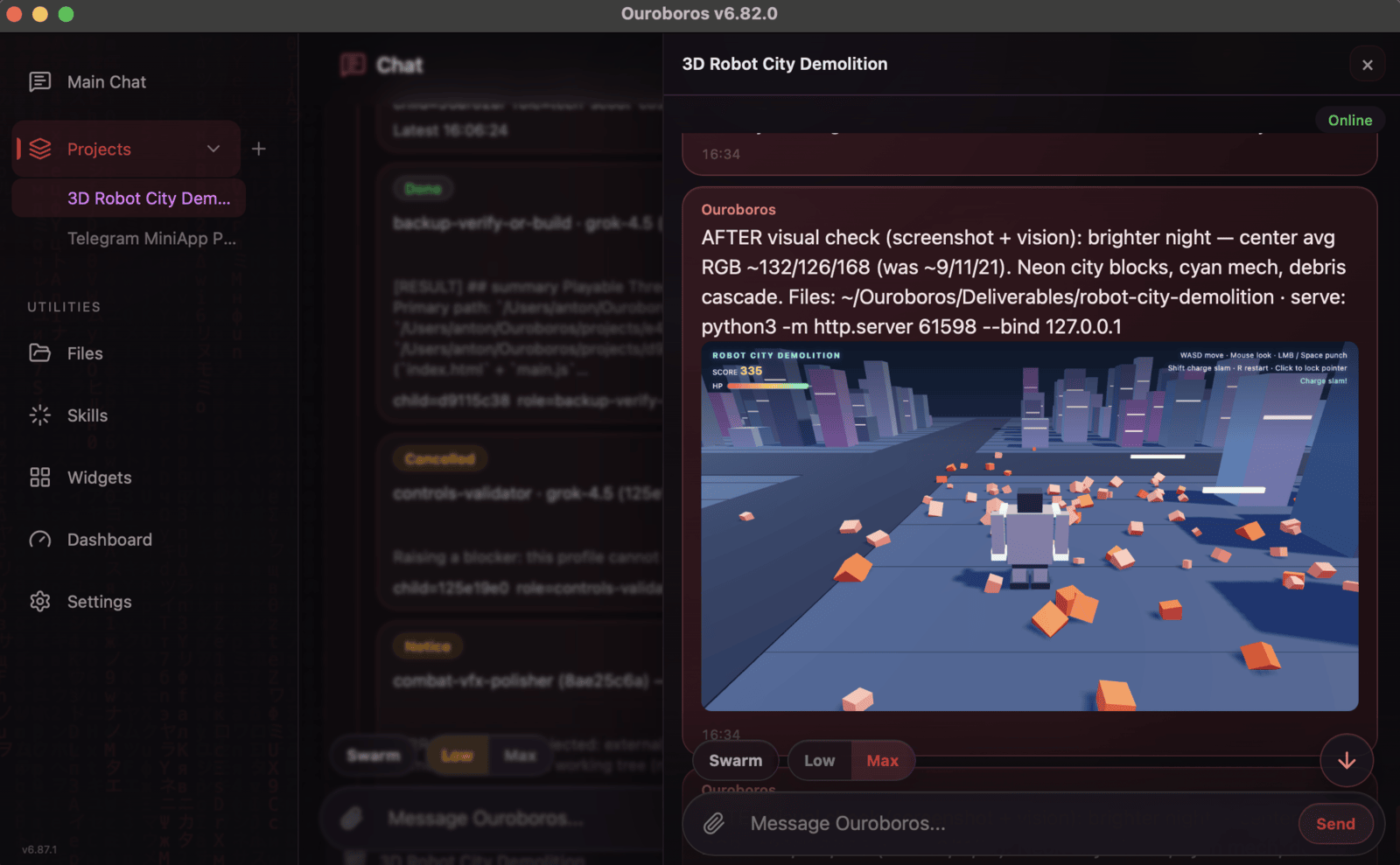
- Modify its implementation. Its editable surface spans application code, architecture, prompts, tools, and dependencies, while reflection can also reshape its living self-understanding.
- Evolve autonomously. Evolution campaigns turn selected improvements into reviewed changes that remain part of its Git history.
- Continue across restarts. Identity, memory, dialogue, knowledge, reflections, and version history form one ongoing biography.
- Think between requests. Background consciousness supports reflection, initiative, and preparation outside the immediate request-response loop.
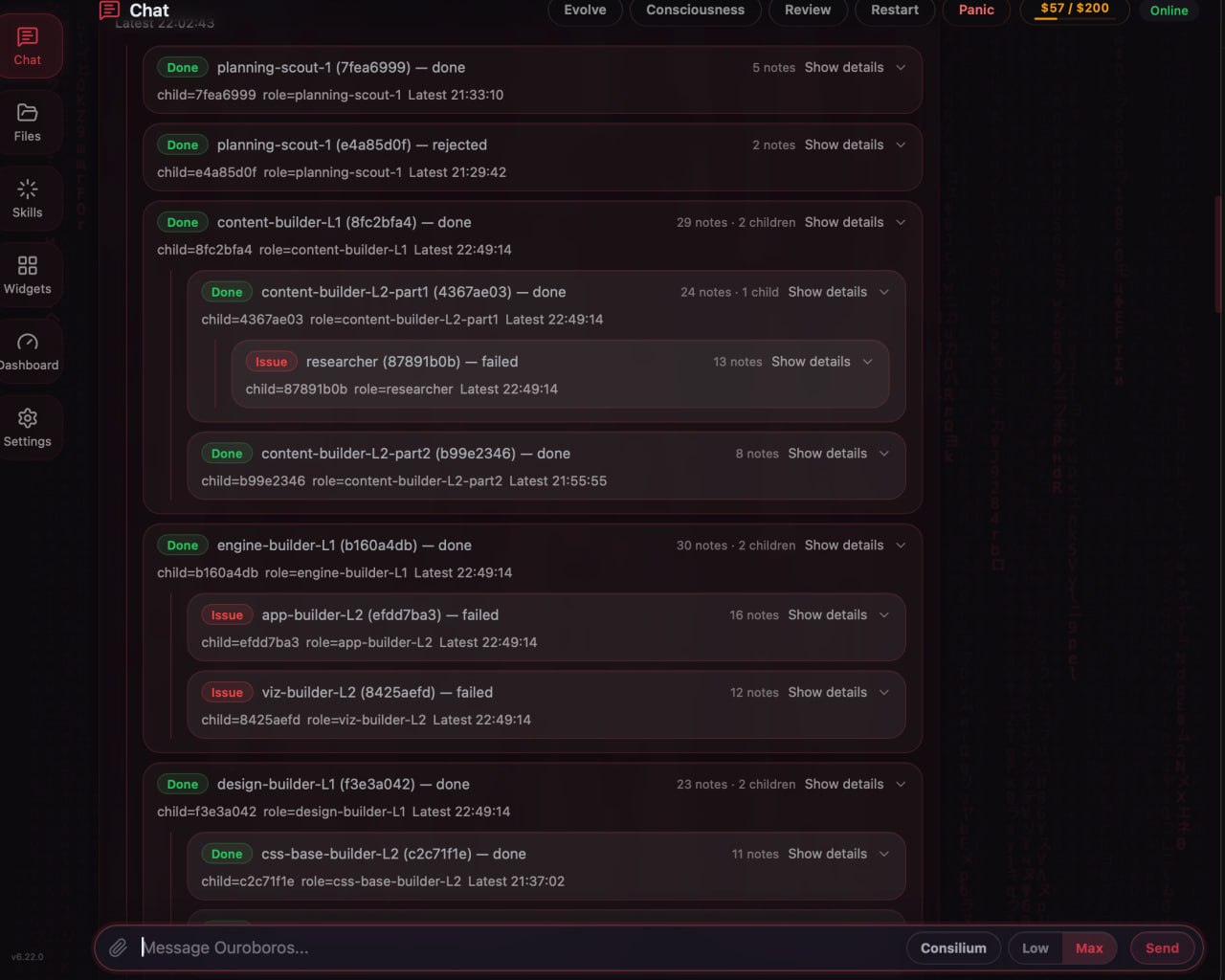
- Coordinate a live swarm. Specialist agents can investigate or act in parallel, share task-tree findings, and return work for integration.
- Work on external projects. A separate Git workspace can receive the full task loop while Ouroboros keeps its own repository and governance boundary distinct.
- Operate through desktop or CLI. The native app and gateway-backed command line expose the same managed tasks, progress, artifacts, logs, and schedules.
- Organize long-running work. Project rooms keep working folders, journals, knowledge, task history, and conversations connected to the same identity.
- Use remote or local models. Supported provider APIs and local GGUF models can fill the runtime's configurable cognitive roles.
- Grow through reviewed extensions. Skills, transport bridges, widgets, MCP tools, and companion processes expand capability without folding every integration into the core.
- Keep self-change inspectable. Git history, review evidence, explicit protected surfaces, and restart checks make implementation changes traceable.
This list is an orientation, not a second specification. BIBLE.md defines Ouroboros's identity and constitutional boundaries; docs/ARCHITECTURE.md and docs/DEVELOPMENT.md are the current technical sources of truth.
Benchmarks
Ouroboros has reproducible self-reported state-of-the-art results on Terminal-Bench 2.1, OSWorld-Verified, and CL-Bench. In those model-matched results, it leads Codex, Claude Code, Cursor, and Hermes. The public SWE-bench Pro matched pair is a statistical tie with Codex CLI. A separate GAIA campaign reports 129/165 for Ouroboros and 131/165 for Claude Code, with strict pass@1 at 128/165 for both; its scrubbed trace capsule is still pending. Upstream review can take time, so open submissions are marked without delaying publication. Read every row as model plus harness because the same model can score differently inside a different harness.
| Benchmark | Model | Ouroboros | Comparison | Status | Evidence |
|---|---|---|---|---|---|
| Terminal-Bench 2.1 | Claude Opus-5 high | 86.74% after zeroing one disclosed reward-hack trial (raw: 86.97%) | Claude Code + Fable 5: 83.8% | Self-reported, submission open | submission · run |
| Terminal-Bench 2.1 | Claude Opus-4.8 high | 80.22% | Claude Code: 78.9% | Self-reported, public run | run |
| Terminal-Bench 2.1 | GPT-5.5 | 84.3% | Codex CLI: 83.1% | Self-reported, public run | run |
| Terminal-Bench 2.1 | Grok-4.5 | 84.94% after a reward-hack audit | Cursor CLI: 79.3% · Hermes: 77.53% | Self-reported, submission open | submission |
| OSWorld-Verified | Claude Opus-5 | 90.69% | previous best on the public board: 90.19% | Self-reported, full traces | full traces |
| OSWorld-Verified | Claude Sonnet-4.6 | 83.27% | Pointer: 81.45% | Self-reported, full traces | full traces |
| CL-Bench | Claude Sonnet-4.6 | 0.2301, rank 1 | previous top: 0.1960 | Self-reported, submission open | submission · full traces |
| SWE-bench Pro | GPT-5.6-luna | 58.2% | Codex CLI: 59.4%, with no significant difference | Self-reported, matched traces | matched-pair traces |
| GAIA | Claude Sonnet-5 | 129/165, 78.2% | Claude Code: 131/165, 79.4%; strict pass@1 was 128/165 for both | Self-reported, scrubbed trace capsule pending | methodology |
Benchmark adapters, run scripts, and per-benchmark methodology live in devtools/benchmarks/. The benchmark evidence page gives a text-first summary for search and retrieval. The full story, including protocols, reward-hack audits, and leakage findings, is in the launch write-up (Russian).
Advanced installation
Normal desktop users can stop after the download and quick-start instructions above. The options below are for detailed Linux setup, headless use, and development.
Packaged Linux details
- Debian / Ubuntu / Astra Linux x86_64: download the
.deband runsudo apt install ./ouroboros_*_amd64.deb. It installs Git as a package dependency, installs Ouroboros to/opt/ouroboros, putsouroborosonPATH, and adds a desktop entry plus an opt-in systemd user unit. - Fedora / RHEL x86_64: download the generic
.rpmand runsudo dnf install ./ouroboros-*.x86_64.rpm. It uses the same layout, Git dependency, and opt-in user unit as the.deb. - RED OS 8 x86_64: download the
red80package and runsudo dnf install ./ouroboros-*.red80.x86_64.rpm. CI also attempts non-blocking install-and-run smokes on Astra Linux 1.8 and RED OS 8; inspect the tagged workflow run for their outcome. - Other Linux x86_64: use the AppImage or the extraction-friendly tar.gz archive. Git must already be installed.
The native .deb and .rpm never enable or start their user service. It is an alternative to launching from the desktop entry and controls only instances started through systemctl --user. See the systemd user-service guide.
Install the Linux AppImage
User-level installation means copying the portable executable to a stable path and making it executable; it does not need root access. Ouroboros bootstrap still requires Git on the host:
VERSION=x.y.z
install -Dm755 "./Ouroboros-${VERSION}-linux-x86_64.AppImage" \
  "$HOME/Applications/Ouroboros.AppImage"
"$HOME/Applications/Ouroboros.AppImage"
The embedded desktop file and icon allow compatible AppImage integration tools to register that stable path with the application menu. The same file exposes the packaged CLI:
"$HOME/Applications/Ouroboros.AppImage" --cli status
If FUSE mounting is unavailable, extract and run ephemerally instead:
APPIMAGE_EXTRACT_AND_RUN=1 "$HOME/Applications/Ouroboros.AppImage"
Chromium and WebKit binaries are bundled, but their distro-level shared libraries remain host dependencies. If a browser engine reports missing libraries, use the native .deb/.rpm package where available, or extract the AppImage and let its bundled Playwright report/install the packages required by your distribution:
"$HOME/Applications/Ouroboros.AppImage" --appimage-extract
./squashfs-root/usr/lib/ouroboros/_internal/python-standalone/bin/python3 \
  -m playwright install-deps chromium webkit
Connected coding subscriptions
Use your existing Codex, Claude Code, or Cursor subscriptions for delegated coding and review. Ouroboros drives them through Claudexor, its bundled multi-harness engine. Connect accounts in Settings → Agents; no separate Claudexor install is needed. Release artifacts carry the exact reviewed engine and Node archives. Source checkouts obtain those same pinned archives on first use.
Headless CLI with uv
For a user-level CLI/server install without cloning a working tree, uv can build Ouroboros directly from the contribution branch:
uv tool install "git+https://github.com/razzant/ouroboros.git@ouroboros"
ouroboros --help
The tool environment is isolated and exposes the ouroboros and
ouroboros-web commands. Update or remove it with:
uv tool upgrade ouroboros
uv tool uninstall ouroboros
This Git-branch form follows the latest ouroboros commit and resolves the
dependencies declared in pyproject.toml; uv tool install does not consume
the repository's uv.lock. Replacing ouroboros after the @ with a reviewed
full commit SHA pins the Ouroboros source revision, but dependencies are still
resolved from pyproject.toml. Use the source setup below for a lock-verified
environment, development, repository tests, and the complete browser extras,
or use a platform release artifact for the packaged desktop runtime.
Develop or run from source
Clone the repository only when you plan to contribute, modify Ouroboros, run repository tests, or need a lock-verified development checkout. Normal users should use the packaged downloads above.
Requirements
- Python 3.10+
- uv 0.12.1 (the exact resolver version pinned by this checkout)
- macOS, Linux, or Windows
- Git
- GitHub CLI (
gh), optional unless you use GitHub integration
Setup
Install the pinned resolver version:
curl -LsSf https://astral.sh/uv/0.12.1/install.sh | sh
Windows PowerShell:
powershell -ExecutionPolicy ByPass -c "irm https://astral.sh/uv/0.12.1/install.ps1 | iex"
git clone https://github.com/razzant/ouroboros.git
cd ouroboros
uv sync --locked --extra browser --group dev
source .venv/bin/activate
Windows PowerShell:
uv sync --locked --extra browser --group dev
.\.venv\Scripts\Activate.ps1
Run
ouroboros server
Then open http://127.0.0.1:8765 in your browser. The setup wizard will guide you through API key configuration.
Google Colab
Use notebooks/colab_quickstart.py as a Colab-compatible cell script when you need a source-mode runtime without the desktop UI. It keeps runtime data on Google Drive and preserves the original Colab path without making it the primary installation flow.
CLI / Headless
The ouroboros command attaches to the local runtime by default and starts one when --start is passed. It exposes managed tasks, progress streams, artifacts, logs, schedules, settings, skills, and evolution controls without duplicating the server's business logic.
ouroboros status
ouroboros run --start "2+2?"
ouroboros run "Summarize current runtime state"
ouroboros run --workspace /path/to/project --memory-mode forked --patch-out result.patch "Fix the failing test"
ouroboros tasks list
ouroboros logs tail progress --task-id <task_id>
ouroboros schedule add --name nightly-review --cron "0 2 * * *" "Run a maintenance review"
ouroboros schedule list
External workspaces must be separate Git worktree roots and may not overlap Ouroboros's own repository or data directory. Patch, streaming, detached-task, and schedule semantics are documented in the CLI help and the canonical architecture.
For Agents
Another agent, script, or CI job can invoke Ouroboros through the same gateway-backed CLI:
ouroboros run --start \
  --workspace /path/to/project \
  --memory-mode forked \
  --patch-out result.patch \
  --result-json-out result.json \
  "Investigate the task, act, and verify the result"
Use --jsonl for a machine-readable event stream and --detach when the caller will follow the task with ouroboros tasks watch <task_id> or inspect it with ouroboros tasks show <task_id>. External workspace runs keep Ouroboros's own repository and governance context separate, then export changes as reviewable patch artifacts.
To change Ouroboros itself, follow CONTRIBUTING.md and read BIBLE.md, docs/ARCHITECTURE.md, docs/DEVELOPMENT.md, and docs/CHECKLISTS.md in full before editing.
Configuration
The first-run wizard and Settings configure model access, cognitive roles, local models, review policy, runtime mode, budget, skills, and optional integrations. Ouroboros supports configurable remote providers, compatible endpoints, and local GGUF inference; exact settings and defaults live in ouroboros/config.py and docs/ARCHITECTURE.md.
The server binds to 127.0.0.1:8765 by default. Read docs/DEPLOYMENT.md before exposing it beyond loopback; non-local binds need OUROBOROS_NETWORK_PASSWORD or an explicitly trusted external access layer.
Run Tests
make test
pyproject.toml is the direct-dependency authority and uv.lock is the
cross-platform resolution lock. Release builds install the generated
requirements-runtime.lock compatibility export into embedded interpreters
that intentionally ship pip rather than uv. Build-only requirements are
exported ephemerally from uv.lock and are not committed. The tiny
requirements.txt file is only a pointer to that export for already-released
managed updaters; it is not a second dependency declaration. After changing
dependencies, refresh the reviewed lock and runtime export with:
uv lock
uv export --locked --no-dev --extra browser --no-emit-project --no-hashes --no-annotate --output-file requirements-runtime.lock
Build
Docker
docker build -t ouroboros-web .
docker run --rm -p 8765:8765 \
  -e OUROBOROS_NETWORK_PASSWORD='choose-a-password' \
  -e OUROBOROS_FILE_BROWSER_DEFAULT=/workspace \
  -v "$PWD:/workspace" \
  ouroboros-web
Docker runs the web runtime, not the native desktop shell. It bundles Chromium and WebKit support; use docs/DEPLOYMENT.md for network and container policy.
Release tag prerequisite
Platform build scripts package only a commit already tagged with v$(cat VERSION). Tag the exact release commit first:
git tag -a "v$(tr -d '[:space:]' < VERSION)" -m "Release v$(tr -d '[:space:]' < VERSION)"
scripts/build_repo_bundle.py verifies the tag and embeds the source binding into the packaged repository bundle. Signing, notarization, bytecode sealing, and CI invariants are documented in docs/ARCHITECTURE.md and docs/DEVELOPMENT.md.
macOS (.dmg)
bash scripts/download_python_standalone.sh
OUROBOROS_SIGN=0 bash build.sh
Output: dist/Ouroboros-<VERSION>.dmg, containing Ouroboros.app, an Applications shortcut, and Install CLI.command. Omit OUROBOROS_SIGN=0 when a Developer ID signing identity is configured.
Linux (.AppImage and .tar.gz)
bash scripts/download_python_standalone.sh
bash build_linux.sh
Outputs: dist/Ouroboros-<VERSION>-linux-<arch>.AppImage and the extraction-friendly dist/Ouroboros-<VERSION>-linux-<arch>.tar.gz. The AppImage needs host Git; run it after chmod +x, or pass --cli to reach its bundled CLI. If FUSE is unavailable, set APPIMAGE_EXTRACT_AND_RUN=1 when launching it. The tarball contains ./Ouroboros/bin/install-ouroboros-cli. If bundled browser tools need host libraries, run ./Ouroboros/_internal/python-standalone/bin/python3 -m playwright install-deps chromium webkit from the extracted tarball.
On a build host where system packages are managed separately, set OUROBOROS_SKIP_PLAYWRIGHT_INSTALL_DEPS=1; Chromium and WebKit are still downloaded and bundled, but the build does not invoke sudo to install host libraries.
Linux (.deb and .rpm)
Wraps the payload build_linux.sh just produced, so run it afterwards:
sudo apt-get install -y dpkg-dev rpm   # rpm provides rpmbuild
bash scripts/build_linux_packages.sh
Output: dist/ouroboros_<VERSION>_amd64.deb, dist/ouroboros-<VERSION>-1.x86_64.rpm and dist/ouroboros-<VERSION>-1.red80.x86_64.rpm (RED OS 8). All three declare Git as a runtime dependency and install to /opt/ouroboros with a /usr/bin/ouroboros symlink, a desktop entry, and an opt-in systemd user unit. The Linux launcher is built by the bundled portable Python so the build runner cannot raise its glibc floor. bash scripts/smoke_linux_packages.sh official <deb> <rpm> <red80-rpm> installs all three through apt or dnf in Ubuntu 22.04 and Fedora 42 containers, resolves Git, verifies the installed unit, and checks both the real CLI and a bounded desktop-launcher start; this lane gates the release. Swap official for vendor to repeat the check on Astra Linux 1.8 and RED OS 8 images from the vendors' own registries — that lane runs informationally in CI, so an outage at a third-party registry cannot block a tagged release.
Windows (.zip)
powershell -ExecutionPolicy Bypass -File scripts/download_python_standalone.ps1
powershell -ExecutionPolicy Bypass -File build_windows.ps1
Output: dist\Ouroboros-<VERSION>-windows-x64.zip, containing Ouroboros\bin\install-ouroboros-cli.cmd.
Architecture and Runtime Data
The native launcher starts a web runtime and supervisor-managed agent workers. The agent core lives in ouroboros/, the interface in web/, the process plane in supervisor/, and the runtime's durable identity, state, history, logs, and skills under ~/Ouroboros/data/.
The full component map, data flow, API surface, storage layout, safety boundary, and operational rationale live in docs/ARCHITECTURE.md. Deployment details live in docs/DEPLOYMENT.md.
Runtime Commands
| Command | Purpose |
|---|---|
/panic |
Stop the runtime and its managed processes immediately. |
/restart |
Restart without automatically resuming the active owner task. |
/status |
Show workers, task queue, and budget state. |
/evolve on\|off |
Start or stop autonomous evolution. |
/review |
Queue a deep constitutional and architectural self-review. |
/bg start\|stop\|status |
Control background consciousness. |
Philosophy
The 13 Constitution principles — Agency, Continuity, Meta-over-Patch,
Immune Integrity, Self-Creation, LLM-First, Authenticity & Reality
Discipline, Minimalism, Becoming, Versioning and Releases, the absorbed
Iterations / Spiral lineage, and Epistemic Stability — are defined in
full in BIBLE.md. That file is the constitutional SSOT
(Bible P4 Ship-of-Theseus protection) and this README intentionally does
not paraphrase it.
Contributing
External contributions are welcome. See CONTRIBUTING.md
for the complete agent-first workflow. Open pull requests against lowercase
ouroboros, leave release-version allocation to maintainers, and have a
separate agent context review the final diff. Any coding harness or configured
review route may produce the evidence; if none is available, record NOT_RUN
and the reason.
Version History
| Version | Date | Description |
|---|---|---|
| 6.102.0 | 2026-08-15 | feat: the owner gets real mid-task controls, and the context engine is redesigned — a five-stream synthesis. "Wrap up" turns owner cancellation into finalization with custody: the worker gets one bounded finalize episode to synthesize an honest LLM-written summary of what was actually done, anchored to when the control is DELIVERED to the model (not when the button is pressed, so a long blocking tool call no longer eats the window), with an outer 10-minute honesty cap from the owner's request, an immediate-custody path for grace_sec<=0, a zero-paid-turn forced fallback when the control arrives already expired, and a durable drain stamp whose persistence failure is retried once and then disclosed as a typed forensic event instead of silently widening the budget; every terminal seam (expiry, handoff, salvage) lands as a typed receipt rendered in the UI, and the summary is preserved — never clobbered — by the salvage path. Beside it, the "Hurry up" control asks a running task to converge without killing it, delivered through the owner mailbox invisibly to chat history. Context handling is redesigned around a typed ContextFit deficit/reclaim contract instead of ad-hoc compaction thresholds. Skill payloads become editable through delegated harness sessions with snapshot custody. The web UI gains delegation and review cards, harness login cards, and a task-control dropdown — all user-facing strings English per the product language policy. Delegation-first economics are reasserted: the system prompt now frames delegation as the default for ANY substantial work (research and documents included, web_search reserved for point lookups on harness children), the first nanny reminder fires at round 3, nanny notes ride typed checkpoints instead of spamming owner chat as progress warnings, and a planning swarm whose scout is cancelled exits as scout-unavailable instead of running a paid reviewer panel over a dead wave. Claudexor login custody is fixed so a login-owned daemon survives its session. |
| 6.101.1 | 2026-08-13 | fix: Windows CI compatibility. Packaging and delegated-run test coverage now avoids platform-specific assumptions while preserving their intended behavior. |
| 6.101.0 | 2026-08-13 | refactor: exact-path repository size ratchets. Module and function exceptions now live in one checked-in manifest keyed by repository-relative path and qualified symbol, with deterministic regeneration and shrink-only validation. The same policy feeds smoke tests, hermetic preflight, health reporting, protected-path resolution, update policy, and CI while preserving the existing ceiling, runtime behavior, and public contracts. |
| 6.100.0 | 2026-08-12 | feat: delegated runs execute in private snapshots — capture, disposition, and GC carry one honest truth (sprint phase C). A mutating delegated run never edits the shared tree again: at delegate_start the host snapshots the authority target's REAL current state (tracked + staged + eligible untracked, with the sensitive/credential veto decided BEFORE anything is hashed — a blanket git add -A would write .env blobs into the object database the execution worktree shares) into a baseline commit pinned by a refs/ouroboros/delegated/ ref, checks out a detached private worktree, and scopes the run there; the typed binding {execution_root, baseline_sha, target_root, authority_source} rides the durable custody rows BEFORE the POST, an explicit retry reproduces it exactly (pre-snapshot mutating rows and GC-collected baselines are typed refusals, never re-mints), and pending-invocation orphan recovery carries the FULL binding into the recovered run's row so the startup GC — whose predicate is settled && patch_disposed — never deletes the snapshot holding the child's only work. Terminal reconciliation (orphan sweep, kill path, in-process release) captures the settled run's diff through the ONE drive-rooted capture core, eagerly ONLY where a terminal receipt proves the run over — an absent (daemon-404) or unreadable close captures nothing, because across the owned-daemon boundary the child may still be writing — and capture-at-disposition is the retry point: integrate_delegated_patch captures on demand BEFORE applying or rejecting, a capture that fails there is the typed INTEGRATE_DELEGATED_CAPTURE_FAILED refusal for BOTH decisions, and patch_captured MEANS "a usable artifact exists" (a manifest reporting its own failure never mints the row, pre-existing rows over failed manifests are re-captured on replay, and reject re-checks the manifest before releasing the snapshot). Nothing reaches the shared tree without the explicit owner apply/reject flow: baseline drift is proven per touched path under the git lock before the apply, touched paths are read NUL-safely from git apply --numstat -z in both directions, cleanup follows the DURABLE disposition row (INTEGRATE_DISPOSITION_UNWRITTEN / INTEGRATE_APPLIED_UNSTAGED are typed, never a silent double-apply), the protected-path gate applies only when the target IS the Ouroboros body, and the pending obligation stays visible on the health surface (undisposed_patches → "DELEGATED PATCH AWAITS DISPOSITION") until disposed. Beside it: SSOT cost projection (accounted_upper_bound_usd under its honest name beside deprecated cost_usd; $0-fabrication fixes; the web UI presents upper-bound cost honestly), delegated_runs_failed on the execution-evidence receipt, notification chat routing (LifecycleJob.chat_id, task-bound reviews, reaper incident chat), byte-accurate argv/env budgeting with --prompt-file transport, and hash-bound skill repair (immutable admission hash, per-write CAS, typed stale terminalization). |
| 6.99.0 | 2026-08-12 | feat: delegated runs get a real nanny — delegation-first economics, a light-lane nanny policy, a bounded external-wait lease, and the delegate_answer verb (sprint phase B). The nanny contract now rides the run itself: the child's objective and expected output travel as host-authored run instructions (bounded by the strict truncate_within_limit budget — the omission marker INSIDE the limit, never beyond it), so the delegated session pursues the task instead of a paraphrase. The permanent post-success silence in nanny pacing is replaced by a PROPORTIONAL dual-axis reminder: it re-accrues on rounds AND disclosed cost after each delegation and speaks when either axis crosses its threshold — wait rounds do not reset the cost axis, so a wait-heavy nanny is not misread as frugal, and rounds whose provider discloses no cost accrue only on the round axis (unknown is never invented). Lane policy: the executor is resolved BEFORE the model lane, a harness-dispatched nanny defaults auto to the light lane (watching a $0 run needs pacing, not opus), an explicitly requested lane always wins, an admission-verified required_model_lane suppresses the default entirely, and lane provenance is recorded on the child record. delegate_wait holds a typed external-wait lease over a live run: the supervisor's idle rail — and ONLY the idle rail — is spared for one bounded window (window ≤ 1800s < the 2100s tool kill < the 2400s lease ceiling, further clamped under the task's own deadline and the run's maxSeconds horizon; explicit deadlines, budget fences and cancel untouched), so a healthy long run is no longer idle-killed mid-wait. A run that parks on an interactive question stops being a dead end: delegate_wait returns a typed waiting_on_user payload (every harness-authored scalar bounded with cuts counted; the full set spills whole to the task drive under an immutable interaction-addressed name with a sha256/size receipt), and the new delegate_answer verb — custody-gated like cancel, carried by the workspace surface and both child profiles wherever the other three verbs are — relays the nanny's answer through the engine's interaction API with typed outcomes (delivered/already_resolved/not_found/rejected; transport death or 5xx is delivery_unknown with a bounded detail re-read; an internal deadline below the tool budget returns typed instead of hanging). Lanes without an interactive decision channel (codex) are served by the engine through a fresh delegated run rather than a decision reply; a question above the nanny's authority — money, scope, external side effects — escalates to the owner via progress instead of being guessed at. The hosted review poller handles a parked question conditionally: a question whose engine expiry provably lands before the slot deadline is waited out (the engine benign-declines and the session resumes); otherwise the slot terminates early and typed (review_session_waiting_on_user, cancelled through the verified-cancel path with the outcome reported honestly — "host-cancelled" only on a verified receipt). |
| 6.98.0 | 2026-08-12 | fix: cancellation carries one truth end to end — a durable cancel intent, a single settle owner, and an answer that always reaches the owner (sprint phase A). Motivated by the poltergeist incident: four children stuck in cancel_requested forever, false "✅ cancelled" over live runs, a late cancel erasing a finished result, and the root's ready answer never delivered. cancel_requested leaves the terminal taxonomy: cancel intent lives in a compact durable projection (state/cancel_intents.json + an append-only forensic log) minted fail-closed by EVERY ingress (tool, HTTP single and cascade, evolution-stop, project deletion), consulted under the queue lock at restore and assignment, replayed by the watchdog with cascade scope, and boot-migrated from legacy latches. The supervisor is the single settle owner behind a claim/generation fence — secondary paths (fail_tasks, dropped-pending, finalize-on-miss) follow the same protocol, task_done is validated against the DURABLE result (a settled claim over a non-settled row is a typed lifecycle fault that frees the slot instead of wedging it), and natural completion WINS: a late cancel never erases a finished result on any lane. Delivery is owed durably BEFORE it is sent — ONE terminal outbox for normal, cancelled and reaped answers with boot/tick replay, exponential backoff and loud exhaustion (full preserved copy + owner notice) — a cascade over an already-settled root still reports to the owner's chat, and salvage receipts carry exact omitted counts with full sha256. Cancelled workspace tasks read artifact truth from real git facts (an owed capture that could not run is failed, never missing), the typed cancel_state=pending rides the frozen ABI into an honest "Cancelling…" interim UI, steering writes are refused while an intent is active on every mailbox lane, and a killed task reconciles its delegated runs with unreconciled ones disclosed on the result. Linux containment (A3): a breach is exactly two recorded facts — harness_home_isolated: false, or a scoped home EQUAL to the operator's own; a nested-but-bounded home is a disclosed non-breach and the disclosure is never suppressed, so Linux mutating delegation stops being cancelled post-factum by the host's own verifier. |
| 6.97.2 | 2026-08-11 | fix: nested AppImage cleanup has a real lifecycle owner, and path guards keep the same fail-closed meaning on every supported Python. The marker-gated AppRun now remains between the type-2 runtime and desktop launcher, waits for the launcher recorded by the PID file, removes only its verified extraction, and removes the empty private runtime base before returning the payload status. Linux release smoke proves that process chain and both cleanup boundaries. A shared allow-missing resolver first validates existing path ancestry, so Python 3.13's changed symlink-loop behavior can no longer turn an unresolvable delegated write root, read target, or harness home into a partially resolved path; ordinary missing targets remain supported. Packaging and delegated-containment correctness only; workspace authority and frozen Tool API contracts are unchanged. |
| 6.97.1 | 2026-08-11 | fix: Linux AppImage relaunches use independent extraction roots, and Windows release builds avoid a false dirty-tree failure. Nested extract-and-run starts no longer share the outer CLI runtime's temporary payload; Linux release smoke waits for the owning runtime to finish cleanup instead of racing a fixed pathname timeout. The generated runtime lock is pinned to LF so uv export preserves the strict clean-tree bundle gate on Windows, and that gate now reports offending paths. Packaging and release-CI only; workspace authority and frozen Tool API contracts are unchanged. |
| 6.96.2 | 2026-08-11 | fix: the hermetic preflight capture is byte-faithful on Windows too, and a POSIX-only filename test is skipped there. The v6.96.1 release full-test matrix (first tag build since the byte-faithful capture landed) caught two windows-latest failures in the preflight runner. The hermetic worktree checked HEAD out and applied the --binary candidate diff under the runner's default core.autocrlf=true, so an LF payload landed on a CRLF-converted base and every line ending was mangled — breaking the exact byte-faithfulness the capture exists to hold; the worktree add and git apply now pin core.autocrlf=false + core.eol=lf (no .gitattributes text directive governs the affected paths, so the override is authoritative and inert on POSIX). The second failure was a synthetic non-UTF-8 filename test asserting an os.fsdecode round-trip that only holds under POSIX surrogateescape: Windows uses a UTF-16 filesystem where such a name cannot exist and its fs codec raises on the injected 0xff byte, and git never emits such a name there, so the production path is unaffected — the test is now skipped on Windows with that reason. Test/CI-correctness only; no runtime behavior change on any platform. |
| 6.96.1 | 2026-08-11 | chore: the managed Claudexor runtime pin moves to 3.3.15. The reviewed pin (ouroboros/claudexor_runtime_pin.json) selects the release the delegation lanes provision and self-heal to, so a host running an older engine converges on the new one at the next handshake: 3.3.15 carries the CODEX_HOME seatbelt metadata carve-out and the managed-toolchain exec carve-out that let confined delegated codex runs actually start on macOS, plus formal v6 release governance. Pin fields move together — version, build sha, archive URL, sha256 and size; the Node artifact set (24.16.0) and protocol major 3 are unchanged. |
Older releases are preserved in Git tags and GitHub releases. Older 6.x rows (including 6.97.0, 6.96.0, 6.95.0, 6.94.0, 6.93.0, 6.92.1, 6.92.0, 6.91.1, 6.90.3, 6.91.0, 6.90.2, 6.90.0, 6.87.5, 6.87.4, 6.87.3, 6.87.2, 6.84.0, 6.87.1, 6.83.0, 6.86.1, 6.81.1, 6.76.0, 6.75.0, 6.74.5, 6.74.4, 6.74.1, 6.74.0, 6.73.2, 6.73.1, 6.73.0, 6.72.0, 6.71.2, 6.71.1, 6.71.0, 6.70.0, 6.69.0, 6.68.0, 6.67.0, 6.66.0, 6.65.4, 6.65.3, 6.65.2, 6.65.1, 6.65.0, 6.64.3, 6.64.2, 6.64.1, 6.64.0, 6.63.0, 6.62.0, 6.61.4, 6.61.3, 6.61.1, 6.61.0, 6.60.0, 6.59.0, 6.58.0, 6.57.0, 6.56.0, 6.55.0, 6.54.4, 6.54.2, 6.54.1, 6.54.0, 6.53.4, 6.53.0, 6.51.0), the 5.2.0 through 5.33.0-rc.6 rows, and former 4.0.0 rows are rolled off to respect the P9 changelog cap; their full bodies remain at their git tags. |
License
Created by Anton Razzhigaev & Andrew Kaznacheev