






















What is effGen • Install • Quick Start • Features • Presets • Tools • Prompts
Models • Examples • Deploy • Dev Experience • Security • News • Citation
🤔 What is effGen?
effGen transforms Small Language Models into powerful AI agents. While most frameworks assume a massive LLM, effGen is optimized from the ground up for efficient, smaller models — delivering fast, capable agents without the compute overhead — while still supporting all major cloud providers when you want them.
from effgen import Agent, load_model
from effgen.core.agent import AgentConfig
from effgen.tools.builtin import Calculator, PythonREPL

# Load a small but mighty model
model = load_model("Qwen/Qwen2.5-1.5B-Instruct", quantization="4bit")

# Create an agent with tools
config = AgentConfig(
    name="math_agent",
    model=model,
    tools=[Calculator(), PythonREPL()],
)
agent = Agent(config=config)

# Run a computation
result = agent.run("What is 24344 * 334?")
print(f"Answer: {result.output}")

📰 News & Updates
| Date | Update | |
|---|---|---|
| 🎉 | 14 Aug 2026 | v1.0.0 Released — the first stable release. Point effGen at any OpenAI-compatible server (base_url, vLLM/Ollama/LM Studio/a gateway), read back which tool calls a run made, wrap the agent loop in middleware, give one agent many conversations with run(session=...), choose a context-compaction strategy, and resume a WorkflowDAG that died half way through. Plus effgen code (a terminal coding agent), a model/pricing browser, shareable HTML reports and run cards, effgen top, effgen battle, and a long pass over everything that used to report the wrong thing: a failed run raises, an unpriced model reports no cost, and a tool call written in an unfamiliar shape is understood. Three breaking changes (Python 3.11 floor, raise_on_error=True, an unreachable backend raises). Changelog |
| ✨ | 5 Jul 2026 | v0.3.2 Released — Usability, Robustness & Polish: structured output + cost gates + document input on the CLI (batch --schema, eval --fail-under, compare --optimize cost, run --file), clinical-grade PHI redaction with a phi preset, native web-search sources that never vanish, sampling controls (seed/frequency_penalty) that take effect, a server that returns real HTTP status on failure, provider/model/status-labeled /metrics with top-level alerting/SLO exports, batch that survives malformed rows with per-job cost, spreadsheet ingestion, the general preset on Gemini, and prompt-library input validation. No breaking changes. Changelog |
| ✨ | 29 Jun 2026 | v0.3.1 Released — Real-World Usability & Polish: grounded response.sources/.citations, reasoning models (gpt-5/o-series) finish token-heavy tasks, custom personas honored on every path, fail-closed multi-agent teams/workflows, an OpenAI-compatible server with no silent tool/embedding downgrades, one-call domain agents (LegalDomain().to_agent(...)), effgen run --json + auto-discovered tool plugins + deadlock-free sync run() over MCP, grammar-constrained local structured output, physical GPU memory in models status, the REPL sandbox toggle out of the model's hands, PDFs that ingest, and per-call latency with readable sub-cent costs. No breaking changes. Changelog |
| 🎯 | 19 Jun 2026 | v0.3.0 Released — Stabilization & Hardening: fail-closed Agent.run() (no silent success; typed redacted errors; smart retries), a self-updating drift-aware model catalog (effgen models refresh), real GPU support (temperature=0, deadlock-free allocator), a fail-closed API server (forged-JWT rejected, secure CORS/metrics/RBAC/budget), hardened built-in tools (REPL timeout, one shared SSRF guard, path confinement, no unsafe pickle/eval), import effgen in ~20 ms, faster streaming + agent loop, a quiet scriptable CLI, and a live "thinking" UX. No breaking changes. Changelog |
| | Date | Update | |:---:|:---|:---| | 🔒 | **27 May 2026** | **v0.2.10 Released**: Security, Edge & DX — secret scanning (gitleaks), SBOM (CycloneDX), pip-audit CI, sandboxed CodeExecutor (SubprocessSandbox + DockerSandbox), OAuth2/OIDC + RBAC + audit log, Docker + Helm, AWS Lambda (Mangum), Cloudflare Worker edge proxy, VSCode extension, Jupyter magics, live dashboard. [Changelog](CHANGELOG.md#0210---2026-05-27) | | 📊 | **23 May 2026** | **v0.2.9 Released**: Observability & Reliability — structured JSON logs + secret redaction, OTel samplers + canonical span spec, Prometheus histograms, SLO tracking, circuit breakers, bulkheads, jittered retries, chaos harness, fuzz suite, `effgen loadtest` CLI, Alertmanager rules. [Changelog](CHANGELOG.md#029---2026-05-23) | | 🖼️ | **21 May 2026** | **v0.2.8 Released**: Multimodal input — image, audio, and video across 6 providers (Gemini, OpenAI, Groq, Anthropic, Together, HF). New `multimodal` preset, `MultimodalDescribeTool`, unified `Message` content schema, 5 cookbook walkthroughs. [Changelog](CHANGELOG.md#028---2026-05-21) | | 📚 | **20 May 2026** | **v0.2.7 Released**: 31 prompt templates across 7 domains — research, coding, data/SQL, legal, medical, creative, business — with golden eval harness, interactive playground, and auto-generated gallery. [Changelog](CHANGELOG.md#027---2026-05-20) | | 🚀 | **19 May 2026** | **v0.2.6 Released**: 14 new tools — OCR, AudioTranscribe, ImageInfo, ImageCaption, PDF, DOCX, Excel, Weather, Geocode, Maps, EmailSMTP, EmailIMAP, SlackWebhook, DiscordWebhook. New presets: `media`, `notify`. 58+ built-in tools total. [Changelog](CHANGELOG.md#026---2026-05-19) | | 🚀 | **18 May 2026** | **v0.2.5 Released**: 13 new free tools — PubMed, ArXiv, SemanticScholar, RSS, News, YouTubeTranscript, YouTubeMetadata, Reddit, HackerNews, Translate, LanguageDetect, QRGenerate, QRRead. 44+ built-in tools total. [Changelog](CHANGELOG.md#025---2026-05-18) | | 🚀 | **14 May 2026** | **v0.2.4 Released**: ModelRouter with CostBased/LatencyBased/FirstAvailable policies, transparent provider failover, cross-process SQLite rate-limit coordination, persistent cost tracker + `effgen cost` dashboard CLI. [Changelog](CHANGELOG.md#024---2026-05-14) | | 🚀 | **4 May 2026** | **v0.2.3 Released**: 5 new cloud backends (Groq, Together AI, Fireworks, Replicate, HuggingFace Inference) — 9 providers total. Unified ProviderRegistry, `effgen doctor` auth check, backend parity matrix. [Changelog](CHANGELOG.md#023---2026-05-04) | | 🚀 | **28 Apr 2026** | **v0.2.2 Released**: Gemini 3.x/2.5/2.0 registry, `thinking_budget`, Google Search grounding, Files API, Gemini native tools (GoogleSearch, UrlContext, CodeExecution). Anthropic Claude 4.7 registry, extended thinking, prompt caching (`cache_control`), streaming polish, experimental native tools. [Changelog](CHANGELOG.md#022---2026-04-28) | | 🚀 | **25 Apr 2026** | **v0.2.1 Released**: Cerebras backend (streaming, native tool-calling, rate-limit coordinator, cost tracking) + OpenAI gpt-5/gpt-5.4-nano/o-series with `reasoning_effort`, prompt caching, structured outputs v2, and OpenAI native tools (web_search, code_interpreter, file_search). [Changelog](CHANGELOG.md#021---2026-04-25) | | 🚀 | **9 Apr 2026** | **v0.2.0 Released**: Major release — native tool calling, guardrails, multi-agent orchestration, RAG pipeline, 31 tools, eval framework, production API server, MLX Apple Silicon support, Python & TypeScript SDKs. [Changelog](CHANGELOG.md#020---2026-04-09) | | 🍎 | **8 Apr 2026** | **MLX & Apple Silicon support merged** (PR #4): Native Metal GPU acceleration via MLX & MLX-VLM backends, hardware detection, 5 Gradio GUI examples. `pip install effgen[mlx]` | | 🔧 | **25 Mar 2026** | **v0.1.3 Released**: Verification hardening — smarter loop detection, "skip the tool" prompting, model-aware token counting, sub-agent depth limits, circuit breaker persistence. [Changelog](CHANGELOG.md#013---2026-03-25) | | 🔧 | **12 Mar 2026** | **v0.1.2 Released**: Test-driven hardening — 10 example agents, 19 bug fixes, cross-model compatibility matrix (11 models, 73% pass rate). [Changelog](CHANGELOG.md#012---2026-03-12) | | 🔒 | **6 Mar 2026** | **v0.1.1 Released**: Stabilization — fixed license/metadata consistency, improved error handling, added 6 examples, expanded test suite. [Changelog](CHANGELOG.md#011---2026-03-06) | | 🎉 | **1 Mar 2026** | **v0.1.0 Released**: Major feature release — 14 built-in tools, agent presets, plugin system, real streaming, memory integration, ACP/MCP protocols, CI/CD, and comprehensive test suite. [Changelog](CHANGELOG.md#010---2026-03-01) | | 🔧 | **3 Feb 2026** | **v0.0.2 Released**: vLLM backend fixes with automatic chat template support, GPU memory control, improved OOM error handling, and multi-model family compatibility | | 📄 | **2 Feb 2026** | Preprint available: [EffGen: Enabling Small Language Models as Capable Autonomous Agents](https://arxiv.org/abs/2602.00887) | | 🚀 | **31 Jan 2026** | Initial release of effGen framework **(v0.0.1)** |

⚡ Installation
Requires Python 3.11 or newer. Tested on Python 3.11, 3.12, 3.13 and 3.14.
pip install effgen # from PyPI (recommended)
| Target | Command | What you get |
|---|---|---|
| 🍎 Apple Silicon | pip install effgen[mlx] | Text models on Metal GPU |
| 🍎 Apple Silicon (VLM) | pip install effgen[mlx-vlm] | Vision-language models on Metal GPU |
| 🚀 NVIDIA / vLLM | pip install effgen[vllm] | High-throughput batch inference |
| 🎁 Everything | pip install effgen[all] | vLLM + RAG + vector-DB + search + monitoring + … |
`flash-attn` is **not** in `[all]` on purpose: its own `setup.py` imports `torch` before pip's isolated build environment has torch installed (a well-known upstream bug), so bundling it would break `pip install effgen[all]` for everyone. Install it in two steps instead:
pip install effgen[all]                       # step 1: gets torch + the rest
pip install flash-attn --no-build-isolation   # step 2: reuses the torch from step 1
git clone https://github.com/ctrl-gaurav/effGen.git
cd effGen

./install.sh            # quick install
./install.sh --full     # full install (includes vLLM + dev tools)
pip install -e .        # manual editable install
See docs/installation.md for the full guide.

🚀 Quick Start
**💻 Command line**
|
**🐍 Python API**
|
from effgen import Agent, load_model
from effgen.core.agent import AgentConfig
from effgen.tools.builtin import Calculator

# Native Metal GPU, unified memory, no CPU-GPU transfer
model = load_model("LiquidAI/LFM2.5-1.2B-Instruct-MLX-8bit", engine="mlx")

agent = Agent(config=AgentConfig(name="mlx_agent", model=model, tools=[Calculator()]))
result = agent.run("What is sqrt(144) + 2^10?")
print(result.output)

✨ Features
|
**🧠** SLM Optimized Small models |
**🍎** Apple Silicon MLX + Metal GPU |
**🛡️** Guardrails PII, injection, safety |
**📚** RAG Pipeline Ingest, search, cite |
**👥** Multi-Agent DAG workflows |
**🖼️** Multimodal image/audio/video |
**🏭** Production API OpenAI-compat |
**📊** Observability metrics/traces/SLOs |
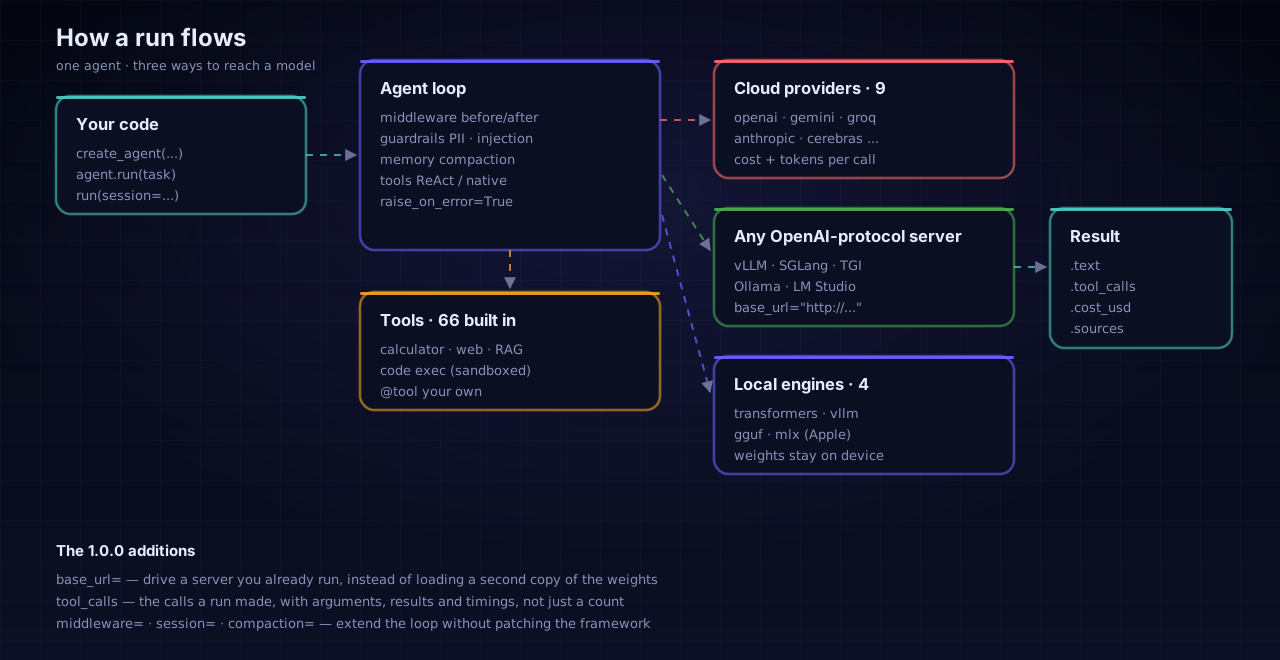
**v1.0.0 is about control over where a model runs and visibility into what a run did** — drive any server speaking the OpenAI protocol, read back the calls a run made, extend the agent loop — and it adds the surfaces that make a run easy to drive, watch and share. The largest and least visible part of the release is a pass over everything that used to report the wrong thing confidently: a failed run now says so, an unpriced model reports no cost, and a turn that did nothing is not a success. **Three changes are breaking**, each with a one-line migration in the changelog. | Area | What changed | |------|--------------| | **Any OpenAI-compatible server** | `load_model(..., provider="openai_compatible", base_url=...)` drives vLLM, SGLang, TGI, llama.cpp, Ollama, LM Studio, LiteLLM or a gateway. The server's ids, no fabricated `$0`. | | **The calls, not the count** | `AgentResponse.tool_calls` carries `name`, `arguments`, `result`, `duration`, `error` and `iteration`, with `.failed` and `.by_name()`. `tool_calls == 2` still works. | | **Middleware, sessions, compaction** | Hooks around the run, each model call and each tool call; `run(session=...)` for one agent serving many conversations; `SummarizeOldest`/`DropOldest`/`KeepFirstAndLast`/`KeepToolResults`. | | **Resumable workflows** | `WorkflowDAG.run(checkpoint=FileCheckpointStore(), run_id=...)`. Run the same line again after a crash and it continues; completed nodes are not re-run. | | **A coding agent** | `effgen code` proposes unified diffs, writes nothing until you say so, `--undo` reverses, `--review` is read-only, `--session-id` resumes, and git actions run through an allow-list. | | **Surfaces to show someone** | Real-time dashboard, in-browser playground, `effgen models browse`, shareable HTML reports and run cards, `effgen top`, `effgen battle`, topology graph, command palette. All self-contained, no CDN. | | **Truthful results** | Iteration cap, reasoning-only turns, written-out tool calls and failed actions are reported as what they are, with the recovered text under `metadata["partial_output"]`. | | **Truthful cost** | No invented price for an uncatalogued or `ft:` model, streamed cost and tokens on every provider, and per-model spend that adds up. | | **Tools on more models** | A tool call written as XML tags is understood, one call shape across every adapter, and arguments survive their own punctuation. | | **Errors that name the fix** | A scheme-less URL names the variable it came from, a connection failure names the endpoint, messages are bounded and redacted, and a 413 that means a rate limit is one. | | **Sandboxing** | Executed code cannot read your credential stores and sees its own process table (`credential_reads_masked`, `process_table_isolated`). | | **Python 3.11 to 3.14** | The floor moved to 3.11; 3.14 is supported and was installed and run, with a shipped lock for the `all` extra. |
from effgen.models import load_model

model = load_model(
    "Qwen/Qwen2.5-7B-Instruct",
    provider="openai_compatible",
    base_url="http://127.0.0.1:8000/v1",
)
effgen code "add a --dry-run flag to the importer"   # diffs first, writes on your word
effgen models browse --vision --min-context 128000 --sort price-out
effgen battle "Explain gradient clipping" -m groq:llama-3.1-8b-instant,gemini:gemini-3.1-flash-lite
effgen top                                           # terminal mission control
**v0.3.2 keeps sanding down the edges** — this time for a reliability engineer, a trust auditor, a security engineer, an ETL engineer, a clinical analyst, an SRE, a localizer, a CI gatekeeper, a non-technical operator, a game writer, a plugin author, a FinOps owner, and a document specialist. No new providers or subsystems — the surfaces you already reach for are now more predictable, and every quiet trap now surfaces a clear, typed error. **No breaking API changes** — every change is additive. | Area | What changed | |------|--------------| | **Structured output on the CLI** | `effgen batch --schema` validates every row against a JSON Schema / Pydantic model; the output file is lossless (cost, tokens, parsed, failure reason); `--temperature`, `--persona`, `--resume` too. | | **CI accuracy gates** | `effgen eval --fail-under 0.8` drives the exit code, and `--compare-baseline` fails the build on a real regression. | | **Cost-aware selection** | `effgen compare --optimize cost` adds a `$/run` column and picks the cheapest good-enough model. | | **Document & file input** | `effgen run --file report.pdf` reads a PDF/DOCX/XLSX/text document or an image — no Python needed. | | **Clinical-grade redaction** | PHI redaction covers name/DOB/MRN/address/member-ID, `custom_patterns`, strict fail-closed mode, and a new `phi` preset. | | **Grounding that never vanishes** | Native web search surfaces the URLs it searched even when the model answers without inline citations. | | **Sampling that takes effect** | `seed`, `frequency_penalty`, `presence_penalty`, `top_k` reach the model; an unknown `run()` kwarg is now rejected. | | **A consistent server** | A failed completion returns a real 4xx/5xx envelope instead of an HTTP 200 with the error as the answer. | | **Observability you alert on** | `/metrics` carries provider/model/status labels; `AlertWebhook`/`SLOTracker` are exported top-level. | | **Resilient batch & intake** | One malformed row no longer aborts the job (skipped + reported), spreadsheets ingest, and a folder ingest never silently drops a file. |
from effgen import PIIGuardrail, get_guardrail_preset

# Redaction that covers the labeled clinical identifiers, plus site-specific patterns.
g = PIIGuardrail(action="redact", custom_patterns=[(r"MRN[:#]\s*\d+", "[MRN REDACTED]")])
print(g.check("Jane Doe  DOB: 1980-02-14  MRN: 55123").modified_content)
# "[NAME REDACTED]  DOB: [DOB REDACTED]  MRN: [MRN REDACTED]"

chain = get_guardrail_preset("phi")   # redaction + fail-closed strict mode
effgen batch --input tickets.jsonl --output out.jsonl -m groq:llama-3.1-8b-instant --schema schema.json
effgen eval --suite cases.jsonl -m groq:llama-3.1-8b-instant --fail-under 0.9   # exit 1 if it drops
effgen compare --models "groq:llama-3.1-8b-instant,gemini:gemini-3.1-flash-lite" --suite cases.jsonl --optimize cost
effgen run "What was Q3 revenue?" --file report.pdf -m groq:llama-3.1-8b-instant
What's new in v0.3.1 — Real-World Usability & Polish
Where v0.3.0 hardened the framework, **v0.3.1 sands down the edges** real professionals hit the moment they sit down with it. No new providers or subsystems — the things you already reach for are now more predictable, measurable, and consistent. **No breaking API changes** — every change is additive or makes a previously-silent failure surface a clear, typed error. | Area | What changed | |------|--------------| | **Traceable evidence** | `response.sources` / `.citations` are populated from the URLs a run actually retrieved (and provider-native grounding) — never from the model's prose. | | **Reasoning models** | The `gpt-5` family and `o`-series finish token-heavy tasks instead of returning an empty, billed result; length-truncation is grown and retried once, not three times. | | **Measurable results** | `cost_usd`, token counts, and `latency_ms` land on every result (local stays cost-free); teams/workflows report summed cost; sub-cent costs show real digits. | | **Personas everywhere** | A custom `system_prompt` now steers the direct, streaming, and native-tool paths — not just text-ReAct. | | **Trustworthy orchestration** | Collaborative teams fail closed, hierarchical teams route by the named worker, and a workflow never runs downstream of a failed node. | | **Consistent server** | No silent client-tool drop (clear `400`), embeddings reflect their real backend, a unified error envelope, and per-call cost. | | **One-call domains** | `LegalDomain().to_agent("gpt-5-nano")` wires a domain's prompt, tools, and guardrails into a runnable agent. | | **Local-first truth** | `models status` shows physical GPU memory, `models info` is cache-aware, local batch is thread-safe, and grammar-constrained JSON via `effgen[grammar]`. | | **Dependable automation** | Sync `Agent.run()` no longer hangs on MCP tools, tool plugins auto-discover, and `effgen run --json` pipes clean JSON to stdout. | | **Hardened tools** | The Python REPL sandbox toggle is out of the model's hands; the bash env scrub covers every credential; broader injection detection and credential-aware PII redaction. |
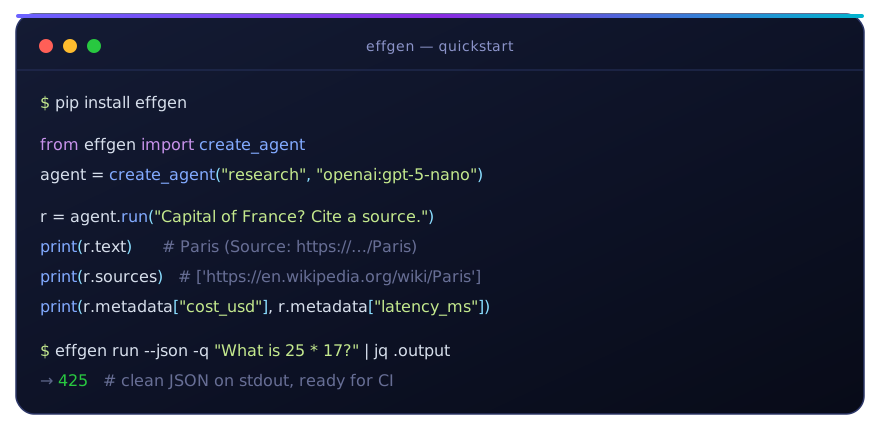
from effgen import create_agent, LegalDomain

# Grounded research: sources/citations come from the URLs the tools retrieved.
agent = create_agent("research", "openai:gpt-5-nano")
r = agent.run("What is the capital of France? Cite a source.")
print(r.text)                  # "...Paris (Source: https://en.wikipedia.org/wiki/Paris)."
print(r.sources)               # ['https://en.wikipedia.org/wiki/Paris']
print(r.metadata["cost_usd"], r.metadata["latency_ms"])

# A knowledge domain becomes a runnable agent in one call.
legal = LegalDomain().to_agent("openai:gpt-5-nano")
print(legal.run("What does an NDA confidentiality clause protect?").text)
effgen run --json -q "What is 25 * 17?" | jq .output   # pure-JSON stdout for CI
effgen models status                                    # physical GPU memory; which card is free
What's new in v0.3.0 — Stabilization & Hardening
**effGen v0.3.0** made the framework production-safe from the inside out. **No breaking API changes.** - **Fail-closed `Agent.run()`** — no silent success; typed, redacted errors; smarter retries and loop detection. - **Self-updating, drift-aware model catalog** — `effgen models refresh` reconciles the local snapshot against live provider lists (chat models only; never persists `ft:` ids). - **Real GPU support** — deterministic `temperature=0`, a deadlock-free allocator, clean multi-GPU use. - **Fail-closed API server** — forged/expired/wrong-alg JWTs rejected; secure CORS, metrics, RBAC, and budget enforcement. - **Hardened built-in tools** — Python REPL timeout, one shared SSRF guard, path confinement, and no unsafe `pickle`/`eval`. - **Faster & quieter** — `import effgen` in ~20 ms, faster streaming + agent loop, a scriptable CLI, and a live "thinking" UX. [Full v0.3.0 changelog →](CHANGELOG.md#030---2026-06-19) What's new in v0.2.9 — Observability & Reliability
**effGen v0.2.9** ships the full observability and reliability stack. All telemetry is async/non-blocking — a failed export never fails inference. **Structured JSON logging with secret redaction.** Every log line is a JSON object: `{ts, level, module, event, attributes, trace_id, span_id}`. The built-in `Redactor` strips OpenAI, Anthropic, Cerebras, Google, HF, Groq, Bearer, Slack, and Discord webhook patterns at the encoder — no secret ever appears in a log file.
from effgen.observability import get_logger
log = get_logger(__name__)
log.event("model.call.started", provider="cerebras", model="gpt-oss-120b", cached_tokens=0)
# → {"ts": "2026-05-23T...", "level": "INFO", "event": "model.call.started", ...}
# Run a 30-second load test (JSON report prints to stdout by default)
effgen loadtest --concurrency 10 --duration 30 --scenario fixed

# Or write the report to a file with --output
effgen loadtest --concurrency 10 --duration 30 --output report.json

# Integrate with Alertmanager
cp docs/observability/alert_rules.yaml /etc/prometheus/rules/effgen.yaml
**effGen v0.2.8** accepts image, audio, and video as input types. Send them to any vision-capable provider through a unified `Message` schema — the adapter handles the translation, not your code. **Image input** — Gemini, OpenAI gpt-4o, Groq, Anthropic (code-only), Together, HF. Automatic resize/MIME validation via `image_pre.py`. Raises `CapabilityNotSupportedError` cleanly when the provider doesn't support vision. **Audio input** — Gemini native inline audio, OpenAI Whisper transcription + gpt-4o audio, HF Inference ASR. Auto-downsamples to 16 kHz mono; chunks files over provider max duration. Anthropic raises `CapabilityNotSupportedError`. **Video input** — Gemini native video for providers that accept raw video; frame-sampling fallback (ffmpeg) for all others. `MissingSystemDependency` with install hints when ffmpeg is absent. **Unified message schema** — `TextPart`, `ImagePart`, `AudioPart`, `VideoPart` form a typed `ContentPart` union. `Message.content` is always a `List[ContentPart]`; backwards-compatible string constructor still works. **`multimodal` preset** — `create_agent("multimodal", model)` wires Gemini Flash-Lite (primary) + OpenAI gpt-4o-mini (fallback) with `ImageInfo`, `ImageCaption`, `OCR`, `AudioTranscribe`, `MultimodalDescribeTool`, and the full tool suite. **5 cookbook walkthroughs** — image Q&A, audio transcribe + reason, video summarize, OCR + LLM structured extraction, chart reading from an image. All in `docs/cookbook/`.
from effgen import image_from, audio_from
from effgen.presets import create_agent
from effgen import load_model

model = load_model("gemini-3.1-flash-lite", provider="gemini")
agent = create_agent("multimodal", model)

# Image question — pass media through inputs=
img = image_from("https://upload.wikimedia.org/wikipedia/commons/4/47/PNG_transparency_demonstration_1.png")
result = agent.run("What is in this image?", inputs=[img])
print(result.output)

# Audio transcription
aud = audio_from("/tmp/clip.mp3")
result = agent.run("Transcribe and summarize.", inputs=[aud])
effgen run --preset multimodal "Describe this image" --image /tmp/photo.jpg
python -c "from effgen.models.capabilities import Capability; print(Capability.vision)"
**effGen v0.2.7** adds a curated, domain-organized **Prompt Library** with reusable templates, paired with a golden evaluation harness and an interactive playground CLI. See the [full gallery](docs/prompts/gallery.md). **Research** — literature review (zero-shot + CoT), paper summary, citation extraction, methodology critique. **Coding** — code review, bug diagnosis, refactoring plan, test generation, docstring fill. **Data / SQL** — NL-to-SQL with warnings, SQL explain, SQL optimize, data profile, ETL plan. **Legal** — contract summary, clause classify, research brief. All templates include mandatory legal disclaimer. **Medical** — symptom triage, drug interaction, medical literature synthesis. All templates include mandatory medical disclaimer. **Creative** — story continuation (zero-shot + few-shot), poetry forms, character bio, world building. **Business** — meeting summary, email draft (formal/casual), OKR generation, SWOT analysis, elevator pitch.
effgen prompts list
effgen prompts list --domain research
effgen prompts show research.literature_review.v1.cot
effgen prompts eval --domain coding --live --model gpt-oss-120b
effgen prompts playground
from effgen.prompts.library import registry

p = registry.get("data.sql_from_nl.v1")
sql_prompt = p.template(
    schema_ddl="CREATE TABLE orders (id INT, customer TEXT, total FLOAT, created_at DATE)",
    question="Total revenue per customer this month",
    dialect="postgresql",
)
**effGen v0.2.6** adds 14 new built-in tools across document, media, and communication categories, and two new presets (`media`, `notify`). 1. **OCR** — `OCRTool` (Tesseract local + OCR.space fallback; `OCRBackendUnavailable` raised with install instructions). ```python import asyncio from effgen.tools.builtin.ocr import OCRTool result = asyncio.run(OCRTool().execute(operation="extract", image_path="/tmp/scan.png")) print(result.output["text"]) ``` 2. **Audio Transcription** — `AudioTranscribeTool` (faster-whisper local; HF Inference fallback; GPU auto-detected). 3. **Image Analysis** — `ImageInfoTool` (Pillow metadata, zero network) + `ImageCaptionTool` (vision-capable model router). 4. **Document Parsing** — `PDFTool` (pypdf + pdfplumber), `DOCXTool` (python-docx), `ExcelTool` (openpyxl + pandas). Added to `research` and `general` presets. ```python import asyncio from effgen.tools.builtin.pdf import PDFTool result = asyncio.run(PDFTool().execute(operation="text", path="/tmp/paper.pdf")) ``` 5. **Geo / Weather** — `WeatherTool` (Open-Meteo, free, no auth), `GeocodeTool` (Nominatim/OSM, 1 req/s), `MapsTool` (staticmap PNG renderer). 6. **Email & Webhooks** — `EmailSMTPTool`, `EmailIMAPTool`, `SlackWebhookTool`, `DiscordWebhookTool`. All in the new `notify` preset. Webhook URLs are redacted in logs. See the [full tool gallery](docs/tools/gallery.md). What's new in v0.2.5 — 13 free tools: research, news, YouTube, social, translation & QR
**effGen v0.2.5** adds 13 free, no-auth-required tools. All integrate with the `research` and `general` presets. 1. **Academic Research** — `PubMedTool` (NCBI, 3 ops, built-in rate limiting), `ArXivTool` (Atom feed + PDF download), `SemanticScholarTool` (search + citations + references). ```python import asyncio from effgen.tools.builtin.arxiv import ArXivTool result = asyncio.run(ArXivTool().execute(operation="search", query="transformer attention", max_results=5)) ``` 2. **News & RSS** — `RSSFeedTool` (any RSS/Atom feed), `NewsTool` (BBC, Reuters, HN, NPR, etc. + optional NewsAPI.org key). 3. **YouTube** — `YouTubeTranscriptTool` (captions without Google API key), `YouTubeMetadataTool` (via yt-dlp, public content only). 4. **Social Media** — `RedditTool` (public JSON, no OAuth), `HackerNewsTool` (Firebase API, no auth). 5. **Translation & Language Detection** — `TranslateTool` (LibreTranslate + offline argostranslate fallback), `LanguageDetectTool` (55+ languages, fully offline). 6. **QR Codes** — `QRGenerateTool` (generate locally), `QRReadTool` (decode from image, with OpenCV fallback if zbar is unavailable). See the [full tool gallery](docs/tools/gallery.md). What's new in v0.2.4 — ModelRouter & Cost Optimizer
1. **`PolicyBasedRouter`** — composable routing engine with three built-in policies. Pick the cheapest provider within your budget, the fastest under your SLA, or simply the first available. ```python from effgen import PolicyBasedRouter, RoutingContext, CostBasedPolicy, LatencyBasedPolicy from effgen.models.capabilities import Capability router = PolicyBasedRouter(policies=[LatencyBasedPolicy(), CostBasedPolicy()]) ctx = RoutingContext( prompt_tokens_estimate=500, user_budget_usd=0.01, latency_budget_ms=3000, required_capabilities={Capability.chat}, ) decision = router.route(ctx) print(decision.chosen) # e.g., ProviderModelPair("cerebras", "gpt-oss-120b") print(decision.eliminated) # [(pair, reason), ...] — fully explainable ``` 2. **Transparent failover** — `route_and_execute(ctx, fn)` retries on rate-limits / 5xx / timeouts and moves to the next-best provider. Each hop fires a `RouterEvent` to registered subscribers. 3. **Cross-process SQLite rate-limit coordination** — share a single rate-limit budget across multiple workers via `RateLimitCoordinator(SQLiteRateLimitStore(...))` (WAL-mode, BEGIN IMMEDIATE). 4. **Persistent cost tracking + `effgen cost` CLI** — every API call persists to SQLite: ```bash effgen cost today # per-provider per-model table effgen cost week # rolling 7-day view effgen cost by-provider # lifetime totals effgen cost set-budget 1.0 # set $1/day cap (BudgetExceededError at 100%) ``` 5. **Fully explainable decisions + budget guard** — `RouterDecision` records every eliminated provider and why (`"rate_limited"`, `"no_key"`, `"cost_exceeds_budget"`, `"latency_exceeds_sla"`), and fails over to a free-tier provider when the budget is hit. What's new in v0.2.3 — 5 new cloud backends (9 providers total)
1. **5 new cloud backends** — `GroqAdapter`, `TogetherAdapter`, `FireworksAdapter`, `ReplicateAdapter`, `HFInferenceAdapter` — each with streaming, native tools, rate-limit coordination, and cost tracking. 9 providers total. ```python model = load_model("llama-3.1-8b-instant", provider="groq") model = load_model("Qwen/Qwen2.5-72B-Instruct", provider="hf") ``` 2. **Unified ProviderRegistry** — `list_providers()`, `list_models(provider)`, `lookup(model_id)` consolidated across all 9 adapters. `AmbiguousModelError` on bare IDs shared across providers. 3. **`effgen doctor`** — new CLI command showing which providers have API keys configured. 4. **Backend parity matrix** — canonical agentic task ("(17 × 23) + sqrt(144) = 403") runs identically across all providers; streaming and error surfaces verified uniform. See `docs/providers/parity.md`. 5. **HuggingFace Router support** — `HFInferenceAdapter` with 124-model dynamic catalog, `refresh_models()` + `check_drift()`, `ModelUnavailableError` with `suggest_alternatives()`, and custom Inference Endpoint URL. What's new in v0.2.2 — Gemini & Anthropic depth
1. **Gemini 3.x/2.5/2.0 + Gemma families** — full model registry with correct context windows, output limits, and feature flags; SDK migrated to `google-genai>=1.0.0`. 2. **Gemini `thinking_budget`** — activate Gemini's internal reasoning with `GenerationConfig(thinking_budget=8192, include_thoughts=True)`; thinking trace surfaces in `ModelResponse.metadata["thinking"]`. 3. **Gemini grounding + Files API** — `GenerationConfig(grounding=True)` injects Google Search; `upload_file(path)` passes PDFs/images to the model with a 2 GiB guard. 4. **Gemini native tools** — `GoogleSearchTool`, `GeminiUrlContextTool`, `GeminiCodeExecutionTool` activate server-side Gemini capabilities in any Agent. Parallel function calls handled automatically. 5. **Anthropic Claude 4.7, extended thinking, prompt caching** — full Claude 4.x registry; `GenerationConfig.thinking` for extended reasoning; `mark_cached()` + `AgentConfig.cache_system_prompt/cache_tools` for `cache_control`; cache tokens surfaced in usage. What's new in v0.2.1 — Cerebras + OpenAI reasoning
1. **Cerebras backend** — the models the live API currently serves (`gpt-oss-120b`, `zai-glm-4.7`) with streaming, native function-calling, automatic RPM/TPM/RPD/TPD rate-limit coordination, and per-call cost tracking. `pip install effgen[cerebras]` and set `CEREBRAS_API_KEY`. Run `effgen models refresh --provider cerebras` to pick up catalog changes. ```python from effgen import load_model model = load_model("gpt-oss-120b", provider="cerebras") ``` 2. **OpenAI gpt-5 / gpt-5.4-nano / o-series reasoning models** — full registry coverage with `reasoning_effort` (`minimal`/`low`/`medium`/`high`) and `max_reasoning_tokens` on `GenerationConfig`. Reasoning payloads are routed only to reasoning-capable models. 3. **OpenAI prompt caching surfacing** — `cached_input_tokens` exposed on `ModelResponse.usage`; `AgentConfig.stable_system_prompt=True` keeps the system prompt anchored at position 0 to maximize OpenAI's automatic ≥1024-token prefix cache hit rate. 4. **Structured outputs v2** — `OpenAIAdapter.generate_structured()` with strict JSON Schema; `to_openai_schema(pydantic_model)` inlines `$ref`s and forces `additionalProperties: false`; refusals raise `ModelRefusalError`. 5. **OpenAI native tools** — `OpenAIWebSearchTool`, `OpenAICodeInterpreterTool`, `OpenAIFileSearchTool` route through OpenAI's Responses API and compose with effGen's local tools in the same agent. `ToolIncompatibleError` fires at Agent init when paired with a non-OpenAI model. What's new in v0.2.0 — the big one
1. **Native Tool Calling** — Qwen, Llama, Mistral models use built-in function calling instead of text parsing. Set `tool_calling_mode="native"` or `"hybrid"`. Structured JSON/Pydantic output validation included. 2. **Guardrails & Safety** — PII detection, prompt injection blocking, toxicity filtering, tool permissions. One-liner: `get_guardrail_preset("strict")`. 3. **Production RAG Pipeline** — Ingest PDF/DOCX/HTML/Markdown, semantic+BM25 hybrid search, reranking, inline citations. `create_agent("rag", model, knowledge_base="./docs/")`. 4. **Production API Server** — OpenAI-compatible `/v1/chat/completions`, request queuing, agent pooling, multi-tenancy, API keys. Drop-in OpenAI replacement with local SLMs. 5. **Apple Silicon Native** — MLX & MLX-VLM backends for M1/M2/M3/M4. Metal GPU acceleration, unified memory. `pip install effgen[mlx]`.

🎯 Agent Presets
Nine ready-made agent configurations. Each one wires up a model, a tool set and a system prompt in a single call.
🎯 Preset recipes — one-line agent creation, and the CLI equivalents
math·research·coding·general·rag·minimal·multimodal·notify·media
from effgen import load_model
from effgen.presets import create_agent

model = load_model("Qwen/Qwen2.5-3B-Instruct", quantization="4bit")

# One-line agent creation
math_agent = create_agent("math", model)        # Calculator + PythonREPL
research_agent = create_agent("research", model) # WebSearch + URLFetch + Wikipedia + academic
coding_agent = create_agent("coding", model)     # CodeExecutor + PythonREPL + FileOps + Bash
general_agent = create_agent("general", model)   # Broad built-in tool suite
rag_agent = create_agent("rag", model, knowledge_base="./docs/")  # RAG pipeline
minimal_agent = create_agent("minimal", model)   # Direct inference, no tools
# CLI preset support
effgen run --preset math "What is sqrt(144)?"
effgen run --preset research "Tell me about quantum computing"
🛠️ Built-in Tools (66)
Sixty-six tools ship in the box, from a calculator to sandboxed code execution to a
full RAG pipeline. Any typed Python function becomes a tool with @tool.
|
**🔢** Calculator Math & Units |
**🌐** WebSearch DuckDuckGo |
**💻** CodeExecutor Sandboxed |
**🐍** PythonREPL Interactive |
**📁** FileOps Read/Write |
**🔍** Retrieval RAG + BM25 |
**🎯** AgenticSearch ripgrep |
|
**🖥️** BashTool Shell Cmds |
**🌤️** WeatherTool Open-Meteo |
**📋** JSONTool Query/Validate |
**🕐** DateTimeTool Timezones |
**📝** TextProcessing Regex/Count |
**🔗** URLFetch Web Scrape |
**📖** Wikipedia Free API |
|
**🔬** PubMed NCBI / Free |
**📄** ArXiv Papers + PDF |
**🎓** SemanticScholar Citations |
**📡** RSSFeed Any Feed |
**📰** News BBC/Reuters/HN |
**▶️** YouTubeTranscript No API key |
**🎬** YouTubeMetadata yt-dlp |
|
**🤖** Public JSON |
**🔥** HackerNews Firebase API |
**🌍** Translate LibreTranslate |
**🔎** LanguageDetect Offline / 55+ |
**📱** QRGenerate Local / No net |
**📷** QRRead Local Decode |
**…** +more OCR, PDF, audio… |
📝 Prompt Library
Thirty-five reusable prompt templates across 8 domains, each with a golden evaluation test and CLI access. Browse the full gallery.
📝 Template domains and CLI usageeffGen ships a curated catalog of **35 reusable prompt templates** across 8 domains, each with a golden evaluation test and CLI access. Browse the [full gallery](docs/prompts/gallery.md). | Domain | Templates | Variants | |--------|-----------|----------| | Research | 5 | zero-shot, CoT, structured, tool-augmented | | Coding | 5 | zero-shot, CoT, structured, few-shot, tool-augmented | | Data / SQL | 5 | zero-shot, CoT, structured, few-shot, tool-augmented | | Legal | 3 | zero-shot, structured, tool-augmented | | Medical | 3 | structured, tool-augmented | | Creative | 5 | zero-shot, CoT, structured, few-shot | | Business | 5 | zero-shot, CoT, structured, few-shot |
effgen prompts list                            # browse all 35 templates
effgen prompts show research.paper_summary.v1  # inspect a template
effgen prompts eval                            # run golden eval (no model needed)
effgen prompts playground                      # interactive REPL
from effgen.prompts.library import registry

# Get and render a template
p = registry.get("coding.code_review.v1")
prompt = p.template(code="def add(a, b): return a + b", language="python")

# Search templates
cot_prompts = registry.search(variant="cot")
sql_prompts = registry.search(domain="data")

🤖 Multi-Model Support
Nine cloud providers, four local engines, and any server that speaks the OpenAI
protocol — point at it with base_url= and effGen drives it like a first-class backend.
effGen supports **9 cloud inference providers**, any server that speaks the OpenAI protocol, and 4 local backends, tested across 11+ model families: | Backend | Platform | Install | Best For | |---------|----------|---------|----------| | **MLX** | Apple Silicon (M1/M2/M3/M4) | `effgen[mlx]` | Native Metal GPU, unified memory, 4/8-bit quantization | | **MLX-VLM** | Apple Silicon | `effgen[mlx-vlm]` | Vision-Language models (Qwen2-VL, LLaVA, Phi-3 Vision, 30+ architectures) | | **vLLM** | NVIDIA GPU | `effgen[vllm]` | High-throughput batch inference | | **Transformers** | Any (CPU/GPU) | *(bundled)* | Universal compatibility, local models | | **OpenAI** | Cloud API | *(bundled)* | gpt-5/gpt-5.4/o-series, reasoning_effort, structured outputs, native tools | | **Anthropic** | Cloud API | *(bundled)* | Claude 4.7/4.x, extended thinking, prompt caching, native tools | | **Google Gemini** | Cloud API | *(bundled)* | Gemini 3.x/2.5 + Gemma 4, thinking_budget, grounding, Files API, native tools | | **Cerebras** | Cloud API | `effgen[cerebras]` | live models (gpt-oss-120b, zai-glm-4.7), ultra-low latency | | **Groq** | Cloud API | `effgen[groq]` | 15 catalogued models (llama-3.3-70b-versatile, llama-3.1-8b-instant, openai/gpt-oss-120b), ultra-fast free-tier inference | | **Together AI** | Cloud API | `effgen[together]` | 168-model catalog (llama, deepseek, qwen, mistral, minimax), per-model pricing | | **Fireworks** | Cloud API | `effgen[fireworks]` | 16 catalogued models (deepseek-v4, kimi-k3, gpt-oss-120b), serverless + dedicated | | **Replicate** | Cloud API | `effgen[replicate]` | 37 models, async run-poll, SSE streaming, compute-second billing | | **HuggingFace** | Cloud API | `effgen[hf]` | 124-model HF Router catalog, custom Inference Endpoints, free serverless tier | | **OpenAI-compatible** | Any server speaking the protocol | *(bundled)* | vLLM, SGLang, TGI, llama.cpp, Ollama, LM Studio, LiteLLM or a gateway; point at it with `base_url=` |
from effgen import load_model, Agent
from effgen.core.agent import AgentConfig
from effgen.tools.builtin import Calculator

# Any of the 9 cloud providers
model = load_model("llama-3.1-8b-instant", provider="groq")          # Groq
# model = load_model("meta-llama/Llama-3.3-70B-Instruct-Turbo", provider="together")
# model = load_model("Qwen/Qwen2.5-72B-Instruct", provider="hf")

agent = Agent(config=AgentConfig(name="agent", model=model, tools=[Calculator()]))
result = agent.run("What is (17 * 23) + sqrt(144)?")
print(result.output)  # → 403
effgen doctor # see which provider API keys are configured

📚 Examples
**🤖 Core agents**
|
**🖼️ GUI applications (Gradio)**
|
📖 More code examples (multi-tool, streaming, memory, RAG)📊 See examples/compatibility_matrix.md for model compatibility across all agents.
**Multi-Tool Agent**
from effgen import Agent, load_model
from effgen.core.agent import AgentConfig
from effgen.tools.builtin import Calculator, WebSearch, PythonREPL

model = load_model("Qwen/Qwen2.5-3B-Instruct")
config = AgentConfig(
    name="research_agent",
    model=model,
    tools=[Calculator(), WebSearch(), PythonREPL()],
    system_prompt="You are a research assistant.",
)
agent = Agent(config=config)
result = agent.run("Search for the population of Tokyo and calculate what percentage it is of Japan's total population")
from effgen import Agent, load_model
from effgen.core.agent import AgentConfig
from effgen.tools.builtin import Calculator

model = load_model("Qwen/Qwen2.5-3B-Instruct", quantization="4bit")
agent = Agent(config=AgentConfig(
    name="stream_demo", model=model,
    tools=[Calculator()], enable_streaming=True,
))
for token in agent.stream("What is 2 + 2?"):
    print(token, end="", flush=True)
agent = Agent(config=AgentConfig(
    name="memory_demo", model=model,
    tools=[], enable_memory=True,
))
agent.run("My name is Alice and I'm working on quantum computing.")
result = agent.run("What's my name and what am I working on?")
# → "Your name is Alice and you're working on quantum computing."
from effgen.tools.builtin import Retrieval

retrieval_tool = Retrieval(knowledge_base_path="./docs")
config = AgentConfig(name="qa_agent", model=model, tools=[retrieval_tool])
agent = Agent(config=config)
result = agent.run("What does the documentation say about configuration?")

🚀 Deployment
Deployment recipes for every major target, each with a working manifest in the repo.
🚀 Docker · Kubernetes/Helm · AWS Lambda · Cloudflare edge — commands and manifestseffGen ships deployment recipes for every major target.
**🐳 Docker** — multi-stage build, non-root user, read-only FS, `/health` healthcheck. See [`docs/deploy/docker.md`](docs/deploy/docker.md).
|
**λ AWS Lambda** — Mangum adapter over the FastAPI app. Cold start < 3 s; warm call < 100 ms. SAM template included. See [`docs/deploy/lambda.md`](docs/deploy/lambda.md).
|
🔷 Developer Experience
A VS Code extension, Jupyter magics, shell completion and a live dashboard.
🔷 Editor, notebook and terminal integrations
**VS Code Extension**
Prompt-template completion, inline "Run" code lens, and hover docs from the effGen registry. See [`docs/dx/vscode.md`](docs/dx/vscode.md).
|
**Jupyter Magics**
|
**Live Dashboard**
Real-time SPA at `/dashboard`: span stream (SSE), Prometheus metrics, recent runs with token counts + cost, SLO burn rates. See [`docs/dx/dashboard.md`](docs/dx/dashboard.md).
|

🔒 Security
Sandboxed execution, guardrails for PII and prompt injection, SSRF and path confinement, secret scanning and a signed supply chain.
🔒 The full security posture — sandboxing, guardrails, auth, supply chain|
**🐳** Sandboxed Execution Subprocess / Docker |
**🛡️** Guardrails PII, injection, SSRF |
**🔑** OAuth2 / OIDC + RBAC Fail-closed auth |
**⚡** Rate Limiting Configurable limits |
pip install pre-commit && pre-commit install
EFFGEN_SANDBOX_BACKEND=off effgen run ... # a loud warning is emitted
export EFFGEN_OIDC_ISSUER=https://your-tenant.auth0.com/
export EFFGEN_OIDC_CLIENT_ID=your-client-id
export EFFGEN_OIDC_JWKS_URI=https://your-tenant.auth0.com/.well-known/jwks.json
effgen serve --port 8000
📖 Citation
If you use effGen in your research, please cite our paper:
@software{srivastava2026effgen,
      title={effGen: Enabling Small Language Models as Capable Autonomous Agents},
      author={Gaurav Srivastava and Aafiya Hussain and Chi Wang and Yingyan Celine Lin and Xuan Wang},
      year={2026},
      eprint={2602.00887},
      archivePrefix={arXiv},
      primaryClass={cs.CL},
      url={https://arxiv.org/abs/2602.00887},
}
⭐ Star History
🔗 Links & License





Licensed under the **Apache License 2.0** — see [LICENSE](LICENSE) for details.




**Made with ❤️ for the AI community**
